
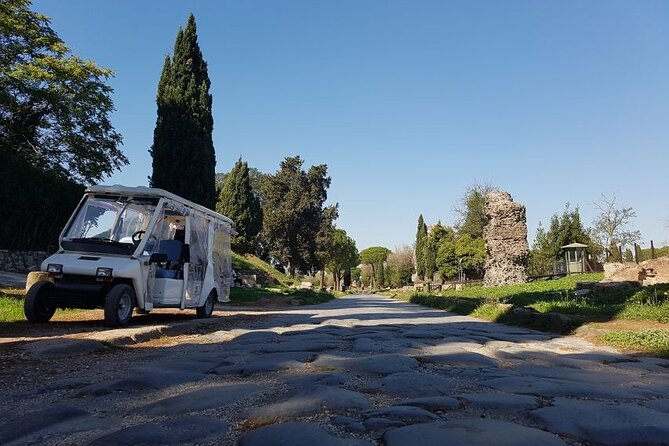
Reviewed · ROMAN CATACOMBS & CRYPTS TOURS
Rome: Appian Way & Catacombs Golf Cart Tour – Shared|Small groups
Roman roads have a strange pull. This 3-hour Appian Way tour by small-group golf cart turns a long, dusty route into something you can actually enjoy, with stops built around major sights like the catacombs and the Circus of Maxentius. I like that the guide keeps the story moving—fast, clear, and practical—so the ruins don’t feel like random rocks.
Two things I really value here: first, you get real “distance” without the bike stress, because the cart handles the long stretches of Via Appia Antica for you. Second, the catacombs visit is guided, with an included entrance to either San Callisto or San Sebastiano depending on availability. The one caution: a couple of stops have short time windows, and if you’re in a later row of the cart, you might find it harder to hear the guide at all moments.
Small-group size (max 7) means you can ask questions and actually get answers.
Catacombs with a guided component saves time and gives context for what you’re seeing.
Circus of Maxentius entry gives you one of the best-preserved ancient circus interiors in the area.
Appian Way hilltop views add a “bigger picture” moment beyond underground tombs.
Entrance tickets for Cecilia Metella and Quintili villa aren’t required for this tour’s stops, which helps keep it lower-friction.
In This Review
- A Golf Cart Day on the Appian Way (Short, Scenic, and Not Exhausting)
- Price and What You’re Really Paying For
- Starting at Via Appia Antica: Setting Yourself Up for an Easy Start
- Stop 1: Chiesa del Domine Quo Vadis (Peter’s Question, Still in Stone)
- Stop 2: Catacombs of San Callisto or Sebastiano (Where Rome Goes Underground)
- Stop 3: The Circus of Maxentius (A Big Arena That Rarely Gets Air Time)
- Stop 4: Cecilia Metella’s Hilltop View and Caetani Castle Angle
- Stop 5: Complesso di Capo di Bove (Philosophy, Emperors, and a Private-Looking Place)
- Stop 6: Villa dei Quintili and Santa Maria Nova (A Quiet Link Between Wealth and Power)
- Stop 7: Appian Way (Via Appia Antica)—Why So Many Tombs Here?
- Stop 8: Appia Antica Archaeological Park (Return Along the Ancient Road)
- The Guides Make (or Break) This Kind of Tour
- Who This Tour Is Best For (And Who Might Want Something Else)
- What to Do Before You Go (So the Day Feels Smooth)
- Should You Book the Rome Appian Way & Catacombs Golf Cart Tour?
- FAQ
- How long is the Rome Appian Way & Catacombs golf cart tour?
- Is this tour in English?
- What’s included in the price?
- Which catacombs will I visit?
- Are tickets needed for Cecilia Metella’s tomb and the Villa dei Quintili?
- Where does the tour start and end?
- Can I cancel for a full refund?
A Golf Cart Day on the Appian Way (Short, Scenic, and Not Exhausting)
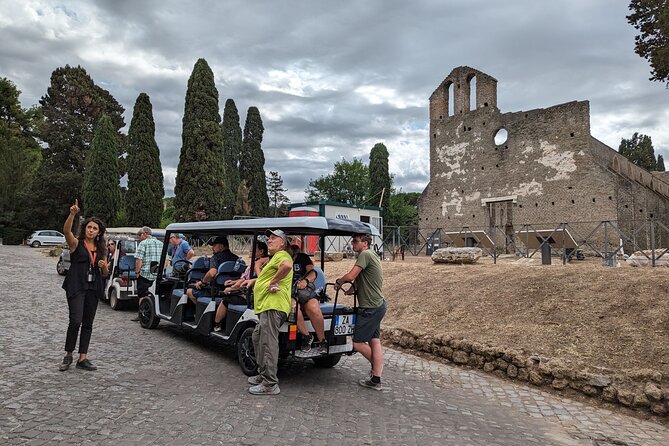
The Appian Way is famous for a reason: it was Rome’s superhighway for centuries, and it’s packed with tombs, churches, and mausoleums that make you feel time layered on top of itself. The hard part is doing it in a way that doesn’t turn into a workout you didn’t plan. That’s where a golf cart shines.
For me, the big win is pacing. The tour strings together several meaningful stops instead of making you choose between “catacombs day” or “outdoor ruins day.” You get a guided route with frequent breaks—so you can look closely at inscriptions and architectural details without arriving at the end already worn out.
Also, the group is capped at 7. In Rome, that matters. Smaller groups tend to mean less crowding at viewpoints and more personal interaction. The tour also runs in English, which helps if you want the explanations in real time rather than trying to translate your way through history.
Price and What You’re Really Paying For
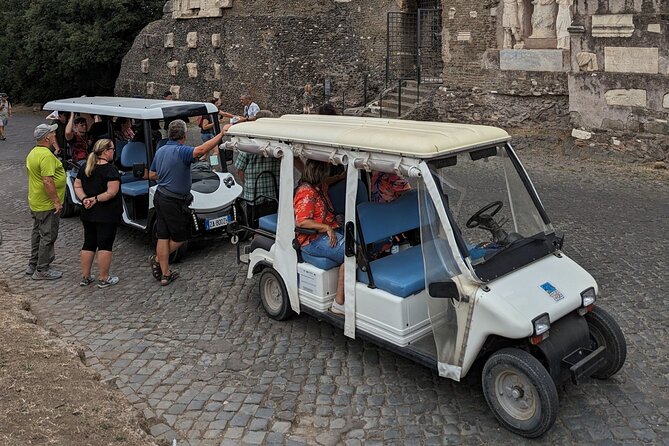
At $91.32 per person for about 3 hours, this is not a “budget bus tour.” But it’s not just sightseeing on wheels either.
Here’s the value equation that makes sense for your day:
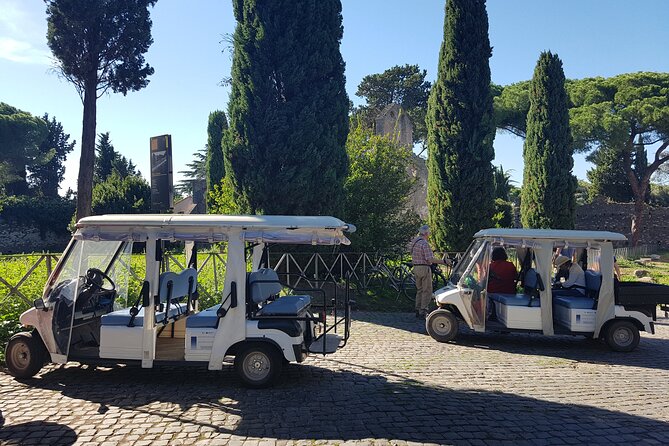
- Golf cart transport for the Appian Way stretch (so you’re not confined to walking or bike stamina).
- Catacombs entrance plus guided tour included (either St Callisto or St Sebastiano based on availability).
- Circus of Maxentius entry included.
- Bottled water (1/2 L) provided.
Not included: coffee/tea, and the entrances for Cecilia Metella’s Tomb and the Villa dei Quintili are not included. The good news is you generally don’t have to buy tickets just to appreciate the stops you’re making (more on that below).
If you’re already done with the “top 3” Rome attractions and you want something that feels different—this is a strong way to spend a half-day.
Deeper underground: more crypts and catacombs
- Rome: Capuchin Crypts and Catacombs Tour with Transfers
★ 4.6 · 6,456 reviews - The Original Roman Crypts and Catacombs Tour with Transfers
★ 4.5 · 4,896 reviews - Rome: Catacombs of St. Callixtus Entry Ticket & Guided Tour
★ 4.6 · 3,037 reviews - Rome: Guided Roman Catacombs Tour with Transfers
★ 4.6 · 1,830 reviews
Starting at Via Appia Antica: Setting Yourself Up for an Easy Start
You meet at Via Appia Antica, 60, 00179 Roma. The key practical point: the location is near public transportation, which makes it less painful to get out there compared with tours that start deep in the countryside with limited transit options.
The tour ends back at the meeting point, so you don’t need to think about lining up a separate ride home.
Stop 1: Chiesa del Domine Quo Vadis (Peter’s Question, Still in Stone)
This first stop is quick—about 10 minutes—but it’s memorable because it’s tied to a moment that’s more story than marble museum.
You’ll visit the Domine Quo Vadis Church, connected to the apocryphal Acts of Peter tradition. According to this story, Saint Peter meets the risen Christ while fleeing persecution in Rome, and Peter asks Lord where are you going (Latin: Domine, quo vadis?). The reason people come isn’t abstract theology—it’s the miraculous footprints tradition preserved here.
Even if you’re not chasing religious sites, I find the appeal is how physical it feels. It’s one of those Rome moments where the past isn’t just displayed—it’s pointed at you. The admission ticket is free for this stop.
Stop 2: Catacombs of San Callisto or Sebastiano (Where Rome Goes Underground)
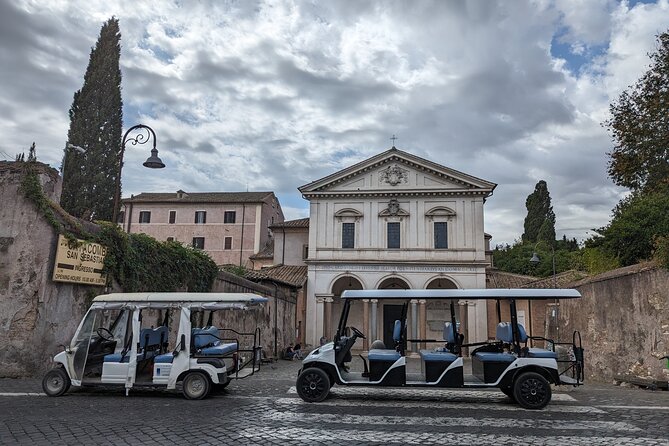
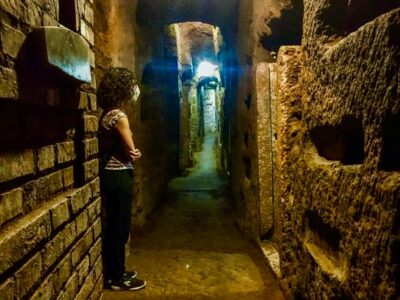
Next comes the part most people are excited about: the catacombs. The tour includes the entrance ticket and a guided visit to Catacombe di San Callisto or S. Sebastiano, depending on availability.
What makes this worthwhile is scale. These burial spaces began around the middle of the second century and belong to a wider cemeterial complex. The St Callisto catacombs, in particular, are described as enormous, with galleries stretching many miles and multiple levels deep.
When you tour catacombs with a guide, you’re not just wandering corridors. You learn what you’re seeing—how these underground spaces functioned, and why certain groups and leaders mattered. I like that the tour gives you enough time to actually process what’s around you, instead of rushing through in a photo sprint.
Keep going down the Appian Way
Stop 3: The Circus of Maxentius (A Big Arena That Rarely Gets Air Time)
After you’re back up and rolling along the Appian Way, you stop at the Circus of Maxentius.
This is a standout because it’s one of the area’s best-preserved circuses, and it’s described as the second biggest in scale after the Circus Maximus. People sometimes connect it to pop culture (it’s been used as a setting in major films), but the real value is what the site is: a space built for spectacle and public events, preserved enough to make the structure legible.
Your entry here is free and the stop is about 20 minutes. The tour also notes that the recorded games associated with the circus were likely funerary in character—tied to Maxentius’ family and the death of his son Valerius Romulus.
Stop 4: Cecilia Metella’s Hilltop View and Caetani Castle Angle
This is the “look up for a minute” pause. The tour stops on a hill with explanations of the big tomb of the Via Appia (the Tomb of Cecilia Metella) and the nearby Caetani castle.
The timing here is short—about 15 minutes—and the entrance to Cecilia Metella’s tomb isn’t included. That’s not a problem. The stop is built around the viewpoint and the explanation, so you still get the meaning without paying extra for entry.
On the opposite side of the road, you’ll also be taken close to S. Nicola with a note about its Cistercian gothic style. Again, the focus is on seeing and understanding, not stacking ticket fees.
Stop 5: Complesso di Capo di Bove (Philosophy, Emperors, and a Private-Looking Place)
The tour rolls to Capo di Bove for another quick stop (about 15 minutes). This area is described as the private villa of a philosopher and teacher connected with Emperor Marcus Aurelius.
This is one of those stops I appreciate because it breaks the pattern. Not everything on the Appian Way is tomb-focused. You also get a sense of how elite Roman life worked—how residences sat next to roads that were constantly used.
Entrance here is listed as free, and your time is brief, which keeps the momentum going.
Stop 6: Villa dei Quintili and Santa Maria Nova (A Quiet Link Between Wealth and Power)
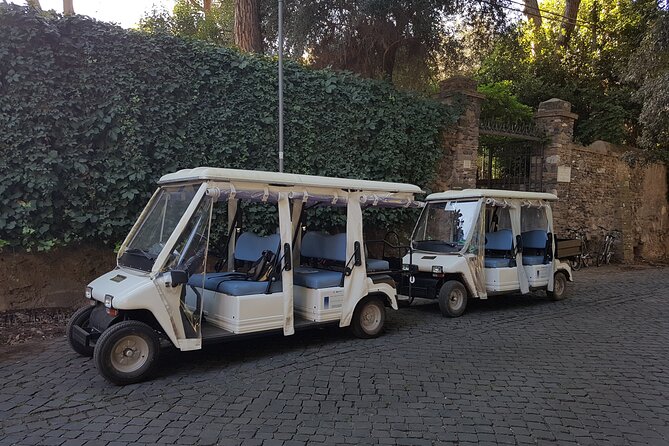
Then you’re at Villa dei Quintili and nearby Santa Maria Nova, again about 10 minutes.
The description emphasizes that this was a major residential area owned by the brothers who were killed on orders connected to Emperor Commodus. That’s heavy stuff, but presented in context it becomes less like “random Roman drama” and more like a snapshot of how power shifted.
You won’t need to buy an entrance ticket for this tour’s stop. It’s another brief “see the footprint, learn the story” moment.
Stop 7: Appian Way (Via Appia Antica)—Why So Many Tombs Here?
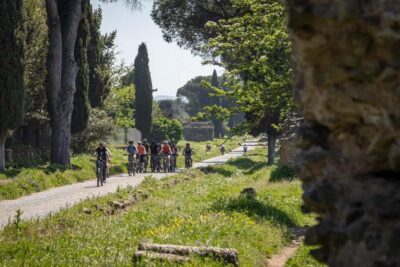
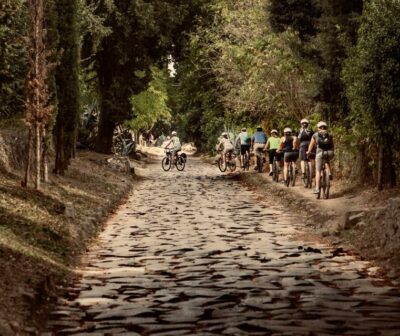
Now you’re in the heart of the experience: the cart ride itself along the famous burial stretch.
The tour explicitly ties the density of tombs and monuments to the “why” behind the Appian Way’s development—catacombs, churches, sepulchers, and mausoleums aligned along Regina Viarum.
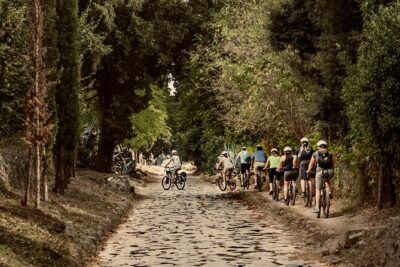
This is where the golf cart makes the difference. You can actually look at details without having to fight your way across long distances on foot. And because you’re stopping regularly, the route doesn’t turn into a blur.
Expect around 20 minutes here, with explanations while you move.
Stop 8: Appia Antica Archaeological Park (Return Along the Ancient Road)
The final segment is a return drive along the ancient route to the starting point. It’s about 30 minutes.
This last stretch matters more than you might think. By the time you reach it, you’ve already seen the underground spaces, a major public arena, and the hilltop tomb story. So even the “just driving back” part starts to feel like a recap—what a road can do when it’s part of daily life for hundreds of years.
The Guides Make (or Break) This Kind of Tour
This type of tour succeeds because someone is translating Rome into something you can picture. The guides named in the feedback are consistently praised: Frederico/Fredrick, Flavia, Federico, Alexander, and Sara/Sarah.
What I’d focus on for you: small-group tours like this tend to reward good guide control. When the guide manages the timing well, you get enough viewing time without losing the storyline. When they don’t, it can feel like you’re being rushed between short stops.
One practical note from the feedback: hearing can vary depending on where you sit on the cart. If you want the best chance at clear commentary, you can request a position that gives you a direct line to the guide when you get seated.
Who This Tour Is Best For (And Who Might Want Something Else)
This is ideal if:
- You want the Appian Way experience but don’t want bike fatigue or constant walking.
- You care about guided storytelling, especially for the catacombs.
- You’ve done Rome’s main center sights and want a different day, away from the heaviest crowds.
- You like a small group. The cap at 7 is a big part of the charm.
You might choose a different format if:
- You need maximum time at a single monument. This itinerary is designed for variety, not for long museum-style dwelling.
- You’re very sensitive to audio. In a cart, sound can be tricky depending on seating.
What to Do Before You Go (So the Day Feels Smooth)
A few practical tips that match what this route demands:
- Wear comfortable shoes, even though you’re on a cart. You’ll still do short walks and approach uneven ground around monuments.
- Bring layers. The Appian Way experience can be cooler or breezier than central Rome, and it’s easy to feel underdressed if you go by city-center weather.
- Plan for no coffee stop being included. The tour doesn’t list coffee/tea, so if you like a mid-day caffeine hit, plan your own nearby option before or after.
Should You Book the Rome Appian Way & Catacombs Golf Cart Tour?
If you want a memorable, efficient Appian Way day with catacombs and real guided stops, I think it’s a strong choice. The pricing feels fair when you consider what’s included—transport, catacombs entrance with guidance, and Circus of Maxentius entry—while keeping the extras simple at Cecilia Metella’s tomb and the Quintili villa.
I’d especially recommend it if you’re a history-minded traveler who doesn’t want to sacrifice comfort. The small group format makes a difference, and a good guide turns the route into a story you can actually follow.
If you prefer long, quiet visits where you can linger at one site for a long time, you may feel this is a bit stop-and-go. But for most people, it hits a sweet spot: ancient Rome, real pacing, and a route you’ll remember long after you’ve left the carts.
FAQ
How long is the Rome Appian Way & Catacombs golf cart tour?
It’s listed at about 3 hours.
Is this tour in English?
Yes, it’s offered in English.
What’s included in the price?
The tour includes bottled water (1/2 L per person), and admission for the catacombs visit (guided) and the Circus of Maxentius stop. Other listed sites may have entrances not included.
Which catacombs will I visit?
You’ll visit either the Catacombs of St Callixtus or St Sebastiano depending on availability.
Are tickets needed for Cecilia Metella’s tomb and the Villa dei Quintili?
The tour notes that entrances for Cecilia Metella’s tomb and the Quintili’s villa are not included, and it also states you don’t need to buy tickets for the tour’s stops.
Where does the tour start and end?
It starts at Via Appia Antica, 60, 00179 Roma RM, Italy, and ends back at the same meeting point.
Can I cancel for a full refund?
Yes. Free cancellation is available up to 24 hours in advance for a full refund.
More Golf Cart Rides
- Rome by Golf Cart Private Tour: Beyond the Landmarks
★ 5.0 · 4,361 reviews - Rome on a Golf Cart Semi-Private Tour Max 6 with Private Option
★ 5.0 · 2,502 reviews - Rome Highlights by Golf Cart Private Tour
★ 5.0 · 2,379 reviews - Rome: Golf Cart Tour with Artisanal Gelato Tasting
★ 4.8 · 1,396 reviews - Rome Highlights City Tour by Golf Cart with Gelato
★ 5.0 · 1,088 reviews - Rome: Imperial City Tour by Golf Cart with Optional Transfer
★ 4.8 · 1,024 reviews
The Appian Way, Continued
- Rome EBike Tour: Appian Way, Catacombs & Roman Aqueducts
★ 5.0 · 1,766 reviews - Rome: Appian Way & Aqueducts E-Bike Tour (Catacombs & Food)
★ 4.9 · 1,498 reviews - Rome: Appian Way, Catacombs, & Roman Aqueducts E-bike Tour
★ 4.9 · 1,421 reviews - Rome Underground: Catacombs Tour, Aqueducts and Appian Way
★ 5.0 · 1,007 reviews - Appian Way Aqueducts Bike Tour (Catacombs & Lunch Option)
★ 5.0 · 975 reviews - Rome: Appian Way, Aqueducts, and Catacombs Tour
★ 4.7 · 942 reviews
Further Below Rome
- Rome: Capuchin Crypts and Catacombs Tour with Transfers
★ 4.6 · 6,456 reviews - The Original Roman Crypts and Catacombs Tour with Transfers
★ 4.5 · 4,896 reviews - Rome: Catacombs of St. Callixtus Entry Ticket & Guided Tour
★ 4.6 · 3,037 reviews - Rome: Guided Roman Catacombs Tour with Transfers
★ 4.6 · 1,830 reviews - Rome: Catacombs Guided Tour with Transfer
★ 4.2 · 1,808 reviews - Rome EBike Tour: Appian Way, Catacombs & Roman Aqueducts
★ 5.0 · 1,766 reviews
Just added to our Rome reviews





Roman Catacombs & Crypts Tours, compared.
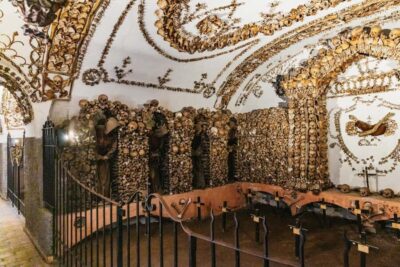 ★ 4.6Capuchin Crypts and Catacombs Tour with TransfersFrom $606,456 reviews
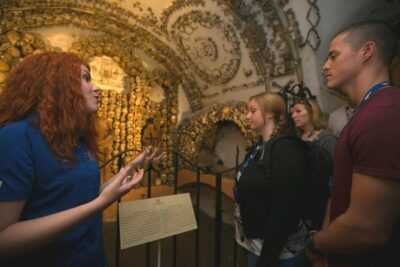 ★ 4.5The Original Roman Crypts and Catacombs Tour with TransfersFrom $664,896 reviews
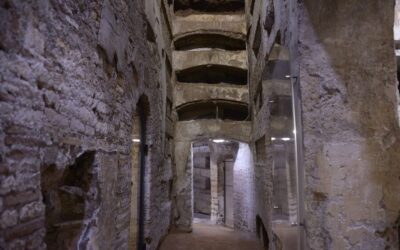 ★ 4.6Catacombs of St. Callixtus Entry Ticket & Guided TourFrom $163,037 reviews
 ★ 4.6Guided Roman Catacombs Tour with TransfersFrom $651,830 reviews
 ★ 4.2Catacombs Guided Tour with TransferFrom $541,808 reviews
 ★ 5.0Rome EBike Tour: Appian Way, Catacombs & Roman AqueductsFrom $1021,766 reviews
 ★ 4.6Catacombs and Capuchin Crypt Guided Tour with TransferFrom $411,606 reviews
 ★ 4.7St. Peter’s Basilica Priority Access Tour with Dome & CryptFrom $701,504 reviews
Browse the lists this tour appears in