
Reviewed · ROME GOLF CART TOURS
Rome by Golf Cart Private Tour: Beyond the Landmarks
Rome looks different from a street-level golf cart. I love how this private tour turns a pile of famous ruins into a story you can actually follow, stop by stop. You get hotel pickup in central Rome and a driver-guide who builds a route around what you care about, not what an assembly line needs.
Two big wins for me: the pace is made for your energy level (you cover a lot without feeling slammed by walking), and the narration gives you those “wait, that’s why it’s here” moments—often the kind you’d miss wandering solo. One thing to consider: this is mainly a sightseeing format, so ticketed entries aren’t included (for example, Colosseum entry). You’ll get great exterior views and photo time, but you’ll plan separate timed tickets if you want to go inside the big-ticket sites.
In This Review
- Key highlights that make this tour worth your time
- Why a golf cart works so well for Rome
- Meet at Piazza del Gesù and plan your route fast
- How the cart ride is set up
- Colosseum to Circus Maximus: ancient Rome at speed
- Knights of Malta Keyhole and Sant’Ignazio: Rome’s quirky surprises
- Spanish Steps and Piazza Navona: classic views, handled the smart way
- Aventine and Borghese: viewpoints that feel like cheating
- Janiculum Hill stops: aqueduct end points and a big-unification mood
- Victory Arches, Trajan’s Column, and the Rome of stories you can read
- Churches and the Jewish Ghetto: different layers of Rome, in human scale
- Monti, fountain rivalries, and Rome after the main tour
- What the tour is really doing when it skips entry tickets
- Pricing and value: what you’re paying for at $180.67
- How long should you book: 2 to 7 hours
- Who this tour suits best (and who might want to rethink)
- Should you book this Rome by Golf Cart Private Tour?
- FAQ
- Is the Rome by Golf Cart Private Tour actually private?
- Are admission tickets included for places like the Colosseum?
- Do you pick up from my hotel in Rome?
- How long is the tour?
- Is the tour available in bad weather?
- Is the guide provided in English?
Key highlights that make this tour worth your time
- Private route planning with your driver-guide so the day fits your interests
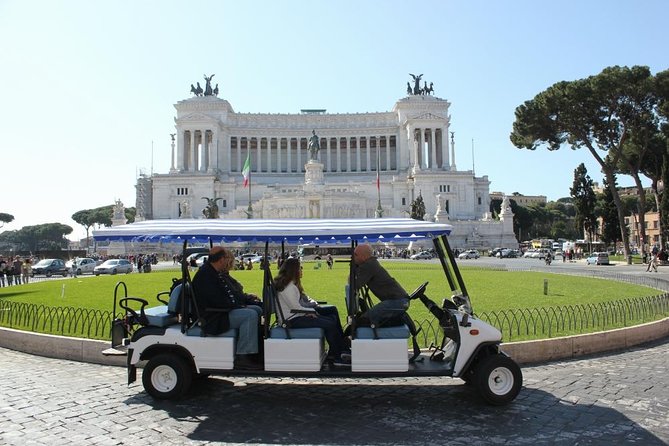
- Street-legal, covered golf cart means less walking and more time at the stops that matter
- Quick, focused photo stops at major landmarks and smaller side streets
- Viewpoints that Rome fans love like Aventine and Janiculum for panoramic moments
- English narration with real personalities (guides like Julio, Francesca, Gabriel, and Eugene show up again and again)
- Rain-ready setup with rain covers, so you’re not stuck canceling at the first drizzle
Why a golf cart works so well for Rome
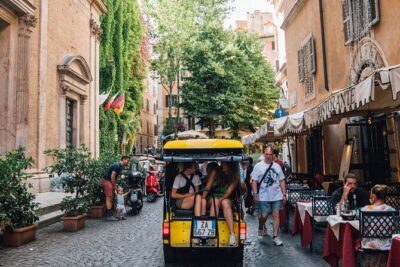
Rome is a maze. Even when you’re paying attention, you can lose time to slow streets, sudden turns, and hills that feel steeper than they look on a map. A street-legal golf cart solves a lot of that, letting you travel between sights while keeping your day comfortable.
The best part is the timing. In a short window, you can hit multiple areas that would take you ages to connect on foot. And because the cart is covered, you’re not baking in sun or freezing in a light rain while you wait for the next stop.
Cover more ground by golf cart
- Rome by Golf Cart Private Tour: Beyond the Landmarks
★ 5.0 · 4,361 reviews - Rome on a Golf Cart Semi-Private Tour Max 6 with Private Option
★ 5.0 · 2,502 reviews - Rome: Golf Cart Tour with Artisanal Gelato Tasting
★ 4.8 · 1,396 reviews - Rome Highlights City Tour by Golf Cart with Gelato
★ 5.0 · 1,088 reviews
Meet at Piazza del Gesù and plan your route fast
You start from Piazza del Gesù 47 (or your hotel if you’re in central Rome and pickup is arranged). Either way, you meet your private driver-guide and talk through what you want to prioritize. The itinerary isn’t fixed. Your guide calculates a realistic route based on your interests and the time you booked.
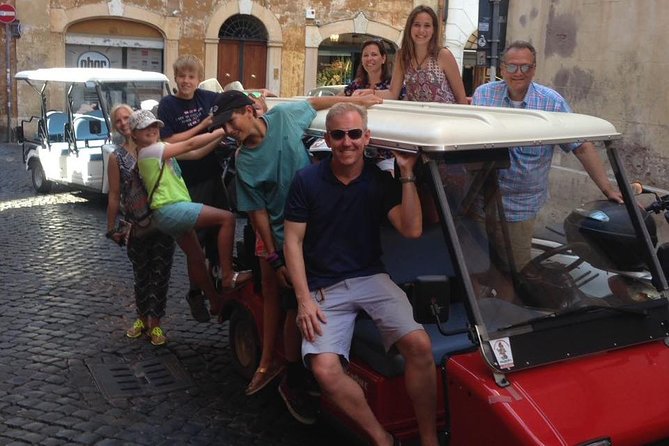
That “talk first” approach is one reason so many people rate this so highly. Guides like Julio and Luca are known for tailoring the stops in a way that keeps the day feeling personal, not templated. If you’ve already done a couple sights on your own, you can steer the day toward the parts you skipped.
How the cart ride is set up
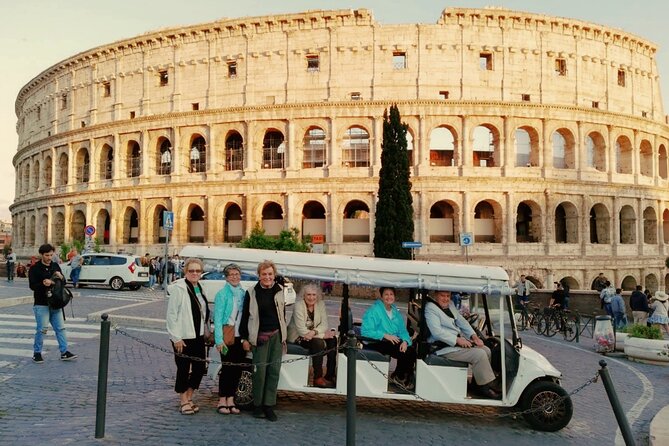
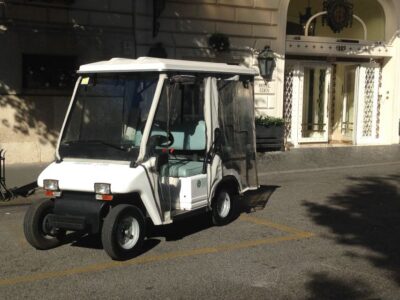
Most carts are six-seat setups: four seats face forward (including the driver’s position) and two face backward. Seat belts and side protection are included, and the carts are equipped with rain covers for wet weather. If you’re traveling as a family with an infant seat, the tour notes that only one baby seat can be accommodated and it must be installed in the middle seat next to a parent.
Colosseum to Circus Maximus: ancient Rome at speed
The Colosseum is usually the headliner, and you’ll spend about 15 minutes there. Importantly, entry isn’t included, so plan on seeing it from the outside and using your time for photos and orientation. This can still be a smart choice, especially if you want the guide’s big-picture context first, then decide later whether you want a separate inside visit with a ticket.
The Colosseum stop also plays well with timing. Some guides handle the route so you catch the building at a nice light (one highlight mentioned Colosseum at dusk when it’s illuminated). Whether or not you hit that exact moment, having a guide explain what you’re looking at makes the arena feel less like a photo and more like a place gladiators once worked and lived around.
Next up is the Circus Maximus, about 10 minutes, and you’ll see it as a long green ribbon rather than a rebuilt stadium. Even if you know the name, the guide’s stories about chariot racing and the sheer scale help you visualize what the space used to feel like. Tickets aren’t required for that stop, which is helpful when your day is packed.
Worth a look next to this Rome booking:
Knights of Malta Keyhole and Sant’Ignazio: Rome’s quirky surprises
If you like Rome with personality, this part is for you. The Knights of Malta Keyhole is a quick 10-minute stop with the wow-factor of a tiny view that reveals something you’d never notice on a normal stroll. The guide also ties it to the broader idea of hidden symbols and odd little surprises folded into the city.
Then you may head to Chiesa di Sant’Ignazio di Loyola, another 10-minute stop. This is a Jesuit church where the surprise is in the dome and the way light and design play together. The value here isn’t just the look—it’s that your guide helps you see the trick. One review-style highlight included a “domeless Church” ceiling that people found so impressive it felt like a major wow moment, even without a big-ticket ticketed interior.
These shorter stops are a key part of why the whole tour feels fun. You’re not stuck in one long queue or standing in one place hoping you guessed the right angle. You move, you learn, you reset.
Spanish Steps and Piazza Navona: classic views, handled the smart way
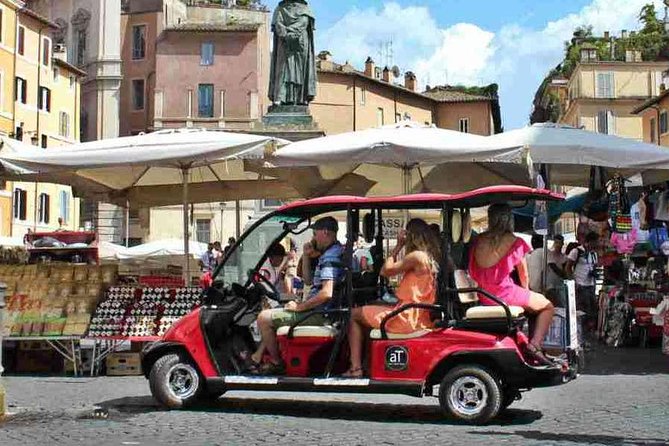
The Spanish Steps are typically a 10-minute photo-and-stroll stop. They’re iconic for a reason: the design includes the butterfly-like irregular geometry of the staircase, and the area is a natural hangout spot. With a guide, you get a quick sense of how Baroque design shapes the way people gather and move.
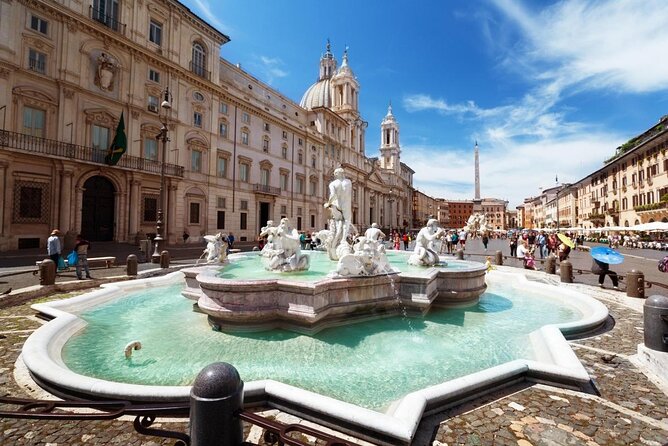
Then comes Piazza Navona, about 10 minutes, with the famous Fountain of the Four Rivers. The square keeps the shape of an ancient stadium of Domitian, so the place is more than pretty. It’s an example of Rome reusing space and layers of time—your guide helps connect the modern square to what it used to be.
A practical note: because this is a private golf cart format with lots of stops, you’re moving through quickly. That’s a feature for people who want efficiency, but if you’re the type who wants to linger for an hour with zero agenda, you may find some stops too short. The fix is simple: use the tour to decide what you want to return to.
Aventine and Borghese: viewpoints that feel like cheating
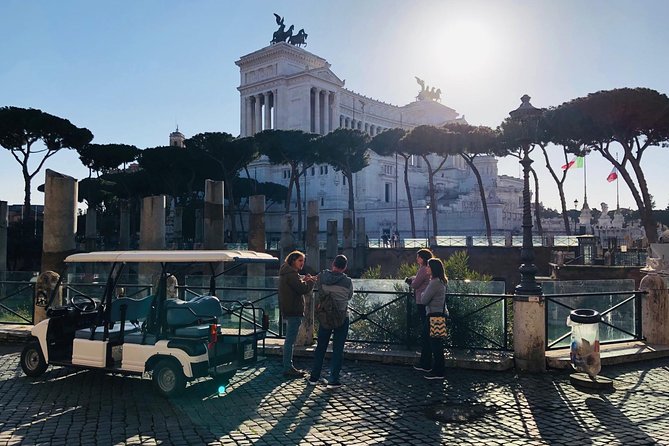
Rome’s best “just one more angle” moments often come from hills and viewpoints. This tour includes two great ones: Giardino degli Aranci on the Aventine Hill (about 10 minutes) and Villa Borghese (about 15 minutes).
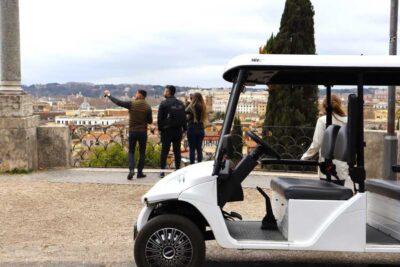
At Giardino degli Aranci, you get roof-top views that make the city feel broader than any postcard. It’s one of those stops where your camera will work harder than you do, but the guide will also point out what to look for so the view becomes a mental map of the city.
With Villa Borghese, you’re in a park setting with statues and fountains, plus your route may pass by the Pincian hill viewpoint area looking toward Piazza del Popolo and across toward St. Peter’s and Rome’s core. Again, you’re not doing a deep park walk. You’re sampling the best views and using the cart to hop to the next story.
Janiculum Hill stops: aqueduct end points and a big-unification mood
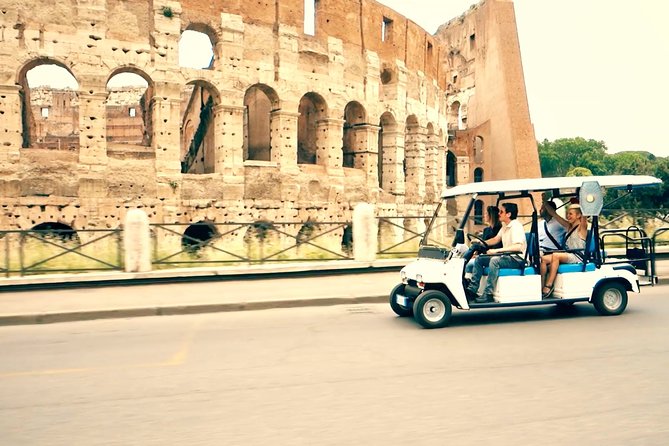
On the Janiculum side, you may stop at the monumental Fontana dell’Acqua Paola (about 5 minutes). The fountain marks the end of the Acqua Paola aqueduct. That fact matters because it turns a fountain into a piece of engineering history and urban planning—Rome doesn’t just look old, it worked old.
From there, you might head to Mouth of Truth (about 5 minutes). This one is playful: you put your hand in the ancient marble mouth, used historically as a lie-detector idea. Tickets aren’t included, so you’ll treat this like a short, memorable moment that you can do quickly between bigger blocks of sightseeing.
Another possible stop is Giuseppe Garibaldi Monument (about 5 minutes) on the Janiculum Hill area. The tour notes that if you arrive by 12pm, you could see the famous canon shooting the city. Even if you don’t time it perfectly, the view and the unification-of-Italy storyline give this stop a mood.
Victory Arches, Trajan’s Column, and the Rome of stories you can read
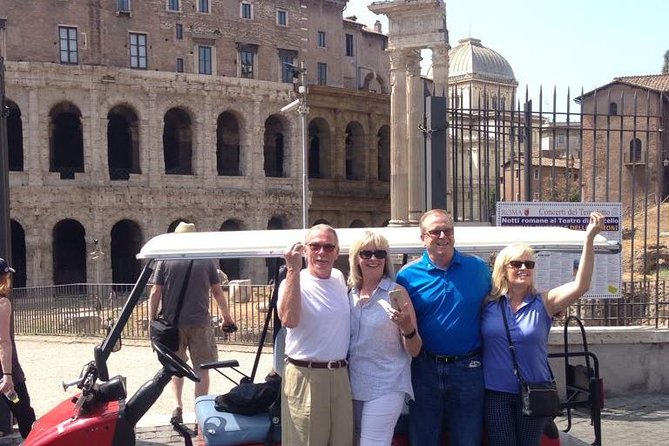
The route often includes a victory arch stop linked to Constantine the Great and Christianity taking over Rome (about quick exterior time). It’s a reminder that Rome’s monuments weren’t just celebrations; they were political messaging in stone.
Then you may head to Trajan Column (about 10 minutes). This is a huge marble column that tells the story of the Dacian wars. The guide’s job is to help you read the narrative in the carvings, which turns “column with spirals” into a scene-by-scene account.
You might also include Teatro di Marcello (about 10 minutes). It’s often described as the little brother of the Colosseum and older than it. The building’s architecture tells multiple stories at once, and because it’s not as packed as the Colosseum area, it can feel calmer while still being dramatic.
Another stop that adds a different angle is Piazza Venezia / Ancient City (about 10 minutes). It’s busy, but the value is in the guide’s context: the square becomes a history dashboard, not just a road-junction where you pass through.
Churches and the Jewish Ghetto: different layers of Rome, in human scale
One of the benefits of having a guide is that you don’t just “see landmarks.” You learn what they meant to people. This tour often includes Basilica of San Pietro in Vincoli (about 10 minutes) where you can see Michelangelo’s famous Moses statue holding the Ten Commandments. Even if you’re not a sculptor-nerd, the statue stop is one of those moments that gives you chills because it’s art tied to belief and power.
Another stop is the Ghetto (about 10 minutes). The tour describes the word origin and notes that a Roman Jewish community continues to this day as one of the oldest. This kind of stop can add weight to your day because it shifts Rome from “ruins for photos” toward “a city where real communities lived through real events.”
If you’re the kind of traveler who likes to understand how different eras co-exist in one block, you’ll likely appreciate this section.
Monti, fountain rivalries, and Rome after the main tour
The itinerary menu also includes modern-leaning stops that show Rome as a living city. You may visit tiny colorful alleys that were once a fishermen neighborhood and are now known for bars, cocktail bars, restaurants, and nightlife. Even if you don’t plan to party, it helps you picture how Romans actually spend evenings, not just what you’ll photograph in daylight.
Another option is Monumento a Giordano Bruno (about 15 minutes). The area is marked with shops, bars, and restaurants. The guide’s story behind the place can explain why today’s relaxed street scene is tied to a heavier past.
And then there’s Fontana dei Quattro Fiumi (about 10 minutes), Bernini’s fountain. The tour notes that it’s often considered alongside Trevi as Rome’s most beautiful fountain, and it includes a rivalry story—Bernini versus Borromini. You’ll get the fountain’s visual drama fast, but the story makes it stick.
Other fountain/romance stops might include Fontana della Terrina (about 10 minutes), framed as a romantic spot with a story that turns it from background to highlight.
What the tour is really doing when it skips entry tickets
This tour explicitly does not include entry for ticketed sites like the Colosseum, Roman Forum, Vatican Museums, or Pantheon. You’ll stop by for exterior views and photos, and you’ll plan your inside visits separately if you want them.
That might sound like a dealbreaker. In practice, it can be a smart strategy. It helps you avoid committing time to one inside ticket too early in your trip. You’re essentially using the guide to build your mental map first, then you decide which interior experiences deserve your money and your patience.
It’s also a good fit if you prefer flexible pacing. If you want to spend more time in a specific area, your guide can adjust the route so the day fits you better.
Pricing and value: what you’re paying for at $180.67
At $180.67 per person, the value depends on what you’re optimizing for. You’re paying for three things that add up fast in Rome: private time with a guide, golf-cart transport as part of the tour, and hotel pickup and drop-off in central Rome when arranged.
You’re not paying for entry tickets, and that’s key. If you’re already planning to buy specific timed-entry tickets for major sites, this tour helps you “pre-load” the context so your paid visits feel more meaningful. If you’re mainly looking for efficient highlights and less walking, then you’re getting a lot of sightseeing for the money—especially since private doesn’t mean short.
For families, couples, and multi-generational groups, this is often where the price feels easiest to justify. Many people also mention it as a way to see a ton quickly without the strain of constant hill-climbing and long distances.
How long should you book: 2 to 7 hours
The tour ranges from about 2 to 7 hours, and the “full-day” version can include a lunch break (offered only on the full-day tour). The route is still flexible: your guide discusses your interests up front and calculates a realistic plan.
Shorter options work best as a first orientation day. I think of it as the way to get bearings fast. A guide like Beatrice is often praised for teaching Ancient Rome in an easy first-day way, so you can later choose deeper museum time with confidence.
Longer options suit you if you want a full loop of central highlights plus extra stops. Reviews often talk about seeing 6–7 sites in just a few hours, which makes sense when you use the cart for movement and spend short bursts at each landmark.
If you want maximum results and you’re not planning to book separate tickets for multiple interiors that day, the longer format can feel like the best value.
Who this tour suits best (and who might want to rethink)
This is a good match if you want:
- A private, tailored route built around your interests
- Less time walking, more time seeing
- A guide who tells the story behind landmarks, not just their dates
It’s also a great tool for travelers who have mobility limits or want to reduce fatigue. Many people highlight guides’ patience and adaptation when someone needs a slower pace.
You might rethink it if:
- You expect inside access to major ticketed sites during the tour (it doesn’t include that)
- You want to spend long, unhurried time at only one or two attractions
- You’re extremely sensitive to quick photo-stop timing
Should you book this Rome by Golf Cart Private Tour?
I’d book it if your priority is efficient, guided Rome with minimal stress and a strong narrative thread from stop to stop. The private format is the real power here, and the most praised aspect is how guides like Julio, Francesca, Gabriel, Eugene, and others tailor the day instead of forcing a script.
I’d skip or adjust expectations if your goal is an all-in, inside-everywhere ticket day. This tour is better at giving you context and orientation, then helping you decide what to do next.
If you want the smartest “first Rome in a short time” move, this is one of the easiest yeses: get the big picture, grab the viewpoints, and then come back for the interiors that deserve your time and money.
FAQ
Is the Rome by Golf Cart Private Tour actually private?
Yes. It’s a private tour/activity, so only your group participates.
Are admission tickets included for places like the Colosseum?
No. Admission to ticketed sites (for example, the Colosseum, Roman Forum, Vatican Museums, or Pantheon) is not included, and entry cannot be added as part of the tour. You’ll typically stop for exterior views and photos.
Do you pick up from my hotel in Rome?
Hotel pickup is offered for centrally located Rome hotels when communicated up to 24 hours in advance. If you don’t select a pickup location, the tour departs from the Rolling Rome office at Piazza del Gesù 47.
How long is the tour?
The duration is about 2 to 7 hours, depending on the option you choose.
Is the tour available in bad weather?
The tour runs rain or shine. The golf carts have rain covers for wet weather.
Is the guide provided in English?
Yes. The tour is offered in English, and the guide/drivers speak English.
More Tours in Rome
- Vatican Museums, Sistine Chapel & St. Peter’s Basilica Tour
★ 4.3 · 73,970 reviews - Vatican Museums, Sistine Chapel & St Peter’s Basilica Guided Tour
★ 4.5 · 39,149 reviews - Rome: Colosseum, Palatine Hill and Roman Forum Guided Tour
★ 4.8 · 32,814 reviews - Rome: Guided Tour of Colosseum, Roman Forum & Palatine Hill
★ 4.7 · 27,897 reviews - Rome: Colosseum, Roman Forum and Palatine Hill Guided Tour
★ 4.5 · 23,903 reviews - Rome: Colosseum Arena Floor, Palatine & Forum Guided Tour
★ 4.5 · 20,180 reviews
More Tour Reviews in Rome
- Vatican Museums, Sistine Chapel & St. Peter’s Basilica Tour
★ 4.3 · 73,970 reviews - Vatican Museums, Sistine Chapel & St Peter’s Basilica Guided Tour
★ 4.5 · 39,149 reviews - Rome: Colosseum, Palatine Hill and Roman Forum Guided Tour
★ 4.8 · 32,814 reviews - Rome: Guided Tour of Colosseum, Roman Forum & Palatine Hill
★ 4.7 · 27,897 reviews - Rome: Colosseum & Forum with Audio Guide App -Optional Arena
★ 4.2 · 24,770 reviews - Rome: Colosseum, Roman Forum and Palatine Hill Guided Tour
★ 4.5 · 23,903 reviews
More Golf Cart Rides
- Rome on a Golf Cart Semi-Private Tour Max 6 with Private Option
★ 5.0 · 2,502 reviews - Rome Highlights by Golf Cart Private Tour
★ 5.0 · 2,379 reviews - Rome: Golf Cart Tour with Artisanal Gelato Tasting
★ 4.8 · 1,396 reviews - Rome Highlights City Tour by Golf Cart with Gelato
★ 5.0 · 1,088 reviews - Rome: Imperial City Tour by Golf Cart with Optional Transfer
★ 4.8 · 1,024 reviews - Golf Cart Small-Group Guided Tour: Rome City Highlights
★ 5.0 · 907 reviews
Just added to our Rome reviews

Rome Golf Cart Tours, compared.
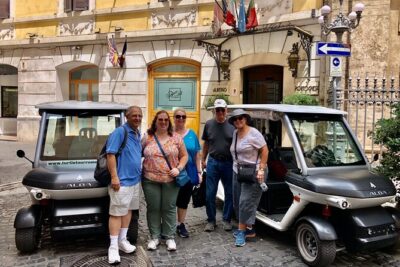
 ★ 5.0Rome on a Golf Cart Semi-Private Tour Max 6 with Private OptionFrom $1682,502 reviews
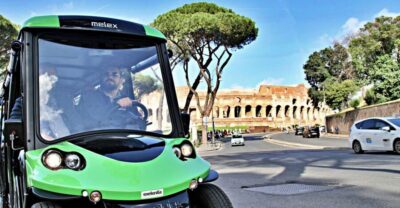
 ★ 5.0Rome Highlights by Golf Cart Private TourFrom $1632,379 reviews
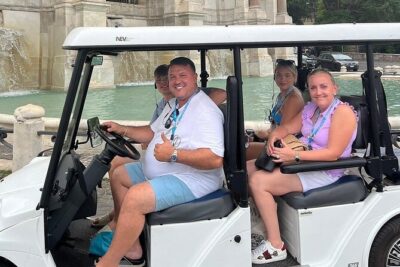
 ★ 4.8Golf Cart Tour with Artisanal Gelato TastingFrom $451,396 reviews
 ★ 5.0Rome Highlights City Tour by Golf Cart with GelatoFrom $1071,088 reviews
 ★ 4.8Imperial City Tour by Golf Cart with Optional TransferFrom $1241,024 reviews
 ★ 5.0Golf Cart Small-Group Guided Tour: Rome City HighlightsFrom $104907 reviews
 ★ 4.8City Highlights Golf Cart TourFrom $45857 reviews
 ★ 5.0Private/Group 4 Hours Golf Cart SightseeingTourFrom $168780 reviews
Browse the lists this tour appears in