

Reviewed · ROME GOLF CART TOURS
Rome: Golf Cart Tour of the Eternal City
Rome’s lanes are perfect for a golf cart. This 3-hour Eternal City ride pairs open-air sightseeing with an English-speaking guide for a jam-packed route that still leaves time to stop and shoot photos. I like that you keep a comfortable pace while covering major icons and quieter corners, and I also like the limited-to-your-group feel that makes it feel more personal than a big bus tour. One thing to watch: the cart can move fast between stops, and if your guide’s setup is harder to hear, you may miss a bit of the story.
You’ll start and end back near the tour’s meeting point, with pickup offered from your central hotel. Then the route hops through gardens, piazzas, ancient monuments, and baroque showpieces, mixing “big wow” moments with practical photo breaks. In short, it’s a great way to get your bearings fast and decide what you want to return to on foot later—just go in knowing you’re seeing Rome in quick, smart segments.
In This Review
- Key things I’d plan around
- Why a golf cart makes Rome feel doable
- Getting picked up near Piazzale delle Canestre (and what that means)
- The 3-hour loop: from Villa Borghese to the Pantheon-and-more zone
- Villa Borghese Gardens: a park break before the city rush
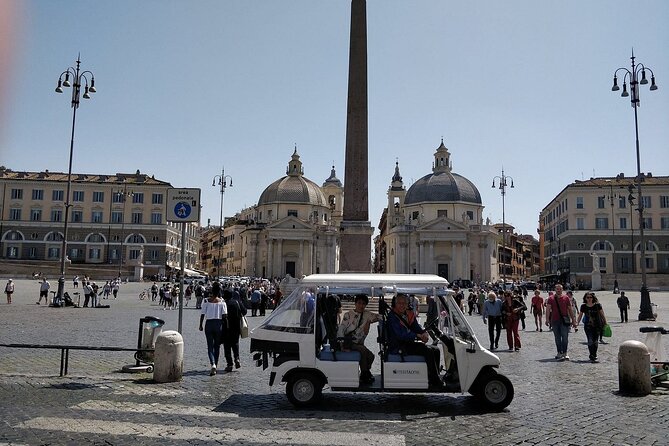
- Piazza del Popolo: obelisk views and a fast orientation point
- Mausoleo di Augusto: quiet power in a small footprint
- Via del Corso: your practical Rome shopping-and-sight corridor
- Column of Marcus Aurelius and Piazza Colonna: ancient relief, modern traffic
- Piazza Venezia and the Vittoriano: big white marble and big views
- Mercati di Traiano (Museum of the Imperial Fora): ruins with serious structure
- Circus Maximus: the big arena feel, even in park form
- Giardino degli Aranci on Aventine Hill: the view stop and the keyhole legend
- Bocca della Verità: instant fun, even if the legend is dramatic
- Piazza del Campidoglio: Michelangelo’s design + an equestrian survivor
- Piazza Navona and the fountains: stand, look, then sit
- Pantheon: the engineering moment you should not rush
- Baroque quick hits: Sant’Ignazio’s false dome and Trevi’s coin scene
- Chiesa di Sant’Ignazio di Loyola: the false dome illusion
- Trevi Fountain: iconic, crowded, and still worth the stop
- Spanish Steps: the final postcard pause
- Price and value: what $160.91 per person buys you
- The guide factor: what I’d look for before you commit
- Who this Rome golf cart tour fits best
- Should you book this tour?
- FAQ
- How long is the Rome golf cart tour?
- Is pickup offered from my hotel?
- Where is the meeting point if my hotel is outside the central area?
- Is this a private tour or shared?
- What language is the tour guide speaking?
- Do I get a mobile ticket?
- Are there admission fees at the stops?
- Where does the tour end?
- Is the tour near public transportation?
- What if I need to cancel?
Key things I’d plan around
- Private group touring: limited to your group, so the pace and stops can fit you better
- Hotel pickup in central Rome: your guide-driver meets you at the main entrance when you’re in the central area
- An English-speaking guide: the tour is built for an English-speaking experience
- Photo-friendly stops: brief pauses at famous places, timed for views and quick pictures
- A big highlights loop in 3 hours: Villa Borghese, Pantheon, Trevi Fountain, Spanish Steps, and more
- Mixed feedback on audio and stopping: some groups report sound/stop pacing can vary
Why a golf cart makes Rome feel doable
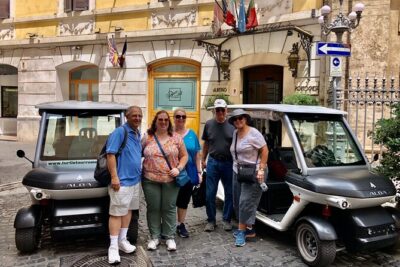
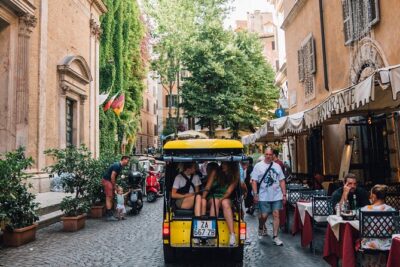
Rome looks compact on a map. In real life, it’s a maze of narrow streets, sudden turns, and heavy traffic around the center. A golf cart tour solves the “too much walking, too many buses” problem in one move: you cover lots of ground without burning your legs before you even reach the big sights.
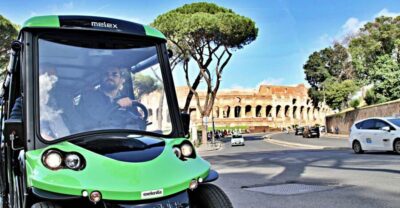
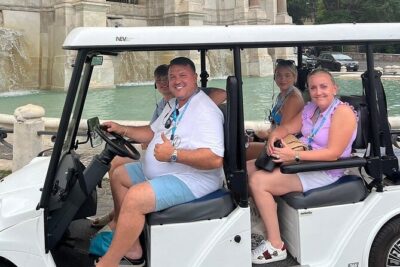
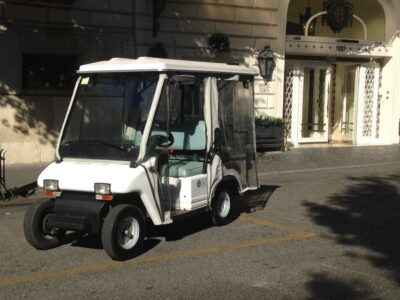
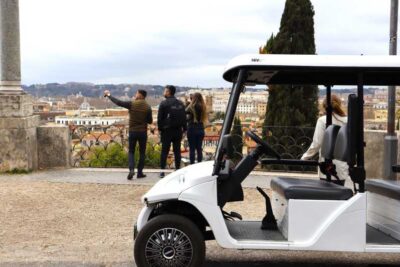
The open-air design matters. You get fresh air, you hear the city atmosphere, and you can frame shots without the glass-and-snorkel feeling of some vehicles. At the same time, the stops are designed to let you get out, look around, and reset your eyes for the next landmark.
The best part is the mix of types of sights. You’re not only chasing the ultra-famous pictures. You also hit viewpoints and classic squares that help you understand how Rome is laid out—so you’re not just collecting icons, you’re building a mental map.
Cover more ground by golf cart
- Rome by Golf Cart Private Tour: Beyond the Landmarks
★ 5.0 · 4,361 reviews - Rome on a Golf Cart Semi-Private Tour Max 6 with Private Option
★ 5.0 · 2,502 reviews - Rome: Golf Cart Tour with Artisanal Gelato Tasting
★ 4.8 · 1,396 reviews - Rome Highlights City Tour by Golf Cart with Gelato
★ 5.0 · 1,088 reviews
Getting picked up near Piazzale delle Canestre (and what that means)
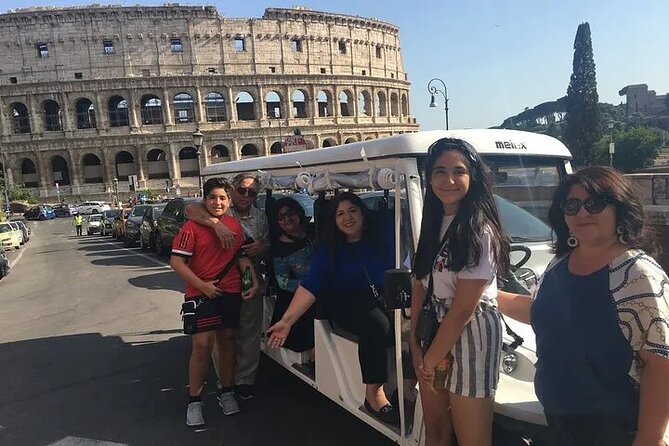
The tour starts and ends back at the meeting point: Piazzale delle Canestre, SNC, 00197 Roma RM. If your hotel is in the central area, the driver-guide waits for you at the main entrance. If it’s outside that central zone, you’ll be directed to meet at a designated meeting point or another central location.
That “central area” detail matters for your sanity. If your hotel is far from the core, you may need to plan a short walk or a taxi ride to reach the meeting spot. In a city full of confusing street numbering, show up a few minutes early at the correct spot and double-check the exact pickup address or landmark name in your confirmation.
From there, the rhythm is simple: drive, stop, look, photos, then back on the cart. You’ll feel the timing most clearly because you’re only out for a few minutes at many stops.
The 3-hour loop: from Villa Borghese to the Pantheon-and-more zone
This tour is built like a highlights sampler. The cart gets you between major areas quickly; the stops act like “glance-and-learn” moments. Here’s how the route flows and what each stop gives you.
Villa Borghese Gardens: a park break before the city rush
You begin at Villa Borghese Gardens, a massive park covering over 80 hectares. This is a smart first stop because it’s a palate cleanser. You’re still in Rome, but the gardens, lakes, fountains, sculptures, and walking paths help your brain switch from traffic mode to “I can actually enjoy this” mode.
Even with only a short visit, it helps to know what you’re looking at:
- the park’s recreational areas (like the boating lake and amphitheater)
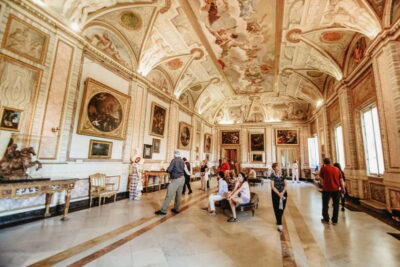
- the museums and galleries inside the estate (including the Borghese Gallery, though admission isn’t the focus here)
If you love photos, aim for greenery + symmetry shots. If you love art, this is also the moment to decide whether you want to return later for museum time.
Worth a look next to this Rome booking:


Piazza del Popolo: obelisk views and a fast orientation point
Next is Piazza del Popolo, one of Rome’s best “orientation” squares. It’s anchored by an Egyptian obelisk and surrounded by major buildings, including the church of Santa Maria del Popolo.
This stop is short, but it does two important jobs:
1) It shows you what Rome’s grand-piazza style looks like in the north/central flow.
2) It gives you an easy mental connection to the surrounding hills and viewpoints.
If you’re the type who likes to plan your return walk later, this is a good place to pause and look around before you move on.
Mausoleo di Augusto: quiet power in a small footprint
Then comes Mausoleo di Augusto. The structure was built in 28 BC to commemorate Augustus, and today you’ll see only part of the original building—but the scale still reads as impressive.
What I like about this stop is the contrast: you get ancient gravitas without the wall-to-wall crowd feeling you can find at other ancient monuments. The tomb sits in a park-like setting, which makes it feel like a mini refuge.
Via del Corso: your practical Rome shopping-and-sight corridor
You pass through Via del Corso, Rome’s famous shopping street running from Piazza del Popolo to Piazza Venezia. This is less about a single monument and more about understanding the city’s movement axis.
The street also connects you to major landmarks like Palazzo Doria Pamphilj, which holds an acclaimed art collection. Even if you don’t go inside, the stop helps you see Rome as a city of corridors, not just isolated attractions.
Column of Marcus Aurelius and Piazza Colonna: ancient relief, modern traffic
The route then reaches Piazza Colonna, home to the Column of Marcus Aurelius, a spiral-relief monument tied to Marcus Aurelius’ campaigns. It rises to about 38 meters, and the carvings are considered one of the best-preserved examples of Roman column sculpture.
You’ll also notice the contrast instantly: in the middle of a still-working urban square, you’re looking at ancient narrative art. If you want a photo, step back and frame it with the square’s buildings so the height reads in the shot.
Piazza Venezia and the Vittoriano: big white marble and big views
Next is Piazza Venezia, dominated by the Vittoriano, the massive marble monument dedicated to King Victor Emmanuel II. This place is famous for being huge and for being hard to ignore.
The time here is short, but it’s enough to take in:
- the monumental facade
- the sense of scale
- the idea that this area connects ancient and modern Rome
If you love panoramic viewpoints, you’ll want to consider coming back when you have more time to climb or linger.
Mercati di Traiano (Museum of the Imperial Fora): ruins with serious structure
Mercati di Traiano (part of the Museum of the Imperial Fora) is a standout because it’s Roman archaeology you can understand from the outside. You’re looking at a complex built under Trajan, where commerce and daily life lived in stone.
Even with a brief stop, you can spot the architectural design: interconnected structures, courtyards, and underground spaces. This is the kind of site where a short visit still makes you feel like you’re seeing something engineered, not just scattered stones.
Circus Maximus: the big arena feel, even in park form
Then you hit Circo Massimo, the ancient chariot-racing stadium that once held up to 250,000 spectators. Today it’s a public park, and you’ll get a sense of scale by walking along the ancient track lines and looking from nearby viewpoints.
This stop works especially well if you like imagining how Rome functioned as entertainment capital—not just temples and forums.
Giardino degli Aranci on Aventine Hill: the view stop and the keyhole legend
On Aventine Hill, the Giardino degli Aranci (Orange Gardens) gives you one of the route’s most relaxing moments. You’re surrounded by citrus trees, greenery, and a calmer pace.
The big “Rome trivia” moment here is the small keyhole in the wall that frames a view of St. Peter’s Basilica when viewed from the right angle. Even if you don’t go hunting for it, the garden itself is worth the pause because it’s a breather between heavy icons.
Bocca della Verità: instant fun, even if the legend is dramatic
Next is Bocca della Verità, the Mouth of Truth disk at Santa Maria in Cosmedin. The legend says if you place your hand inside and tell a lie, your hand will be bitten off. It’s silly. It’s fun. And it’s one of those Rome experiences that feels almost like a museum exhibit made for photos.
If you want the classic picture, expect a line and use it as a way to keep your timing tight—this stop is short, but it’s memorable.
Piazza del Campidoglio: Michelangelo’s design + an equestrian survivor
You then reach Piazza del Campidoglio on Capitoline Hill. This is where the tour gives you design and symbolism, not just stone.
Michelangelo designed the piazza layout, and it sits near major ancient anchors like the Temple of Jupiter and the seat of the Roman Senate. You can also spot the famous statue of Marcus Aurelius, one of the few equestrian statues from ancient Rome that survived.
The effect is: you see Rome’s layers, where ancient political power later gets reshaped through Renaissance planning.
Piazza Navona and the fountains: stand, look, then sit
Piazza Navona is a favorite stop for many people because it’s theatrical. You’re surrounded by historic buildings and three major fountains, including Fontana dei Quattro Fiumi by Bernini.
Even if you only have a short time, you’ll understand why people linger here. The square is also a natural “break” stop in an otherwise drive-and-walk schedule.
Pantheon: the engineering moment you should not rush
You finish with the Pantheon, one of Rome’s best-preserved ancient buildings and a masterclass in proportions. The dome is still the largest unsupported dome in the world, and the oculus pulls light into the space in a way that makes you pause.
This stop is only about 15 minutes, but it’s enough to do the basics right: enter, look up, and take in the feel of the interior before you move on.
If you’re short on time in Rome, Pantheon is one of those “do it right now” stops. I’d prioritize it even more than many other places on a first pass.
Baroque quick hits: Sant’Ignazio’s false dome and Trevi’s coin scene
After the Pantheon, the tour turns toward baroque Rome with two high-impact stops.
Chiesa di Sant’Ignazio di Loyola: the false dome illusion
At Sant’Ignazio di Loyola, you’ll find the famous “False Dome,” a painted trompe-l’oeil created by Jesuit artist Andrea Pozzo. There’s no real dome here; instead, the ceiling artwork makes it look like one.
The short time can feel tight, but this is a classic you shouldn’t skip because it shows how Roman art tricks the eye. Even if you only catch part of it, you’ll understand the idea of baroque theatricality.
Trevi Fountain: iconic, crowded, and still worth the stop
Next is Trevi Fountain, the baroque masterpiece everyone knows—Neptune at the center, and the sculptures and carvings everywhere. The coin-toss tradition is part of the experience here, even if you’re not trying to play along.
This stop is quick, so if you want a cleaner photo, be ready to shift position and stand where you can avoid the densest crowd flow.
Spanish Steps: the final postcard pause
The last stop is Piazza Di Spagna and the Spanish Steps. The steps run from Piazza di Spagna up toward Trinità dei Monti, with 138 steps, lined with flowers in season and framed by Roman buildings.
This is a great place to finish because it’s both a viewpoint and a people-watching platform. Sit for a minute if you can, and use the sight lines to plan your next Rome walk. The Spanish Steps area is one of the easiest zones to revisit later on your own.
Price and value: what $160.91 per person buys you
At $160.91 per person for about 3 hours, the value comes less from ticket admission (many stops show as free to enter) and more from three things:
- transport in a vehicle built for Rome’s small streets
- an English-speaking guide who connects the dots
- a route that compresses a lot of key Rome areas into one afternoon
For me, this makes sense when you’re on a tight schedule, you want a first-day overview, or your group includes mixed walking energy. You also get the benefit of a guide who can adjust pacing to what you’ve already seen, which matters in Rome where lines and crowds can throw off plans.
Where value can drop is if you don’t get the stops you expected or you can’t hear the guide clearly while the cart moves. A couple of negative experiences point to problems with sound setup or a rushed feel. If audio clarity is a dealbreaker for you, I’d ask your booking confirmation about whether there’s a way to hear the narration clearly during driving segments.
The guide factor: what I’d look for before you commit
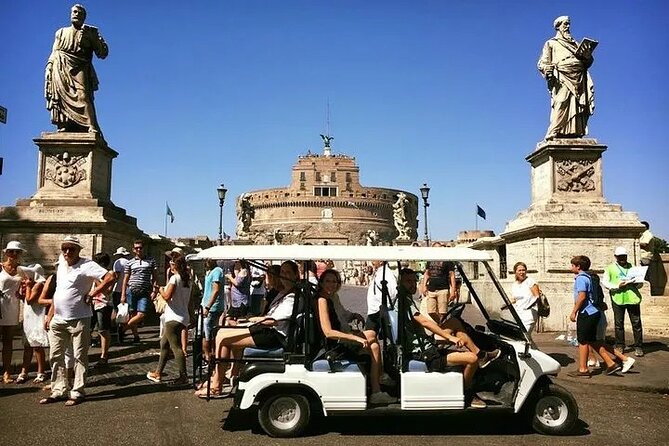
This tour’s reputation is strongly tied to the guide. Names like Hadi, Francesco, Marco, Pietro, Gianluca, Sahar, Sabrina, Claudio, Ivana, and Matter show up as examples of guides who are friendly, energetic, and good at pacing.
What to pay attention to when you book:
- Does the tour description clearly say English? (It does.)
- Is this private? (It is: only your group.)
- Do you care about narration detail vs. just fast sightseeing? The best guides do both, but your experience will still depend on how your guide handles pace and audio.
Even with great guidance, remember the format: you’re not on a slow museum crawl. You’re on a smart “see it, learn it, move on” route.
Who this Rome golf cart tour fits best
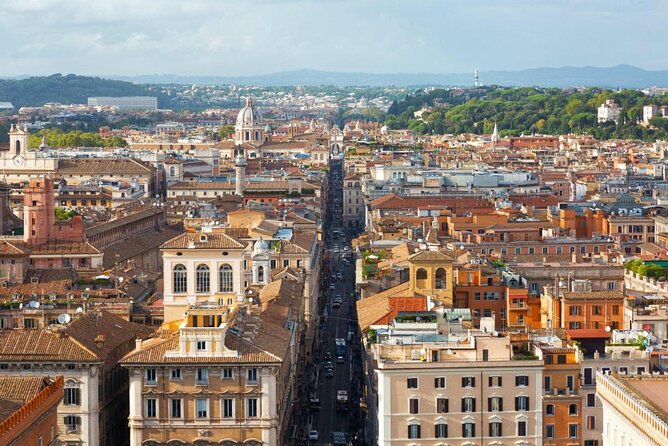
This is a strong match if:
- you want a high-impact first overview
- you prefer fewer walking hours
- you’re traveling as a family or mixed-age group
- you want a guide to help you connect the ancient and baroque layers
It’s less ideal if you want long time inside monuments or you need very detailed stop-by-stop museum depth in one go. This is more “Rome in motion” than “Rome in depth.”
Should you book this tour?
I’d book it if you want an efficient way to see major Rome landmarks, especially if you’re short on time or your group includes people who need a lighter walking day. The open-air golf cart is exactly the kind of transport that fits Rome’s narrow streets, and the private setup makes the experience feel less like a production line.
I’d hesitate if your top priority is crystal-clear narration while the cart drives, or if you’re counting on long, unhurried time at each monument. In that case, you may want to combine this with a follow-up day focused on one or two areas you love most—after you use the tour to map out where you want to go deeper.
FAQ
How long is the Rome golf cart tour?
It’s about 3 hours.
Is pickup offered from my hotel?
Yes. The driver-guide waits at the main entrance of your central Rome hotel.
Where is the meeting point if my hotel is outside the central area?
If your hotel is outside the central area, you’ll meet the driver at a designated meeting point or another central location in Rome. The listed start meeting point is Piazzale delle Canestre, SNC, 00197 Roma RM.
Is this a private tour or shared?
This is a private experience. Only your group participates.
What language is the tour guide speaking?
The tour is offered in English.
Do I get a mobile ticket?
Yes, a mobile ticket is included.
Are there admission fees at the stops?
The stop details provided show Admission Ticket Free for each listed stop.
Where does the tour end?
It ends back at the meeting point.
Is the tour near public transportation?
Yes, it is listed as being near public transportation.
What if I need to cancel?
You can cancel for a full refund up to 24 hours before the experience starts. If you cancel less than 24 hours before, the amount paid is not refunded.
More Tours in Rome
- Vatican Museums, Sistine Chapel & St. Peter’s Basilica Tour
★ 4.3 · 73,970 reviews - Vatican Museums, Sistine Chapel & St Peter’s Basilica Guided Tour
★ 4.5 · 39,149 reviews - Rome: Colosseum, Palatine Hill and Roman Forum Guided Tour
★ 4.8 · 32,814 reviews - Rome: Guided Tour of Colosseum, Roman Forum & Palatine Hill
★ 4.7 · 27,897 reviews - Rome: Colosseum, Roman Forum and Palatine Hill Guided Tour
★ 4.5 · 23,903 reviews - Rome: Colosseum Arena Floor, Palatine & Forum Guided Tour
★ 4.5 · 20,180 reviews
More Tour Reviews in Rome
- Vatican Museums, Sistine Chapel & St. Peter’s Basilica Tour
★ 4.3 · 73,970 reviews - Vatican Museums, Sistine Chapel & St Peter’s Basilica Guided Tour
★ 4.5 · 39,149 reviews - Rome: Colosseum, Palatine Hill and Roman Forum Guided Tour
★ 4.8 · 32,814 reviews - Rome: Guided Tour of Colosseum, Roman Forum & Palatine Hill
★ 4.7 · 27,897 reviews - Rome: Colosseum & Forum with Audio Guide App -Optional Arena
★ 4.2 · 24,770 reviews - Rome: Colosseum, Roman Forum and Palatine Hill Guided Tour
★ 4.5 · 23,903 reviews
More Golf Cart Rides
- Rome by Golf Cart Private Tour: Beyond the Landmarks
★ 5.0 · 4,361 reviews - Rome on a Golf Cart Semi-Private Tour Max 6 with Private Option
★ 5.0 · 2,502 reviews - Rome Highlights by Golf Cart Private Tour
★ 5.0 · 2,379 reviews - Rome: Golf Cart Tour with Artisanal Gelato Tasting
★ 4.8 · 1,396 reviews - Rome Highlights City Tour by Golf Cart with Gelato
★ 5.0 · 1,088 reviews - Rome: Imperial City Tour by Golf Cart with Optional Transfer
★ 4.8 · 1,024 reviews
Just added to our Rome reviews





Rome Golf Cart Tours, compared.
 ★ 5.0Rome by Golf Cart Private Tour: Beyond the LandmarksFrom $1804,361 reviews
 ★ 5.0Rome on a Golf Cart Semi-Private Tour Max 6 with Private OptionFrom $1682,502 reviews
 ★ 5.0Rome Highlights by Golf Cart Private TourFrom $1632,379 reviews
 ★ 4.8Golf Cart Tour with Artisanal Gelato TastingFrom $451,396 reviews
 ★ 5.0Rome Highlights City Tour by Golf Cart with GelatoFrom $1071,088 reviews
 ★ 4.8Imperial City Tour by Golf Cart with Optional TransferFrom $1241,024 reviews
 ★ 5.0Golf Cart Small-Group Guided Tour: Rome City HighlightsFrom $104907 reviews
 ★ 4.8City Highlights Golf Cart TourFrom $45857 reviews
Browse the lists this tour appears in