
Reviewed · ROME GOLF CART TOURS
Rome Golf Cart Tour: Highlights of the Eternal City
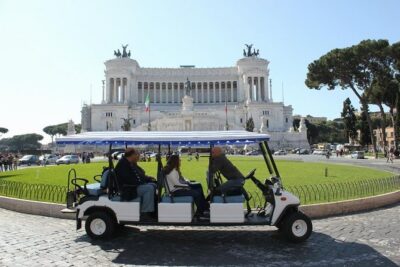
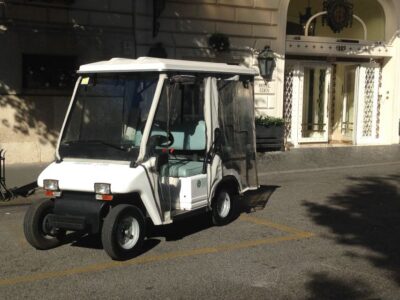
Rome on wheels is the fast way to get your bearings. This private 3-hour golf cart (or eFiat) ride hits the biggest sights while steering you through quieter backstreets that help you dodge traffic. You also get the “wait, that’s why it matters” factor from an English-speaking driver who keeps the story moving without turning it into a lecture.
My favorite part is how much ground you cover without feeling crushed by walking. You also get easy pacing: brief stops at the top photo spots and enough context to understand what you’re seeing, including big landmarks like the Pantheon and Piazza Navona. One possible drawback: the timing is tight at some iconic stops, so if you want long, unhurried museum-style time inside buildings, you may still need a separate visit.
In This Review
- Key takeaways
- Why riding a golf cart through Rome’s backstreets works
- Price, time, and what you actually get for $163.26
- Hotel pickup: the difference between starting relaxed and starting stressed
- Pantheon (free) in 15 minutes: how to use the time well
- Piazza Navona (free, 15 minutes): baroque energy you can actually see
- Trevi Fountain (free, 10 minutes): the classic stop, without the classic time sink
- Spanish Steps + Campo de’ Fiori: two different moods, two short stops
- Villa Borghese + Palatine Hill: when the cart turns viewpoints into a story
- Circo Massimo (free) + the Aventine Hill: ancient venues in plain sight
- Piazza del Popolo (free, 5 minutes): city angles at the northern gate
- Chiesa di Sant’Ignazio di Loyola (free, 5 minutes): Baroque details you can actually notice
- Comfort on cobblestones: what to expect from the ride itself
- Best use of your 3 hours: plan your follow-up day
- Who this tour suits best (and who might want a different format)
- Should you book this Rome Golf Cart Tour?
- FAQ
- How long is the Rome Golf Cart Tour?
- What does the tour cost?
- Do I need to speak Italian for this tour?
- Is hotel pickup included?
- Are entrance tickets included?
- Is this tour private?
- What’s the cancellation timeline?
- Is the activity suitable for most people, and can I bring a service animal?
Key takeaways
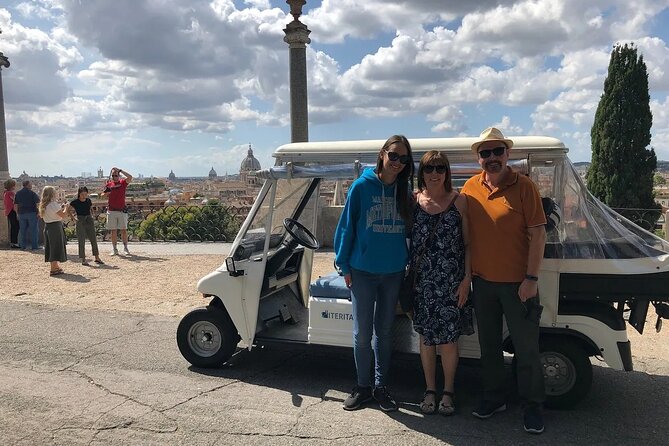
- Private cart touring means only your group rides together for a more relaxed pace.
- Hotel pickup in central Rome helps you start smoothly, with a clear pickup plan if you’re not staying downtown.
- Short, strategic photo windows keep the tour moving, especially at the Pantheon, Navona, Trevi, Spanish Steps, and Campo de’ Fiori.
- Backstreet routes aim to reduce traffic hassle and make the ride feel smoother than hopping between sights on foot.
- English-speaking drivers bring the history to life and often help with practical suggestions on what to do next.
Why riding a golf cart through Rome’s backstreets works
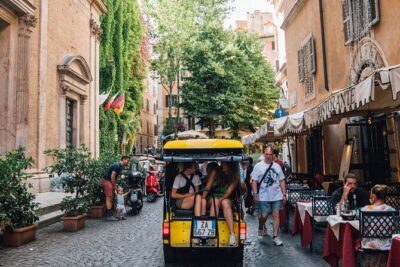
Rome is gorgeous, but it’s also… a lot. Streets are narrow, traffic is real, and walking between major sights can eat up your day faster than you expect. This tour solves that problem with a 3-hour loop that keeps you moving while you still get real views, not just a bus window.
The golf cart (or eFiat) is also a sanity saver if you’re traveling with kids, have limited stamina, or simply want to spend your energy on photos, viewpoints, and gelato instead of long uphill treks. Plus, being in a small private group changes the vibe: you’re not trying to listen over crowds, and you can ask questions without feeling like you’re interrupting a school field trip.
And here’s the best part: the route is designed to take you through quieter side streets. That means you get glimpses of how the city actually feels in between the famous stops.
Cover more ground by golf cart
- Rome by Golf Cart Private Tour: Beyond the Landmarks
★ 5.0 · 4,361 reviews - Rome on a Golf Cart Semi-Private Tour Max 6 with Private Option
★ 5.0 · 2,502 reviews - Rome: Golf Cart Tour with Artisanal Gelato Tasting
★ 4.8 · 1,396 reviews - Rome Highlights City Tour by Golf Cart with Gelato
★ 5.0 · 1,088 reviews
Price, time, and what you actually get for $163.26
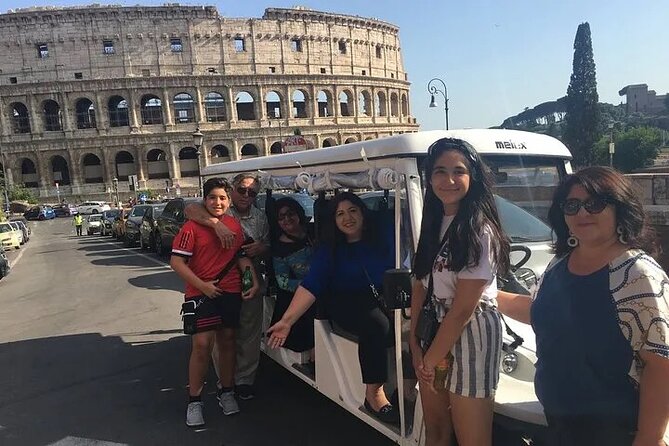
At about $163.26 per person for roughly 3 hours, this isn’t a bargain-basement deal. But it can still be good value for the right traveler—because you’re paying for three things at once: transportation around central Rome, a guided route, and a format that compresses a lot of landmarks into one efficient outing.
One thing to keep clear in your head: entry tickets aren’t included. That said, many of the key stops on the route are listed as admission free (for example, the Pantheon, Piazza Navona, Trevi Fountain, and the Spanish Steps). So for the core sights, you may not need to buy extra tickets just to enjoy the stop. If you want special timed entry or paid access to particular areas beyond what’s included in the general stop, that’s on you.
Also, duration matters. Three hours sounds short until you try to connect these places on foot. This tour is built for “first-time Rome” energy: get the layout, hit the icons, and leave with a mental map for the rest of your trip.
Hotel pickup: the difference between starting relaxed and starting stressed
A big selling point here is the pickup plan. You can be picked up from your central Rome hotel, and the tour is run in English. That alone can save you time and hassle, especially if you’re dealing with luggage, jet lag, or the challenge of finding the right meeting point.
If you’re not staying in Rome center, you’re asked to contact the provider so they can potentially arrange a private car. Translation: they’re trying to make this work even if your hotel isn’t conveniently located for a shared-style pickup.
If you prefer to start from the meeting point instead, the tour starts at Pic Nic – Just Amir srl on Piazzale delle Canestre, SNC (near 00197 Roma). The tour ends back at the meeting point.
Pantheon (free) in 15 minutes: how to use the time well
The Pantheon is stop one, and it’s a smart way to start. You’ll arrive at a place that started as a Roman temple site and has been used as a Catholic church since 609 AD. That layered identity is part of the thrill: you’re standing in a building that survived centuries of changes.
You’ll have about 15 minutes here. That’s not long enough to do a slow, deep “study every detail” visit, but it is plenty of time to:
- Take a quick exterior and courtyard moment
- Look up and appreciate the dome proportions
- Step inside for the main interior view
Practical tip: when you get there, don’t race to photos. Spend the first minute just looking around so the big features register. Then go for the pictures once you know what to frame.
Worth a look next to this Rome booking:

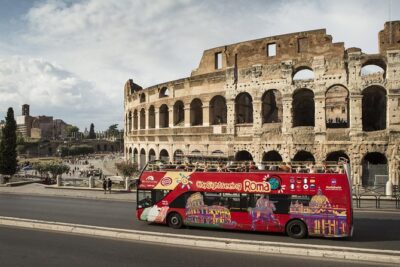

Piazza Navona (free, 15 minutes): baroque energy you can actually see
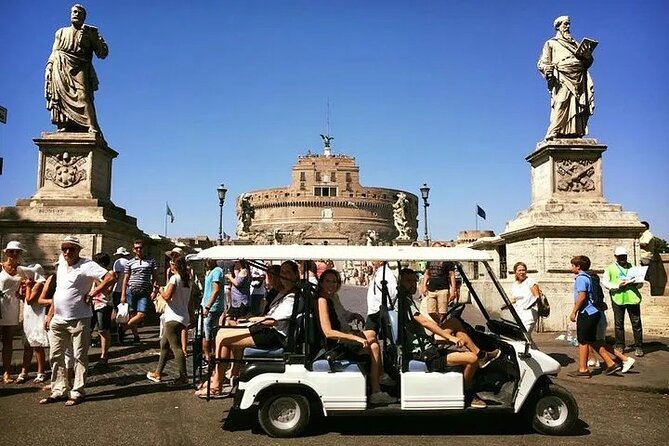
Next up is Piazza Navona, one of the most characteristic squares in baroque Rome. The square sits on top of the old Stadium of Domitian, so it’s one of those places where the modern scene overlaps with the ancient footprint.
You’ll get about 15 minutes. Use it like this:
- Walk the perimeter rather than standing still in the middle
- Pause long enough to see the square’s layout from multiple angles
- Take advantage of quick photo opportunities before the tour moves on
The stop is short, so you don’t want to spend all your time fighting for the perfect “only me in the frame” picture. Let the square do its job: it’s dramatic, and the atmosphere is the point.
Trevi Fountain (free, 10 minutes): the classic stop, without the classic time sink
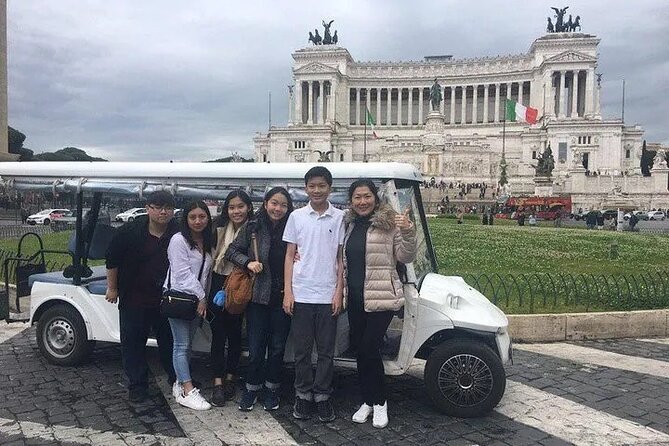
Trevi Fountain is famous for a reason, but the crowds can turn a simple stop into a time-waster. Here you get about 10 minutes, which is a realistic way to enjoy it without letting it swallow your tour.
The fountain you’ll see is an 18th-century design attributed to architect Nicola Salvi, with completion work involving Giuseppe Pannini and others. That’s your cue to look beyond the postcard angle. Even in a short stop, try to notice:
- The overall sculptural composition
- The central storytelling elements around the basin
- The architectural symmetry that makes it feel stage-like
Since your time is limited, choose one primary photo spot and one “walk-up” viewpoint. Then enjoy the rest of your minutes just watching the flow of the square.
Spanish Steps + Campo de’ Fiori: two different moods, two short stops
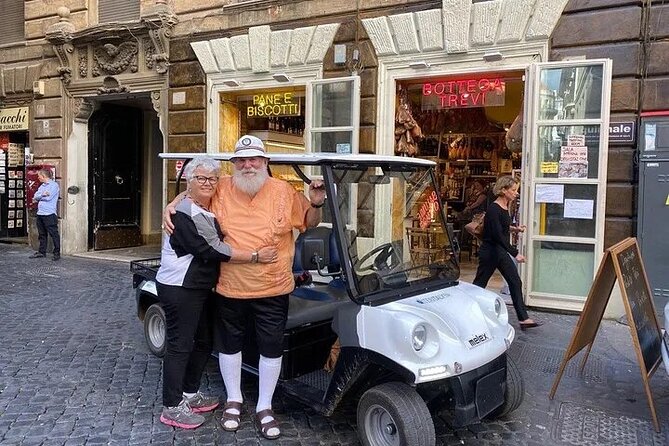
The Spanish Steps are next, with about 5 minutes on the schedule. You’ll see the climb between Piazza di Spagna and Piazza Trinità dei Monti. It’s steep, it’s iconic, and it’s exactly the kind of place where a quick stop can still feel complete if you know what you want.
For Spanish Steps time, I’d focus on the base view first, then decide whether to angle yourself for stairs-and-church framing. If you want a slower sit-down moment, treat this as the “orientation stop,” not your final visit.
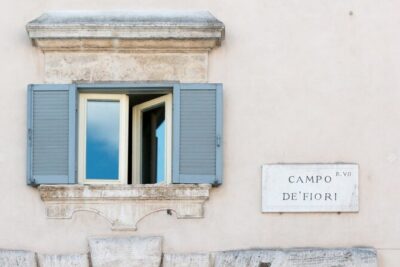
After that, you’ll roll into Campo de’ Fiori for about 5 minutes. This piazza is described as one of the souls of Rome, with color, sound, and energy. In the center you’ll find the statue of philosopher Giordano Bruno, burned alive in the piazza. That’s a heavy note under a lively setting, and it makes the stop more meaningful than just another street-corner snapshot.
Because both stops are short, the value is in context. If your driver is good at storytelling (the tour is run with English-speaking drivers), you’ll walk away with a clearer sense of why each place looks the way it does.
Villa Borghese + Palatine Hill: when the cart turns viewpoints into a story
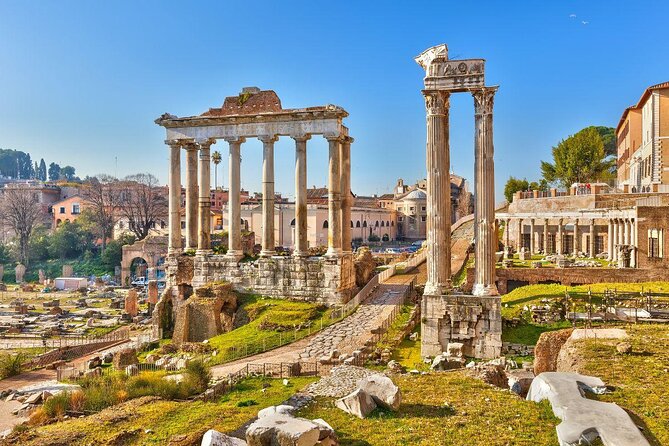
After the squares, the tour shifts toward Rome’s layers—parks, hills, and ancient anchors. Villa Borghese is a large public park area, and your stop there gives you a break from the dense city core. You’ll also be in the broader zone where museums and attractions sit within the garden environment.
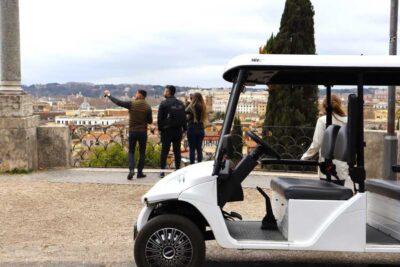
Then comes Palatine Hill. It’s one of the most ancient parts of Rome, often described as the first nucleus of the Roman Empire. This is where you start to feel how the city’s “center” has changed over time. On a cart, the big advantage is perspective: you can take in wider views and connect what you’re seeing to the ancient layout without trekking across multiple vantage points.
One note: since the schedule doesn’t specify exact minutes for these sections in the outline you’ll be using, expect a flexible, viewpoint-focused experience rather than a museum-like deep visit. If you love reading stones and want longer time on the ground, save that for a separate day with timed access.
Circo Massimo (free) + the Aventine Hill: ancient venues in plain sight
Circo Massimo is one of those names that sounds like a history quiz until you see it. This was an ancient chariot-racing stadium and major entertainment venue. It was the first and largest of its kind in ancient Rome, and it later continued as a massive imperial venue too.
Your schedule lists about 5 minutes for Circo Massimo. That’s short, but it works because the space is open. You’ll be able to get the shape of the site quickly, especially if your driver points out what to look for so you aren’t just staring at flat ground.
Next is the Aventine Hill, one of Rome’s Seven Hills. You’ll learn it belongs to Ripa, in the modern ward system. Even if you don’t know the Roman hill geography yet, this stop helps you build a mental map: Rome isn’t one “thing.” It’s hills, neighborhoods, and shifting centers.
Piazza del Popolo (free, 5 minutes): city angles at the northern gate
Piazza del Popolo is your next quick stop, around 5 minutes. It’s located inside the northern gate once called Porta Flaminia. The meaning—people’s square—also hints at why this spot matters: it’s not just royal symbolism. It’s connected to public life at a major entry point.
This stop is ideal for a quick reset. Take a breath. Get one clean wide photo. Then you’re off again while the tour maintains momentum.
Chiesa di Sant’Ignazio di Loyola (free, 5 minutes): Baroque details you can actually notice
The last listed stop is Chiesa di Sant’Ignazio di Loyola, with about 5 minutes. This is a church built on a design by the Jesuit mathematician Orazio Grassi, using plans associated with Carlo Maderno and others. The facade details are described as inspired by the nearby church of Gesù.
In a short visit, you won’t “finish” a church the way you might on a standalone day. But you can still catch what makes it special:
- Look at the facade structure
- Notice how elements are layered (columns, pilasters, and windows)
- Spend 60 seconds inside if the entry is open during your stop window
This is one of the stops where a good driver really helps. When the guide explains what to look for, you leave with real visual memory—not just a stamp photo.
Comfort on cobblestones: what to expect from the ride itself
Rome cobblestones are no joke. Even with the cart, the ride can feel bumpy at times. That’s normal here. The upside is that you’re still seated and moving—so you’re not doing “standing on one leg while you guess where the next step is” all day.
A seatbelt detail matters too. One rider specifically called out that seatbelts were present, and that’s the kind of small detail that changes how relaxed the ride feels.
Weather also plays into the experience. Even on a rainy day, the tour can still work well, since you’re not just standing in the elements between distant stops.
If you get motion-sensitive, consider planning for it like you would with any short vehicle tour: keep your phone secured and expect some jostling on rougher sections.
Best use of your 3 hours: plan your follow-up day
This tour is great for orientation. You see a concentrated sample of Rome’s big icons plus less obvious anchors like the hills and Circo Massimo area. When you’re done, you’ll know what you actually want to revisit.
Here’s what I’d do right after, while the route is fresh:
- Pick one stop you want to return to for longer time (Pantheon, Trevi, or a hill viewpoint)
- Use Piazza Navona and Campo de’ Fiori as reference points for where you want to wander next
- If you’re eating nearby, treat your driver as a source for suggestions on where to go next—multiple guides on past tours have offered dinner and lunch ideas
One small strategy: don’t schedule a “must-do” museum far across town right after your cart tour. Let the day breathe so you can actually enjoy what you just learned.
Who this tour suits best (and who might want a different format)
This cart tour is a strong fit if:
- You’re in Rome for the first time and want the fastest path to a mental map
- You prefer less walking and more seeing
- You’re traveling as a couple, family, or group and want a private ride
- You want to enjoy the highlights without spending all day in transit
It might be less ideal if:
- You want extended time inside major sites as part of the main plan
- You hate tight schedules and want a slow, long-form tour feel
- You’re expecting an everything-you-can-do ticket bundle (entry tickets aren’t included)
A final note on guides: this experience is run by English-speaking drivers, and names like Francesco, Yvonna, Hadi, Mario, Alexxis, Claudio, Pietro, Ivanka, Alessi, and Sabrina show up in people’s praise. You may not get any one of those specific drivers, but the consistent theme is that the guides focus on making the route understandable and enjoyable.
Should you book this Rome Golf Cart Tour?
If you want to see Rome’s top sights in a way that feels efficient, comfortable, and easy to manage, I think this is a smart booking. The private format plus hotel pickup in central Rome helps you lose less time to logistics, and the quick stop structure keeps you from burning your whole day waiting in crowds or walking uphill between famous landmarks.
Book it if your goal is to get oriented and come away knowing exactly which areas you want to revisit on your own. Consider skipping (or pairing with another plan) if you expect long stays inside major attractions as part of the same outing. In Rome, that’s usually a separate day.
FAQ
How long is the Rome Golf Cart Tour?
It runs for about 3 hours.
What does the tour cost?
The price is listed as $163.26 per person.
Do I need to speak Italian for this tour?
No. The tour is offered in English, and it includes an English-speaking driver.
Is hotel pickup included?
Yes, hotel pickup is offered if you’re in central Rome for a private experience. If you’re not in Rome center, you’re asked to contact the provider to see if a private car can be arranged.
Are entrance tickets included?
Entry tickets are not included. Many stops are listed as admission free, but if you want paid access beyond what’s included, you’ll need tickets separately.
Is this tour private?
Yes. It’s listed as a private tour/activity, so only your group participates.
What’s the cancellation timeline?
You can cancel for a full refund up to 24 hours in advance. If you cancel less than 24 hours before the start time, the amount paid is not refunded.
Is the activity suitable for most people, and can I bring a service animal?
The tour notes that most travelers can participate, and service animals are allowed.
More Tours in Rome
- Vatican Museums, Sistine Chapel & St. Peter’s Basilica Tour
★ 4.3 · 73,970 reviews - Vatican Museums, Sistine Chapel & St Peter’s Basilica Guided Tour
★ 4.5 · 39,149 reviews - Rome: Colosseum, Palatine Hill and Roman Forum Guided Tour
★ 4.8 · 32,814 reviews - Rome: Guided Tour of Colosseum, Roman Forum & Palatine Hill
★ 4.7 · 27,897 reviews - Rome: Colosseum, Roman Forum and Palatine Hill Guided Tour
★ 4.5 · 23,903 reviews - Rome: Colosseum Arena Floor, Palatine & Forum Guided Tour
★ 4.5 · 20,180 reviews
More Tour Reviews in Rome
- Vatican Museums, Sistine Chapel & St. Peter’s Basilica Tour
★ 4.3 · 73,970 reviews - Vatican Museums, Sistine Chapel & St Peter’s Basilica Guided Tour
★ 4.5 · 39,149 reviews - Rome: Colosseum, Palatine Hill and Roman Forum Guided Tour
★ 4.8 · 32,814 reviews - Rome: Guided Tour of Colosseum, Roman Forum & Palatine Hill
★ 4.7 · 27,897 reviews - Rome: Colosseum & Forum with Audio Guide App -Optional Arena
★ 4.2 · 24,770 reviews - Rome: Colosseum, Roman Forum and Palatine Hill Guided Tour
★ 4.5 · 23,903 reviews
More Golf Cart Rides
- Rome by Golf Cart Private Tour: Beyond the Landmarks
★ 5.0 · 4,361 reviews - Rome on a Golf Cart Semi-Private Tour Max 6 with Private Option
★ 5.0 · 2,502 reviews - Rome Highlights by Golf Cart Private Tour
★ 5.0 · 2,379 reviews - Rome: Golf Cart Tour with Artisanal Gelato Tasting
★ 4.8 · 1,396 reviews - Rome Highlights City Tour by Golf Cart with Gelato
★ 5.0 · 1,088 reviews - Rome: Imperial City Tour by Golf Cart with Optional Transfer
★ 4.8 · 1,024 reviews
Just added to our Rome reviews


Rome Golf Cart Tours, compared.
 ★ 5.0Rome by Golf Cart Private Tour: Beyond the LandmarksFrom $1804,361 reviews
 ★ 5.0Rome on a Golf Cart Semi-Private Tour Max 6 with Private OptionFrom $1682,502 reviews
 ★ 5.0Rome Highlights by Golf Cart Private TourFrom $1632,379 reviews
 ★ 4.8Golf Cart Tour with Artisanal Gelato TastingFrom $451,396 reviews
 ★ 5.0Rome Highlights City Tour by Golf Cart with GelatoFrom $1071,088 reviews
 ★ 4.8Imperial City Tour by Golf Cart with Optional TransferFrom $1241,024 reviews
 ★ 5.0Golf Cart Small-Group Guided Tour: Rome City HighlightsFrom $104907 reviews
 ★ 4.8City Highlights Golf Cart TourFrom $45857 reviews
Browse the lists this tour appears in