
Reviewed · ROME GOLF CART TOURS
Tour of Rome in Golf Cart: Squares and Fountains of Rome
Rome from a golf cart beats the usual slog. This Squares and Fountains route gives you quick hop-off time at big-name sights, without the walking grind, and the group stays small with a max of 15.
I also like that the guide is part driver, part storyteller—so you don’t just coast past Rome, you get context at each stop. The main trade-off: the schedule is tight, and from the back of the cart you can struggle to hear the guide clearly.
In This Review
- Key Highlights to Notice Before You Ride
- Why This Rome Golf Cart Tour Feels Like the Smart Shortcut
- Via dei Condotti: Starting on the Luxury Street (and Getting Your Bearings)
- Pantheon Stop: A Quick Look at a Dome That Still Feels Impossible
- Jewish Ghetto of Rome: Narrow Streets, Synagogues, and Living Neighborhood
- Campo de’ Fiori: Market Square by Day, Social Spot by Night
- Piazza Navona and the Fountains Moment: Baroque Drama Up Close
- Trevi Fountain: Famous for a Reason (But Plan for the Crowd)
- Piazza Venezia / Ancient City: Where Big Monuments and Rome’s Crossroads Meet
- Via Sistina and Trinità dei Monti: A Softer Rome Moment After the Icons
- What the Best Guides Do (and Why It Matters on a Short Tour)
- Value Check: Is $83.87 Worth It for Only 3 Hours?
- Booking Decision: Who This Tour Fits Best
- FAQ
- How long is the golf cart tour?
- Where does the tour start and end?
- Is hotel pickup available?
- Is the Pantheon admission included?
- Does the tour include bottled water?
- What language is the tour in?
- How big is the group?
- FAQ
- Does the tour use a mobile ticket?
- Is free cancellation available?
- Are there multiple start times?
Key Highlights to Notice Before You Ride
- Guide-driver setup means you get explanations while you’re moving, not only when you park.
- Short, timed stops (about 20 minutes at most sites) are perfect for getting oriented fast.
- Pantheon is a quick visit and its admission is not included.
- Trevi Fountain and Piazza Navona give you classic photo landmarks plus water-and-statues details.
- Jewish Ghetto + Campo de’ Fiori add neighborhoods you might not hit on a fast highlights walk.
- Via dei Condotti start puts you in the fashion zone right away, near the Spanish Steps area.
Why This Rome Golf Cart Tour Feels Like the Smart Shortcut
If your Rome days are packed—or you just don’t want to spend half the morning squinting at directions—this style of tour can be a lifesaver. In roughly 3 hours, you cover a run of famous squares, fountains, and streets that are spread out enough to make normal walking tiring.
You also get a small-group vibe. With a maximum of 15 people, it’s easier to ask questions, and the guide can usually keep you moving without the feel of herding cats. One extra plus I like: the tour includes interactive reading material, which helps you connect what you’re seeing with the story behind it.
That said, the timing is the whole deal. Most stops are only around 20 minutes, so it works best when you want a solid overview and photos—then you follow up later on your own. If you’re the type who wants to linger until the next century, you may feel rushed.
Cover more ground by golf cart
- Rome by Golf Cart Private Tour: Beyond the Landmarks
★ 5.0 · 4,361 reviews - Rome on a Golf Cart Semi-Private Tour Max 6 with Private Option
★ 5.0 · 2,502 reviews - Rome: Golf Cart Tour with Artisanal Gelato Tasting
★ 4.8 · 1,396 reviews - Rome Highlights City Tour by Golf Cart with Gelato
★ 5.0 · 1,088 reviews
Via dei Condotti: Starting on the Luxury Street (and Getting Your Bearings)
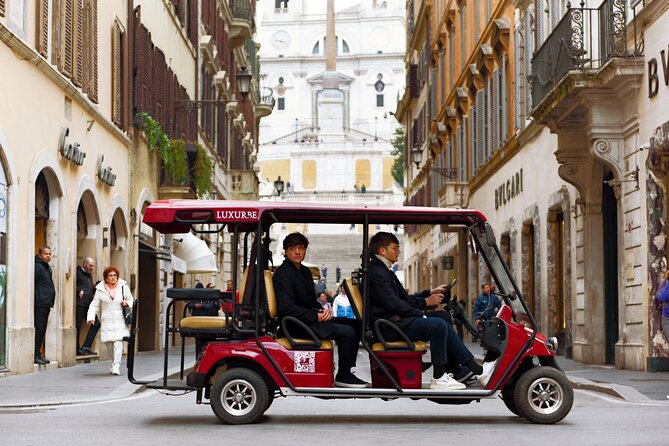
The tour begins on Via dei Condotti (61, 00187 Roma RM), one of Rome’s most iconic shopping streets. Expect cobblestones, elegant historic building lines, and the kind of atmosphere that makes you glance at storefronts even if you’re not buying anything.
This is also a clever starting spot because it puts you near key landmarks—especially the Spanish Steps area, which sits at the lower end of Via dei Condotti. You’re basically starting your Rome intro in the “recognizable map” zone, which helps the rest of the tour snap into place.
Practical note: the meeting point is right in front of the entrance at the address, and your driver comes to you. There’s said to be no Luxurbe sign at that specific spot, so look for the driver/golf cart instead of hunting for a storefront.
Pantheon Stop: A Quick Look at a Dome That Still Feels Impossible
Next up is the Pantheon, one of the most famous buildings in Rome—and one of the best examples of Roman building skill. The big visual payoff is the famous dome, plus the oculus opening that changes how the light falls inside. Even if you don’t go deep into Roman architecture, you’ll recognize why this place has stayed in use for centuries.
The visit is timed (about 20 minutes), and the important detail for planning is: Pantheon admission is not included. So bring or be ready to purchase what you need, and treat the stop like a focused exterior/interior check—rather than a long sit-down study.
One value point here: the tour format helps you see the Pantheon without turning your day into a scheduling puzzle. You’re not spending your entire morning trying to figure out timing and transport between scattered landmarks.
Jewish Ghetto of Rome: Narrow Streets, Synagogues, and Living Neighborhood
A stop near the Jewish Ghetto is one of the more meaningful parts of this route. The area was established in 1555, and it’s still a neighborhood you walk through—not a dead museum set. Expect narrow cobblestone streets and visible layers of the past mixed with daily life.
The tour includes time for you to experience key points at a human pace (about 20 minutes). It also points you toward what matters most here: the Great Synagogue and the Jewish Museum, which help explain the community’s long story and resilience.
This stop is a good reminder that Rome isn’t only domes and marble statues. It’s also real people, real communities, and a place where history shows up in the shape of streets.




Campo de’ Fiori: Market Square by Day, Social Spot by Night
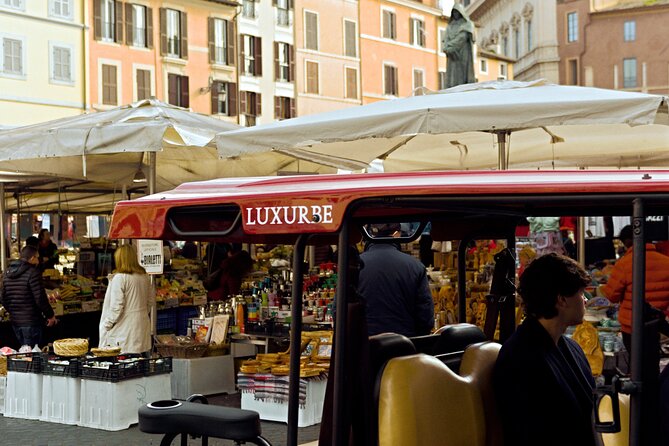
Then you hit Campo de’ Fiori, a square that’s famous for shifting moods. During the day it’s known for the market scene—produce, small vendors, and locals doing their routine. When evening arrives, the whole place tends to flip into a social hangout with cafes around the edges.
The tour gives you about 20 minutes here, and that’s enough to do the basics: get the layout, spot the central Giordano Bruno statue, and take in how the square works from different angles.
If you like Rome where life happens right in front of you, this stop delivers. It also helps you understand Rome’s “square culture”—how these open spaces work as living rooms for the city.
Piazza Navona and the Fountains Moment: Baroque Drama Up Close
From Campo de’ Fiori, you roll to Piazza Navona, famous for its Baroque elegance. What makes it stand out is the mix of architecture and water features, especially Fontana dei Quattro Fiumi.
You’ll get about 20 minutes, which means you won’t have time to do a slow, foot-by-foot study. But you will get the “feel” of it: cafes, the square geometry, and that fountain presence that turns the space into a centerpiece.
If you’ve only seen Piazza Navona in photos, you’ll likely notice something on-site: it’s not just pretty. The space is set up to make you linger—people flow around the fountain, and it’s easy to catch great angles without needing a specific photo mission.
Trevi Fountain: Famous for a Reason (But Plan for the Crowd)
No Rome “squares and fountains” tour is complete without the Trevi Fountain. This one is basically a Baroque showpiece in stone: mythological sculpture details around the fountain’s structure, plus that iconic sweeping centerpiece with Neptune’s chariot.
The tour keeps it simple—about 20 minutes—and it’s best used for photos and a quick, satisfying look at the details. The fountain’s “ritual” part is part of what makes it famous; the tour description notes people toss coins and make wishes, and you’ll see plenty of that in person.
Do keep expectations realistic. Trevi gets busy. This stop is a “hit the landmark, get the photos, enjoy the sound of water” moment—not a quiet reflection stop.
Piazza Venezia / Ancient City: Where Big Monuments and Rome’s Crossroads Meet
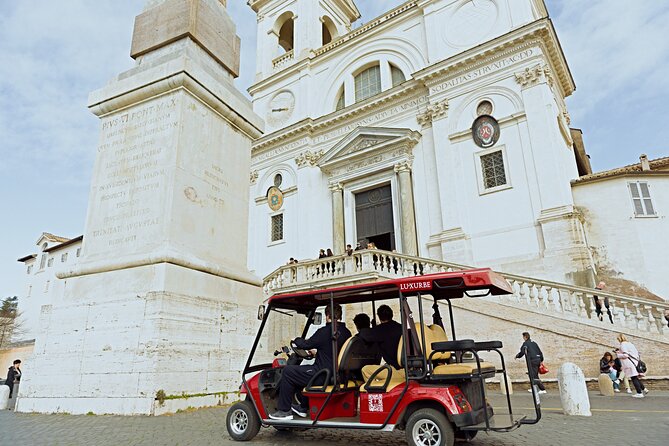
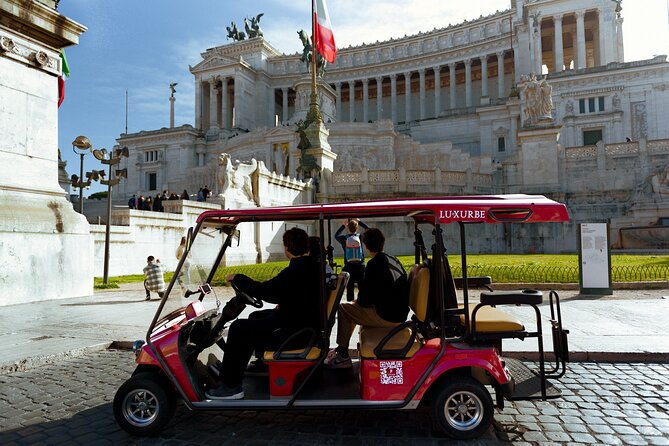
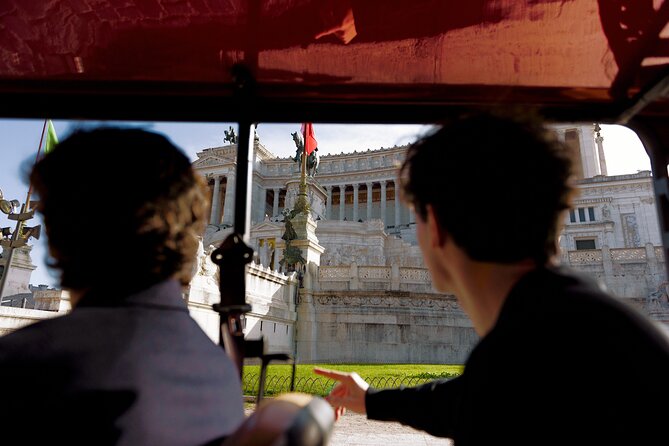
Next is Piazza Venezia, anchored by the monumental Altare della Patria (Vittoriano). This area feels like a crossroads of Rome—ancient layers nearby, modern national symbolism under your feet, and a lot of street energy around the edges.
Your time here is about 20 minutes, enough to appreciate the scale and understand why it’s such a key hub. The surrounding historic structures—like Palazzo Venezia—help frame the square as more than just a traffic magnet.
If you want a quick “big picture” moment in the middle of the tour, this is it. It also sets you up for the later street stops, because you start to see how Rome’s landmarks connect in a real geography sense.
Via Sistina and Trinità dei Monti: A Softer Rome Moment After the Icons
After the big monuments, you get two smaller-feeling street stops that help the tour breathe.
Via Sistina links Piazza Trinità dei Monti and Piazza Barberini, with boutiques and cafes along the way. It’s a “walk-and-look” street even if you stay near the cart, because the buildings and storefront rhythm give you that classic Rome street vibe.
Then you reach Trinità dei Monti (another about 20 minutes). This is the kind of stop that works well if you like charming corners and viewpoints more than ticketed interiors. It also fits the theme of the day: squares, fountains, and the streets that connect them.
What the Best Guides Do (and Why It Matters on a Short Tour)
On short tours, the guide can make or break the experience. The strongest feedback I saw focused on guide-driver performance: people praised the way guides like Paolo, Matteo, Otto, Jimmy, Tony, Dennis, Francesco, and Jordan kept things engaging and offered practical direction—often including photo help and good food recommendations after the tour.
That’s not fluff. On a cart tour, you’re moving fast, and you’re always deciding whether a stop is “worth it for a few photos” or “skip it.” A good guide helps you decide in the moment, tells you what’s important to notice, and gives you just enough context to make the sight click.
One caution, based on reviews: hearing can be hard in the back. If you’re sensitive to that, choose your seat early, and don’t assume you’ll catch every word while the cart is rolling.
Value Check: Is $83.87 Worth It for Only 3 Hours?
At $83.87 per person for about 3 hours, this tour sits in the “spend a bit, save effort” category. Whether it’s a good deal depends on what you want from Rome.
Here’s the value math as I see it:
- You’re paying for transport in the center of Rome, plus a licensed guide and short timed stops.
- You’re not paying for Pantheon admission (so your final cost may be higher if you visit).
- Bottled water is not included, so plan to grab water separately if you need it.
If you want maximum highlights with minimal planning, the price feels fair—especially for a first Rome day or when you only have two days and need an overview. If you already have a tight walking plan and prefer long, unhurried time inside each site, you might find you’ll get less satisfaction from short stops.
Booking Decision: Who This Tour Fits Best
I’d book this tour if:
- you want a fast orientation to Rome’s famous squares and fountains
- you have mobility limits or you simply want to reduce walking
- you like the idea of photo stops with context, not a deep-dive lecture for hours
- you’re the kind of traveler who enjoys neighborhoods like the Jewish Ghetto and Campo de’ Fiori, not just the top postcard icons
I’d skip it (or pair it with other plans) if:
- you know you’ll need lots of time at the Pantheon or any stop and hate timed visits
- you really care about hearing every detail while moving (the back seat can be a challenge)
- you expect everything to be perfectly quiet and uncrowded at Trevi or Navona (those areas get busy)
If you’re on the fence, I’d treat this as your “get oriented and grab the photos” pass—then plan a second visit to the sights that really grab you.
FAQ
How long is the golf cart tour?
It’s about 3 hours (approx.), with about 20 minutes allocated at each main stop and remaining time for travel.
Where does the tour start and end?
The tour starts at Via dei Condotti, 61, 00187 Roma RM, Italy and ends back at the same meeting point.
Is hotel pickup available?
Yes. Pickup is offered, and there’s an option to upgrade for hotel pickup.
Is the Pantheon admission included?
No. Pantheon admission ticket is not included.
Does the tour include bottled water?
No. Bottled water is not included.
What language is the tour in?
The tour is offered in English.
How big is the group?
The tour has a maximum of 15 travelers.
FAQ
Does the tour use a mobile ticket?
Yes. It’s listed as having a mobile ticket.
Is free cancellation available?
Yes. You can cancel up to 24 hours in advance for a full refund.
Are there multiple start times?
Yes. You can choose from multiple start times to fit your itinerary.
More Tours in Rome
- Vatican Museums, Sistine Chapel & St. Peter’s Basilica Tour
★ 4.3 · 73,970 reviews - Vatican Museums, Sistine Chapel & St Peter’s Basilica Guided Tour
★ 4.5 · 39,149 reviews - Rome: Colosseum, Palatine Hill and Roman Forum Guided Tour
★ 4.8 · 32,814 reviews - Rome: Guided Tour of Colosseum, Roman Forum & Palatine Hill
★ 4.7 · 27,897 reviews - Rome: Colosseum, Roman Forum and Palatine Hill Guided Tour
★ 4.5 · 23,903 reviews - Rome: Colosseum Arena Floor, Palatine & Forum Guided Tour
★ 4.5 · 20,180 reviews
More Tour Reviews in Rome
- Vatican Museums, Sistine Chapel & St. Peter’s Basilica Tour
★ 4.3 · 73,970 reviews - Vatican Museums, Sistine Chapel & St Peter’s Basilica Guided Tour
★ 4.5 · 39,149 reviews - Rome: Colosseum, Palatine Hill and Roman Forum Guided Tour
★ 4.8 · 32,814 reviews - Rome: Guided Tour of Colosseum, Roman Forum & Palatine Hill
★ 4.7 · 27,897 reviews - Rome: Colosseum & Forum with Audio Guide App -Optional Arena
★ 4.2 · 24,770 reviews - Rome: Colosseum, Roman Forum and Palatine Hill Guided Tour
★ 4.5 · 23,903 reviews
More Golf Cart Rides
- Rome by Golf Cart Private Tour: Beyond the Landmarks
★ 5.0 · 4,361 reviews - Rome on a Golf Cart Semi-Private Tour Max 6 with Private Option
★ 5.0 · 2,502 reviews - Rome Highlights by Golf Cart Private Tour
★ 5.0 · 2,379 reviews - Rome: Golf Cart Tour with Artisanal Gelato Tasting
★ 4.8 · 1,396 reviews - Rome Highlights City Tour by Golf Cart with Gelato
★ 5.0 · 1,088 reviews - Rome: Imperial City Tour by Golf Cart with Optional Transfer
★ 4.8 · 1,024 reviews
Just added to our Rome reviews





Rome Golf Cart Tours, compared.
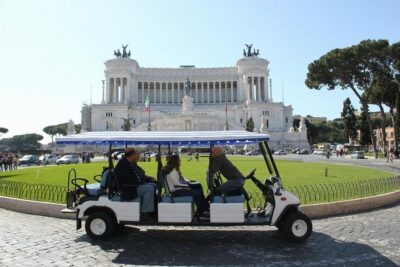 ★ 5.0Rome by Golf Cart Private Tour: Beyond the LandmarksFrom $1804,361 reviews
 ★ 5.0Rome on a Golf Cart Semi-Private Tour Max 6 with Private OptionFrom $1682,502 reviews
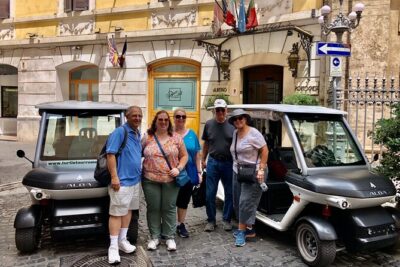 ★ 5.0Rome Highlights by Golf Cart Private TourFrom $1632,379 reviews
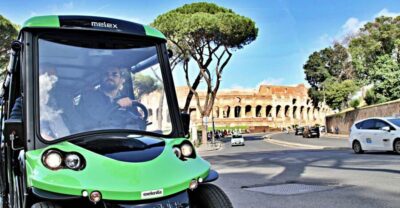 ★ 4.8Golf Cart Tour with Artisanal Gelato TastingFrom $451,396 reviews
 ★ 5.0Rome Highlights City Tour by Golf Cart with GelatoFrom $1071,088 reviews
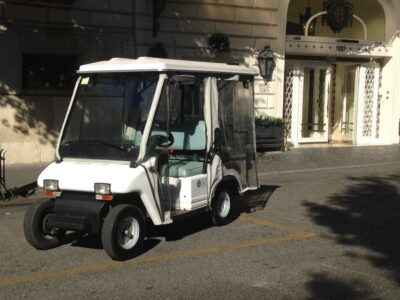 ★ 4.8Imperial City Tour by Golf Cart with Optional TransferFrom $1241,024 reviews
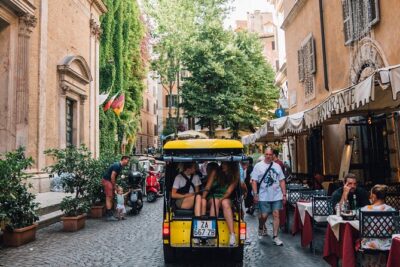 ★ 5.0Golf Cart Small-Group Guided Tour: Rome City HighlightsFrom $104907 reviews
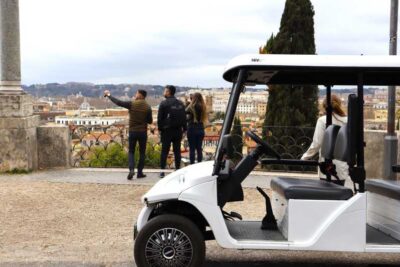 ★ 4.8City Highlights Golf Cart TourFrom $45857 reviews
Browse the lists this tour appears in