
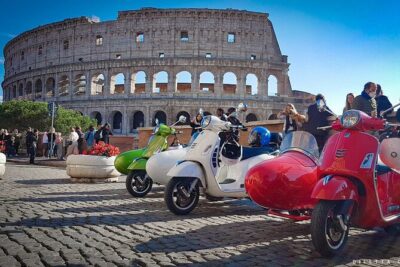
Vespas make Rome feel like a movie. This Rome Vespa round strings together classic ancient stops, with a real Colosseum photo moment and multiple lookouts that put the Vatican in your sights. You’ll cover hills and districts that feel hard to reach on foot in one day.
I especially like the included helmet and the simple, practical phone photo setup at the sights. The ride is paced for sightseeing, not for long waits, and it runs with a small group of up to 8.
One thing to consider: the time at each landmark is short. If you want long museum-style exploring, this isn’t built for that, and the tour needs good weather to run.
In This Review
- Key Points at a Glance
- Why This Rome Vespa Round Works in 90 Minutes
- Small Group, Personal Driver, and Practical Time Management
- Colosseum Stop: A 10-Minute Photo Moment That Gets You Oriented
- Circo Massimo: Chariot-Racing Scale Without a Long Museum Detour
- Aventine Hill + Santa Sabina Basilica: A Quieter Side of Ancient Rome
- Giardino degli Aranci (Orange Garden): The Vatican View in 15 Minutes
- Trastevere Moment: Santa Maria in Trastevere and Local Streets
- Terrazza del Gianicolo: The Highest Hill View Close to Vatican Gardens
- Pantheon Wrap-Up: A 5-Minute Orientation Stop (Ticket Not Included)
- Price and Value: What $70 Buys You in Rome
- Tips for a Better Ride and Better Photos
- Who This Vespa Tour Fits Best (and Who Might Skip It)
- Should You Book This Rome Vespa Round?
- FAQ
- How long is the Rome Vespa Round?
- What does the tour include?
- Is admission included for all the sights?
- How big is the group?
- What language is the tour offered in?
- Where do I meet and where does it end?
- Can I cancel for free?
Key Points at a Glance
- Colosseum photo stop in 10 minutes: quick views, quick info, photos with the Vespas.
- Circo Massimo big-open-space feeling: the arena that once held up to 250,000 spectators.
- Orange Garden for Vatican views: 15 minutes in one of Rome’s calmer viewpoints.
- Aventine Hill + Santa Sabina: you get a quieter, older side of the city by the ride route.
- Gianicolo Hill viewpoint: 15 minutes from Rome’s highest hill near Vatican Gardens.
- Pantheon wrap-up: a short 5-minute stop where you’ll get orientation; entry isn’t included.
Why This Rome Vespa Round Works in 90 Minutes
Rome has a way of eating your time. Between walking distance, ticket lines, and getting from one side of town to the other, a “quick look” can turn into a long day fast. This tour’s value is that it uses a Vespa ride to move you between major landmarks and viewpoints without turning your day into a marathon.
The rhythm is simple: you park the scooter for brief landmark moments, then roll on to the next area. You get the big-picture orientation (ancient Rome, what you’re looking at, why it matters) but you’re not stuck spending hours in one spot. At around 1 hour 30 minutes, it’s a great fit when you only have a few days and want the city to feel vivid.
More of Rome from the sidecar
- Vespa Sidecar Tour By Night with Pickup
★ 5.0 · 1,803 reviews - Rome Morning Vespa Sidecar Tour in Rome with Cappuccino
★ 5.0 · 1,771 reviews - Rome: Explore the City by Vespa with an Optional Photoshoot
★ 5.0 · 1,103 reviews - Rome Vespa Scooter Tour with Professional Photographer
★ 5.0 · 857 reviews
Small Group, Personal Driver, and Practical Time Management
This is a max 8 people experience, which matters more than it sounds. Small groups keep stops manageable and help you actually see what you came for instead of getting swept into the edges of a crowd.
You also ride with a personal driver, so you’re not trying to navigate narrow streets or figure out where parking would even make sense. Helmets are included, which keeps the whole thing comfortable and straightforward. And there’s a built-in history explanation that stays focused on what you’re seeing right now—useful when you’re trying to connect Colosseum, circus arenas, and religious Rome into one mental map.
There’s a detail I really appreciate: admission is marked as free at some stops (like the Colosseum and Orange Garden), and the Pantheon portion is separate. That means you can plan your day without surprises, as long as you understand what’s included and what isn’t.
Colosseum Stop: A 10-Minute Photo Moment That Gets You Oriented
The Colosseum portion is short on purpose: 10 minutes close to the Colosseum so you can take in the view, get the key facts, and get photos with the Vespas. That’s the right length for people who want the classic postcard image, but also want more than just standing there and guessing where entrances and viewpoints are.
The practical advantage here is that you’re not committing to a full-immersion day. You’re doing a quick “first chapter” visit—enough context to make your later exploring (on your own) far more meaningful.
A minor consideration: 10 minutes passes quickly. If you’re the type who wants a long, slow look at architecture details, you might wish the stop were longer. Still, for most first-time visitors, it’s a smart way to get the Colosseum into your trip without derailing your schedule.
Circo Massimo: Chariot-Racing Scale Without a Long Museum Detour
Next comes Circo Massimo, the enormous stadium of ancient Rome. The tour framing here helps you understand what you’re looking at. It’s not treated like a random open space; it’s presented as the heart of major public events—chariot racing, festivals, and celebrations.
The way this stop is described makes it feel big even if you’re only there briefly. You get the sense of the arena’s scale—at one time it could hold 250,000 spectators—and you walk through enough of the area to picture what the crowd would have looked like.
This is one of those stops that works well with a Vespa day. You don’t have to drag yourself across the city to find it, and you get a strong contrast: after the Colosseum’s enclosed feel, Circo Massimo’s open space and views help you see Rome in a different shape.
Worth a look next to this Rome booking:


Aventine Hill + Santa Sabina Basilica: A Quieter Side of Ancient Rome
On the ride toward the viewpoints, you go through Aventine Hill, one of the Seven Hills of ancient Rome. This is where the tour becomes more than sightseeing checklist work. Aventine gets treated as part of a living story: it was historically the second settled hill of the city, and it has a calmer, more grounded feel than the headline attractions.
On the way, there’s a stop at Santa Sabina Basilica, described as one of the oldest and most important churches in Rome. That’s a great match for this kind of tour because you’re not trying to do a full church-hopping day. You’re getting a meaningful snapshot while the city is doing the work of moving you from place to place.
If you like Rome when it feels a bit less crowded, this segment is a win. Just know it’s still time-limited, so treat it as a focused pause rather than a deep dive into every chapel and detail.
Giardino degli Aranci (Orange Garden): The Vatican View in 15 Minutes
Now for the viewpoint people remember. Giardini degli aranci / Orange Garden gives you about 15 minutes to take in the Vatican view and the terrace outlook over Rome.
This garden is described as having once been the private space of the Savelli family and now being public. That matters because the setting feels calmer than the main attraction corridors. It’s the kind of stop that can make you slow down for a moment—especially if you’re traveling during hot months and you want a shaded break without losing sight of the big landmarks.
In a Vespa day, this is also a smart pacing move: you’ve been rolling and stopping, and then you get a slightly more still moment where you can actually look.
Trastevere Moment: Santa Maria in Trastevere and Local Streets
Between the major viewpoints, there’s time on the road and on foot in Trastevere, Rome’s older neighborhood vibe. The description emphasizes cobblestone streets, colorful buildings, and local life—plus the key church stop at Santa Maria in Trastevere.
What I like about this part is that it gives you contrast. After ancient monuments and viewpoints, Trastevere lets Rome feel everyday—markets, artisan shops, and the kind of trattoria atmosphere you’ll see when locals are out doing normal life.
One thing to keep in mind: Trastevere can feel very different depending on time of day. If you’re there when it’s lively, great. If it’s quieter, you’ll still get the historic atmosphere, just with a different energy.
Terrazza del Gianicolo: The Highest Hill View Close to Vatican Gardens
Then you climb to Gianicolo, which the tour notes as Rome’s highest hill. You get about 15 minutes at Terrazza del Gianicolo for skyline-level views.
This is also the stop that’s positioned as the closest hill viewpoint to Vatican City, with mention that you can see the Vatican Gardens from the hill. Even without going inside, this kind of sightline does something special: it makes the Vatican feel less like a distant landmark and more like a part of Rome’s everyday geography.
Because the stop is short, your best move is to decide what you want first. If you care about wide city views, stand where you can take in the horizon. If you care about the Vatican angle, orient yourself toward that side right away so you don’t lose your “best look” window.
Pantheon Wrap-Up: A 5-Minute Orientation Stop (Ticket Not Included)
The tour ends with a 5-minute look at the Pantheon and an introduction to what you’re seeing. The key detail here is practical: admission is not included.
That doesn’t make the stop pointless—it’s more like a quick orientation finish. You’ll learn what makes the Pantheon special and get shown around enough to understand the building’s place in the Roman world, which is helpful before you decide whether you want to go inside on your own time.
The tour concludes in front of the Pantheon at Piazza della Rotonda, which is convenient because it drops you exactly where you can keep walking, grab a meal nearby, or take more photos without needing a long transfer.
Price and Value: What $70 Buys You in Rome
At $70 per person for about 90 minutes, this isn’t a budget transfer service. It’s priced like an experience built around photos, a driver, and a tight route that hits major sights.
Here’s what makes the value feel real:
- You get included helmet and a phone photo experience (not just a quick selfie).
- You cover several zones of Rome without wasting your day figuring out transport.
- Admission is listed as free for the Colosseum and Orange Garden portions, which helps keep your spending predictable.
- The group stays small, so the time you pay for doesn’t disappear into chaos.
It’s also worth noting the booking demand: on average, this is booked around 42 days in advance. That’s usually a sign it sells at popular times. If Rome is busy during your dates, booking ahead isn’t just “nice,” it can be the difference between getting the time you want and settling for a less ideal slot.
Tips for a Better Ride and Better Photos
A few practical things will help you get more out of the experience:
- Wear comfortable shoes. You’ll step out for short viewpoint and landmark moments, including church stops.
- Keep your phone ready for the photo segment. The tour includes photos with your phone, so you’ll want to cooperate with the timing instead of fumbling with settings.
- Consider a sunset-style departure if available. One guide-specific tip from the experience vibe: doing it at sunset gets high praise, mainly because the views feel dramatic and the heat can be easier on your body.
- Manage expectations about time. Everything is short: 10 minutes, 15 minutes, 5 minutes. That’s the whole concept. You’re buying momentum and orientation, not slow, in-depth exploring.
If you’re sensitive to weather, pay attention too. The tour requires good weather, and if conditions aren’t right, you’ll be offered another date or a full refund. That’s a big deal for Rome planning because rain can turn a scooter day into a miserable one fast.
Who This Vespa Tour Fits Best (and Who Might Skip It)
This tour is a strong match if:
- you want an efficient Rome sampler in a limited time window
- you like seeing landmarks without spending hours managing logistics
- you want a fun, photo-friendly way to hit places like the Colosseum area, Vatican viewpoints, and the Pantheon zone
It may be less ideal if:
- you want long museum time or deep interior exploration at multiple stops
- you strongly prefer walking-only travel, with lots of time to linger at one place
Also note the physical limit: the tour lists a maximum weight requirement of 100 kg. If that’s relevant for you, double-check before you book.
Should You Book This Rome Vespa Round?
I’d book it if you’re trying to get the best mix of ancient Rome sights and Vatican-area views without turning your day into endless walking. The included helmet and photo component are nice, and the route makes sense for a first visit because it gives you orientation fast: Colosseum context, Circo Massimo scale, Aventine and Santa Sabina’s quieter side, Orange Garden views, Gianicolo’s hill angle, and a Pantheon finish.
Skip it or consider alternatives if you need long stop times at major monuments, or if you’re going at a time when weather is unpredictable and you hate changing plans.
If you do book, try to pick a departure time that gives you good light for photos, and go in knowing the stops are brief. Do that, and you’ll come away with the kind of Rome memories that feel immediate—like you rode through the city instead of just watching it.
FAQ
How long is the Rome Vespa Round?
It runs for about 1 hour 30 minutes.
What does the tour include?
Included are a helmet, photo with your phone, a personal driver, and brief history of Rome.
Is admission included for all the sights?
The tour information says admission is free for the Colosseum stop and for Giardino degli aranci (Orange Garden). Pantheon admission is not included.
How big is the group?
This experience has a maximum of 8 travelers.
What language is the tour offered in?
The tour is offered in English.
Where do I meet and where does it end?
You start at Via Cavour, 207, 00184 Roma RM, Italy and end at the Pantheon area (Piazza della Rotonda, 00186 Roma RM, Italy).
Can I cancel for free?
Yes. You can cancel up to 24 hours in advance for a full refund. If it’s canceled due to poor weather, you’ll be offered a different date or a full refund.
More City Tours in Rome
- Rome: City Sightseeing Hop-on Hop-off Bus with Audioguide
★ 4.0 · 16,045 reviews - Roma Pass: Official City Card with Transportation
★ 3.9 · 6,236 reviews - City Sightseeing Rome Hop-On Hop-Off Bus Tour
★ 3.5 · 5,446 reviews - Rome: Fettuccine Pasta Cooking Class in Rome’s City Center
★ 4.8 · 2,414 reviews - Rome: City Highlights Open-Top Bus Night Tour
★ 4.1 · 2,038 reviews - Rome City Small Group Bike Tour with quality Cannondale EBike
★ 5.0 · 1,380 reviews
More Tour Reviews in Rome
- Vatican Museums, Sistine Chapel & St. Peter’s Basilica Tour
★ 4.3 · 73,970 reviews - Vatican Museums, Sistine Chapel & St Peter’s Basilica Guided Tour
★ 4.5 · 39,149 reviews - Rome: Colosseum, Palatine Hill and Roman Forum Guided Tour
★ 4.8 · 32,814 reviews - Rome: Guided Tour of Colosseum, Roman Forum & Palatine Hill
★ 4.7 · 27,897 reviews - Rome: Colosseum & Forum with Audio Guide App -Optional Arena
★ 4.2 · 24,770 reviews - Rome: Colosseum, Roman Forum and Palatine Hill Guided Tour
★ 4.5 · 23,903 reviews
More Vespa Days in Rome
- Vespa Sidecar Tour By Night with Pickup
★ 5.0 · 1,803 reviews - Rome Morning Vespa Sidecar Tour in Rome with Cappuccino
★ 5.0 · 1,771 reviews - Rome: Explore the City by Vespa with an Optional Photoshoot
★ 5.0 · 1,103 reviews - Rome Vespa Scooter Tour with Professional Photographer
★ 5.0 · 857 reviews - Rome: Highlights Vespa Sidecar Tour with Coffee and Gelato
★ 4.9 · 747 reviews - Rome: Vespa Ride with Pictures and Sweet Tastings
★ 5.0 · 723 reviews
Just added to our Rome reviews





Rome Vespa Tours, compared.
 ★ 5.0Vespa Sidecar Tour By Night with PickupFrom $1461,803 reviews
 ★ 5.0Rome Morning Vespa Sidecar Tour in Rome with CappuccinoFrom $1631,771 reviews
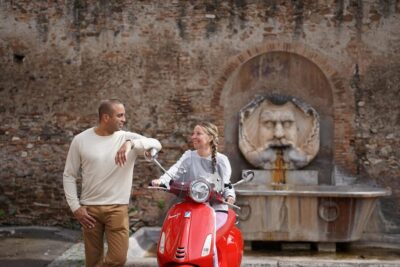 ★ 5.0Explore the City by Vespa with an Optional PhotoshootFrom $371,103 reviews
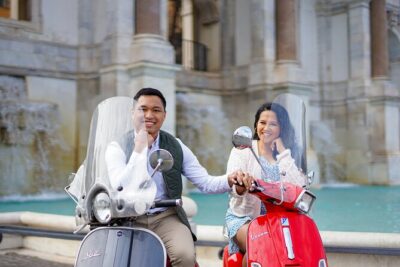 ★ 5.0Rome Vespa Scooter Tour with Professional PhotographerFrom $66857 reviews
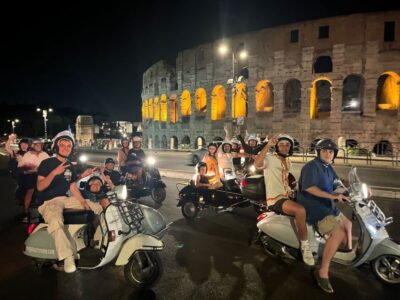 ★ 4.9Highlights Vespa Sidecar Tour with Coffee and GelatoFrom $141747 reviews
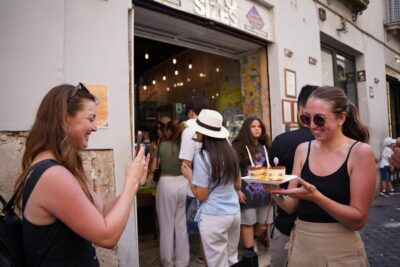 ★ 5.0Vespa Ride with Pictures and Sweet TastingsFrom $34723 reviews
 ★ 5.0Rome Afternoon Sightseeing Vespa Sidecar Tour with Gourmet GelatoFrom $163692 reviews
Pro Photoshoot include free transport with VESPAFrom $33501 reviews
Browse the lists this tour appears in