
Reviewed · ROME VESPA TOURS
Rome Morning Vespa Sidecar Tour in Rome with Cappuccino
First thing: Rome moves differently when you are riding. This 3-hour morning Vespa sidecar tour lets you sit back while a driver threads narrow streets, and it feeds you the story through English audio headsets as you roll past major sights. I like the mix of big landmarks and quick photo windows, and I love that breakfast is built in with a classic cappuccino and cornetto. One thing to consider: this experience depends on good weather, and it is not allowed for pregnant travelers.
You also get one of those rare combos in Rome: comfort (licensed guide, helmets, no driving or parking stress) plus serious sightseeing density. The group stays small, with a maximum of 12 people, so the ride feels more personal than a big bus shuffle. If you hate early mornings, you may feel it, since the start time is 9:00 am.
Here’s the deal: you will cover a lot on a Vespa sidecar, but you won’t get long museum-style time at every stop. That trade-off is part of the value. It is a smart way to get your bearings fast and leave you with a short list of what to explore in depth later.
In This Review
- Key highlights you actually feel on the ride
- Riding a Vespa sidecar through Rome: the fast, fun way to see the center
- Piazza della Repubblica start: morning fuel before you zoom off
- Headsets and live narration: how you keep up with the city
- Piazza della Repubblica to Palazzo del Quirinale: start with the big squares
- Quick consideration
- Trevi Fountain and the Pantheon: two stops where time matters
- Piazza Navona and St Peter’s Square: art and scale, delivered on the fly
- What you should expect
- Terrazza del Gianicolo and the Jewish Ghetto drive: where Rome gets quieter
- Piazza Venezia’s Altare della Patria and the Colosseum: the imperial wall-to-wall moment
- Quick reality check
- Santa Maria Maggiore: ending on a major basilica note
- Price and value: what you get for $163.26 in 3 hours
- Who this is perfect for, and who should skip it
- Practical tips before you go
- Should you book this Rome morning Vespa sidecar tour with cappuccino?
- FAQ
- How long is the Rome morning Vespa sidecar tour with cappuccino?
- Where does the tour start and what time does it begin?
- What’s included with the cappuccino?
- Is Pantheon entrance included?
- Do I need to drive or handle parking?
- What’s the group size limit?
- Can children ride, and who can sit where in the sidecar?
- What happens if the weather is poor?
Key highlights you actually feel on the ride
- No driving, no parking: you just sit tight while a professional driver handles traffic and turns.
- Live English narration in your headphones: the guide explains what you are seeing as you pass it.
- Breakfast is part of the tour, not a separate plan: cappuccino and a cornetto.
- Pantheon entrance included: you are paying less for one of Rome’s most popular stops.
- Small group size (max 12): less waiting, more time at the curb for photos and quick looks.
- Seat swapping can happen at stops (if you are sharing the vehicle): a practical fix for mixed bookings.
Riding a Vespa sidecar through Rome: the fast, fun way to see the center
If you’ve ever tried to see Rome by foot, you know the math: you spend more time routing yourself than looking at the city. This tour flips that. You are cruising at a pace where your eyes can actually enjoy the streets, the facades, and the sudden turns that reveal Rome’s landmarks.
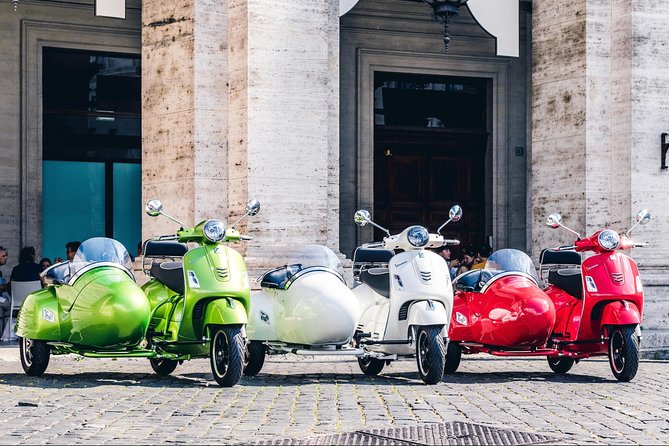
The sidecar setup is simple: one person rides in the sidecar, the other sits behind the driver. If you book one seat only, you will share the vehicle with another guest, and you may swap positions during stops so everyone can get time in the sidecar. That matters because the view and the feel of the ride can be different on each side.
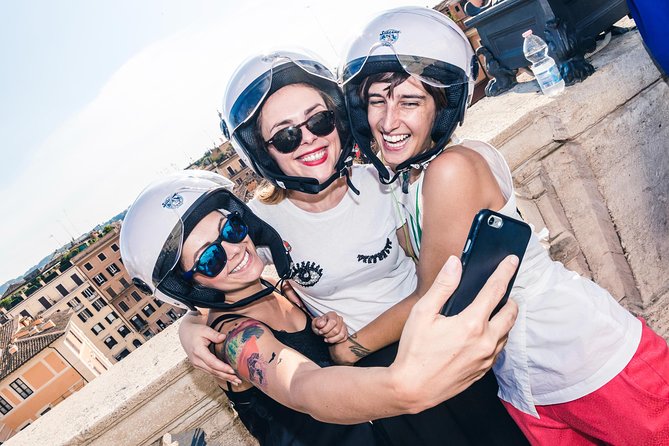
Safety is handled in the basic ways that count. You get homologated CE helmets, plus sterilized disposable head covers for hygiene. You also get headphones, so you aren’t constantly asking the guide to repeat things over engine noise.
Real talk: riding on a Vespa through busy areas is still “street travel,” not a smooth highway. Expect bumpy moments on uneven pavement and quick pauses at traffic lights. If you get car sick easily, consider whether a short, 3-hour ride might bother you.
More of Rome from the sidecar
- Vespa Sidecar Tour By Night with Pickup
★ 5.0 · 1,803 reviews - Rome Morning Vespa Sidecar Tour in Rome with Cappuccino
★ 5.0 · 1,771 reviews - Rome: Explore the City by Vespa with an Optional Photoshoot
★ 5.0 · 1,103 reviews - Rome Vespa Scooter Tour with Professional Photographer
★ 5.0 · 857 reviews
Piazza della Repubblica start: morning fuel before you zoom off
The meeting point is Piazza della Repubblica (41, 00185 Roma), and the tour starts at 9:00 am. That timing is great for sightseeing because you beat some crowds at key spots like the Pantheon area, and your brain is still awake for details.
Before the motor starts, you eat breakfast the Roman way: traditional cappuccino and a cornetto. This is not an afterthought snack. It’s timed so you’re ready to do the next few hours of standing near fountains and stretching your neck to look up at domes.
Why this matters: Rome is heavy on walking in the classic itineraries, and that can make you cranky. Here, the ride does the legwork, while breakfast keeps your energy up for the photo stops.
One small practical note: the tour is designed for a maximum group size of 12, so you’re not trapped in a long line during check-in-style moments. That can help the overall flow.
Headsets and live narration: how you keep up with the city
The tour uses a professional licensed guide with live commentary delivered through headphones. You’ll get clear narration throughout, which is a big deal in Rome. Many of the details are easy to miss if you are just scanning buildings from the street.
Headsets also change how you experience the day. Instead of stopping every few minutes to read a sign, you can keep your eyes on the scene. The guide helps you understand what you’re seeing, including why the places matter and what to look for when you get off the bike for a quick visit.
You may hear guides with different personalities, but the common thread seems to be enthusiasm plus clear explanations. In past experiences with this kind of team, names like Luca, Claudio, Matteo, Barbara, and Alessio come up. (You can’t count on a specific person, but you can expect the narration to be the centerpiece, not background noise.)
Piazza della Repubblica to Palazzo del Quirinale: start with the big squares
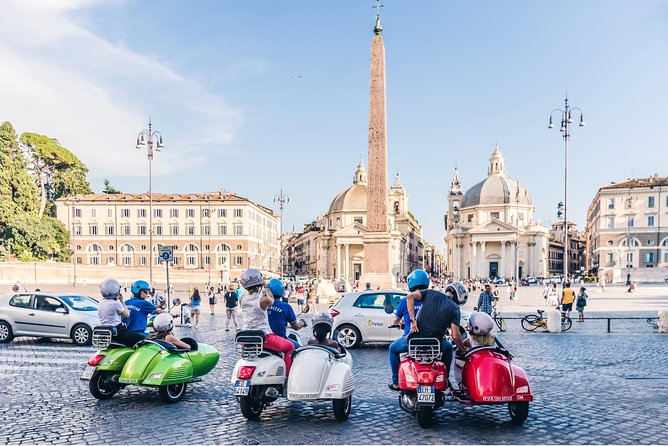
The tour begins with Piazza della Repubblica, a standout redevelopment-era square that feels more “grand plan” than old-world maze. Look for the large roundabout and the fountain, Fontana delle Naiadi. The scale is what gets you first, then the details in the surrounding buildings.
From there, you head toward Palazzo del Quirinale on Quirinal Hill. This is one of the official residences of the Italian President, and it sits in an area locals call Monte Cavallo. Even if you only spend a moment, it’s a good early stop because it gives you context for Rome beyond the postcard monuments.
What I like about starting here: you get variety right away. Instead of jumping straight to Trevi and Colosseum, you begin with Rome’s official and civic face, then you move into the religious and imperial highlights.
Worth a look next to this Rome booking:
Quick consideration
These early stops are short. If you want long interior visits, this tour isn’t trying to be that. It’s built for seeing the city’s major moments fast, then letting you choose what to return to later.
Trevi Fountain and the Pantheon: two stops where time matters
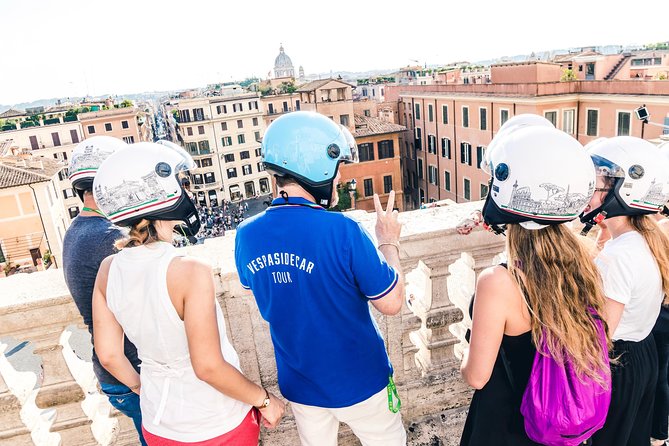
Trevi Fountain is on most lists for a reason, and this tour treats it like a true priority stop. You get around 30 minutes here, which is enough time to photograph the fountain from good angles and still walk around to take in the design.
Trevi’s scale is the shock. It measures about 20 meters wide and 26 meters tall, and it sits at the end of the Aqua Virgo aqueduct. The area is also tied to the “Tre Vie” idea, three ways, since streets converge at the fountain. If you know those points, you’ll notice more when you arrive.
Then you move to the Pantheon. This is one of the best returns on time in Rome. The Pantheon is the best preserved ancient Roman building, completed in 126 AD, and it’s famous for the oculus—its main source of natural light.
The tour includes your Pantheon entrance fee, which is a real value add. You are not just being brought to a fence-line view. You get inside time on one of Rome’s most impressive interiors.
Practical thought: 30 minutes inside the Pantheon goes quickly. Your best move is to decide what you want most—photos, the dome and oculus details, or quiet time to look up. The architecture rewards both.
Piazza Navona and St Peter’s Square: art and scale, delivered on the fly
After the Pantheon area, you connect to two of Rome’s biggest “people-watching” stages.
Piazza Navona is built on an ancient Roman stadium site, and it shows in the shape. The square is especially known for Baroque fountains, including Bernini’s Fountain of the Four Rivers. Even when it’s busy, the space is made for lingering because the buildings frame the center and the fountains pull your eye inward.
Then it’s on to St Peter’s Square in Vatican City. This is one of the most famous squares in the world, designed by Bernini. The scale here is hard to absorb from a quick approach, which is why your ride matters. You see the square’s geometry and then you get a short visit near the action.
What you should expect
These are not long sit-down museum stops. You’re getting the dramatic “yes, that’s real” moments—then moving on. If you are the type who needs hours in one place to absorb it, you’ll want to pick one of these later for deeper time.
Terrazza del Gianicolo and the Jewish Ghetto drive: where Rome gets quieter
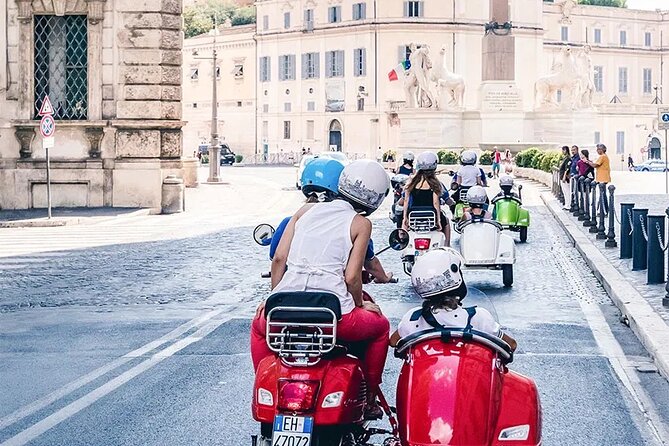
Janiculum Hill, or Terrazza del Gianicolo, is a pressure-release valve after the heavy hitters. It’s often described as the eighth hill, and it sits just outside the ancient city walls.
You get about 15 minutes here, which is perfect for the main payoff: the panorama. If you’ve stared at maps of Rome all trip, this is where the city finally makes sense. The views help you connect neighborhoods to landmarks in your head.
Janiculum is also tied to defense history and the Garibaldi-era battle on the hill. Paths are lined with sculptures of heroes like Giuseppe Garibaldi. Even in a short visit, the setting feels less like a chore and more like a breather.
After that, the tour includes a drive through Rome’s alleys with a stop-and-pass feel for the local atmosphere, including the Jewish Ghetto area. This part is more about the feel of neighborhoods than about a single monument. You see how Rome looks when you are not just aimed at the next famous facade.
Piazza Venezia’s Altare della Patria and the Colosseum: the imperial wall-to-wall moment
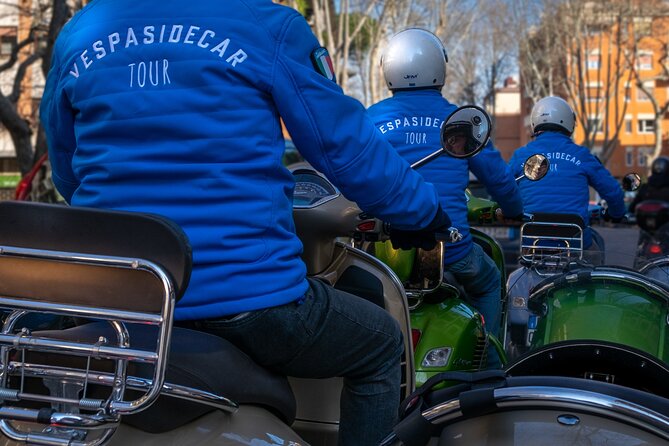
Next comes Piazza Venezia and the Monumento Nazionale a Vittorio Emanuele II, often called Altare della Patria. This is an imposing structure built in honor of Victor Emmanuel II, inaugurated in 1911. It also holds important exhibits related to the Risorgimento, and it is the site of the tomb of the unknown soldier with an eternal flame guarded by soldiers.
Even if you don’t go deep into the interior exhibits, the viewpoint around the monument gives you a strong “Rome as capital” perspective. It’s a good mid-to-late stop because it keeps the day moving forward to the big Roman symbol.
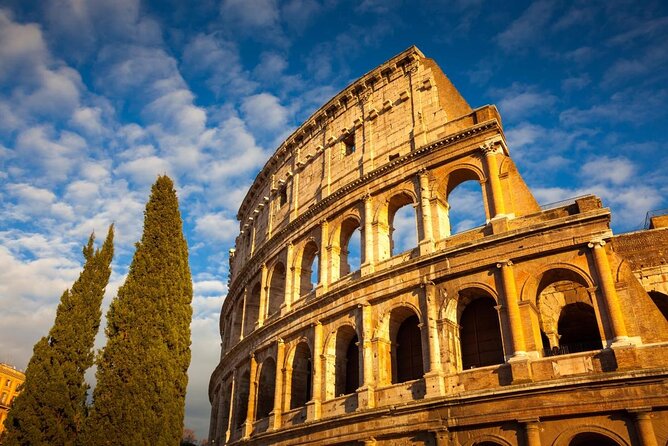
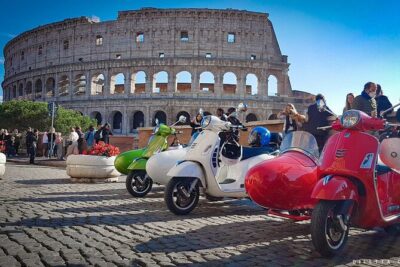
Then you ride to the Colosseum. It’s the Flavian Amphitheatre, Rome’s most recognizable arena, and it still does the job instantly. You don’t need a lecture to feel the scale.
Why it works in this format: you get the Colosseum as a photo-and-walk moment without spending the whole day stuck in just lines and slow routes. The tour keeps you moving, and you end up with better momentum for photos while your energy is still decent.
Quick reality check
A Vespa tour will not replace a full archeology-style day at the Colosseum. But it does a great job of giving you the first emotional read of the site—then you can decide if you want to return for deeper exploration.
Santa Maria Maggiore: ending on a major basilica note
The last stop is Basilica di Santa Maria Maggiore, one of Rome’s four major basilicas dedicated to the Virgin Mary. It is also described as the largest church dedicated to Mary in Rome.
This ending choice is smart because it adds a different kind of grandeur than imperial ruins. Basilicas deliver long lines of art and architecture, and even a short visit can make you appreciate Rome’s religious layers.
If you’re thinking ahead: Santa Maria Maggiore is a good anchor stop to help you remember that Rome is not only ancient stone. It’s also living churches, ongoing tradition, and centuries stacked in the same area.
Price and value: what you get for $163.26 in 3 hours
At $163.26 per person for roughly 3 hours, this tour is not cheap. The value comes from the bundle.
You get:
- Licensed guide narration delivered through audio headsets
- Professional drivers, so you don’t have to think about traffic or parking
- Breakfast with cappuccino and cornetto
- Entrance fee for the Pantheon
- A compact route that hits multiple top sights in one morning
That Pantheon entrance inclusion alone can take the edge off the cost, because it’s one of Rome’s most in-demand stops. Add the breakfast and the fact that you don’t spend the whole day fighting logistics, and the price starts to make sense for a first-time visit.
Also, the max group size of 12 helps. Smaller groups generally mean fewer delays at the curb and less crowding at quick stops.
One more value angle: the Vespa sidecar changes how you experience distance. In Rome, distance can be a budget-killer in time and energy. Here, the transport is part of the sightseeing plan.
Who this is perfect for, and who should skip it
This tour suits you if you want a high-impact first pass at Rome, with minimal stress. I’d book it if you are traveling with kids over the minimum age, or if you want your morning to feel like a mini adventure instead of a checklist.
It also fits well if you hate the hassle of navigating crowds and finding the “right” entry points. The guide keeps the flow moving, and you get audio so you’re not dependent on reading in the moment.
But skip it if any of these apply:
- You are pregnant (not permitted)
- You have mobility issues that make short getting-on and off the vehicle uncomfortable
- You might be sensitive to a street ride in traffic and uneven pavement
Kids rules are important here. Children must be minimum 5 years old. If they are taller than 150 cm, they can sit behind the driver; otherwise they have to sit in the sidecar. There are also weight limits for the sidecar and for the back seat, so the tour operates with safety constraints.
If you want a seat in the sidecar, plan around those rules. If you book fewer seats, you may swap during stops so different riders can enjoy the sidecar seat at different points.
Practical tips before you go
To get the most out of the ride, dress for quick changes in morning weather. The tour requires good weather, so you’ll want layers you can adjust if you get warm near monuments and chilly when you move into shaded streets.
Also, bring a practical mindset. This is a “see a lot in 3 hours” plan, not a slow, linger-all-day plan. For each stop, choose what you want most: a photo, a quick look inside, or a moment of calm.
If you are concerned about comfort on the bike, you might find that some drivers add little extras. One group reported a driver offered a hot water bottle and blanket when they got back on, which is a nice touch if the morning feels cool.
Finally, arrive a few minutes early at Piazza della Repubblica. You don’t want a rushed start. With a tour this dense, smooth check-in makes the whole morning feel better.
Should you book this Rome morning Vespa sidecar tour with cappuccino?
Yes, if your goal is to get oriented quickly and enjoy Rome with low effort. The combination of Vespa sidecar rides, live audio in English, breakfast, and Pantheon entrance is exactly the kind of “pay once, enjoy the day” setup that works well on a short trip.
Book it early if you can, since this experience is often reserved about 71 days in advance. And if you are visiting in a season where rain is common, keep your backup plans in mind because the tour depends on good weather.
If you prefer long, quiet museum time and hate riding through crowded areas, you may be happier with a slower walking-and-transit day. But for most people seeing Rome for the first time, this is one of the most fun ways to make a tight schedule feel generous.
FAQ
How long is the Rome morning Vespa sidecar tour with cappuccino?
It runs for about 3 hours.
Where does the tour start and what time does it begin?
It starts at Piazza della Repubblica, 41, 00185 Rome, and the start time is 9:00 am.
What’s included with the cappuccino?
Breakfast includes traditional cappuccino and a cornetto.
Is Pantheon entrance included?
Yes. The Pantheon entrance ticket is included in the tour.
Do I need to drive or handle parking?
No. You do not have to think about driving or parking because professional drivers handle it.
What’s the group size limit?
The tour has a maximum of 12 travelers.
Can children ride, and who can sit where in the sidecar?
Children must be at least 5 years old. If they are taller than 150 cm, they can sit behind the driver; otherwise they must sit in the sidecar.
What happens if the weather is poor?
The tour requires good weather. If it’s canceled due to poor weather, you’ll be offered a different date or a full refund.
More Tours in Rome
- Vatican Museums, Sistine Chapel & St. Peter’s Basilica Tour
★ 4.3 · 73,970 reviews - Vatican Museums, Sistine Chapel & St Peter’s Basilica Guided Tour
★ 4.5 · 39,149 reviews - Rome: Colosseum, Palatine Hill and Roman Forum Guided Tour
★ 4.8 · 32,814 reviews - Rome: Guided Tour of Colosseum, Roman Forum & Palatine Hill
★ 4.7 · 27,897 reviews - Rome: Colosseum, Roman Forum and Palatine Hill Guided Tour
★ 4.5 · 23,903 reviews - Rome: Colosseum Arena Floor, Palatine & Forum Guided Tour
★ 4.5 · 20,180 reviews
More Tour Reviews in Rome
- Vatican Museums, Sistine Chapel & St. Peter’s Basilica Tour
★ 4.3 · 73,970 reviews - Vatican Museums, Sistine Chapel & St Peter’s Basilica Guided Tour
★ 4.5 · 39,149 reviews - Rome: Colosseum, Palatine Hill and Roman Forum Guided Tour
★ 4.8 · 32,814 reviews - Rome: Guided Tour of Colosseum, Roman Forum & Palatine Hill
★ 4.7 · 27,897 reviews - Rome: Colosseum & Forum with Audio Guide App -Optional Arena
★ 4.2 · 24,770 reviews - Rome: Colosseum, Roman Forum and Palatine Hill Guided Tour
★ 4.5 · 23,903 reviews
More Vespa Days in Rome
- Vespa Sidecar Tour By Night with Pickup
★ 5.0 · 1,803 reviews - Rome: Explore the City by Vespa with an Optional Photoshoot
★ 5.0 · 1,103 reviews - Rome Vespa Scooter Tour with Professional Photographer
★ 5.0 · 857 reviews - Rome: Highlights Vespa Sidecar Tour with Coffee and Gelato
★ 4.9 · 747 reviews - Rome: Vespa Ride with Pictures and Sweet Tastings
★ 5.0 · 723 reviews - Rome Afternoon Sightseeing Vespa Sidecar Tour with Gourmet Gelato
★ 5.0 · 692 reviews
Just added to our Rome reviews

Rome Vespa Tours, compared.
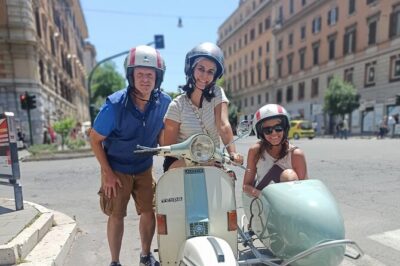 ★ 5.0Vespa Sidecar Tour By Night with PickupFrom $1461,803 reviews
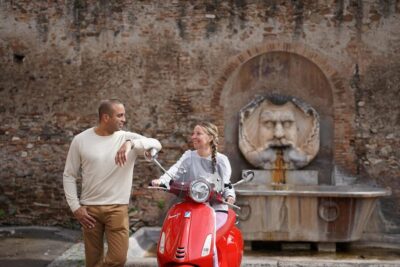 ★ 5.0Explore the City by Vespa with an Optional PhotoshootFrom $371,103 reviews
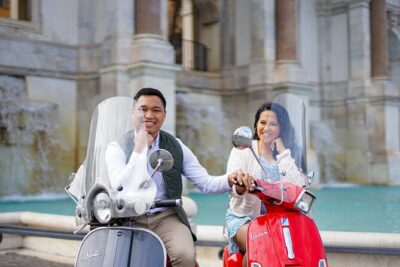 ★ 5.0Rome Vespa Scooter Tour with Professional PhotographerFrom $66857 reviews
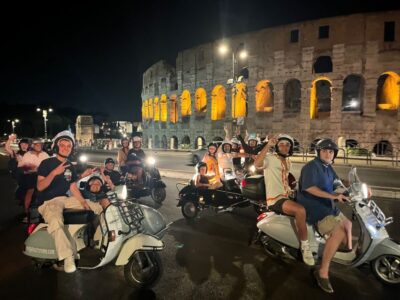 ★ 4.9Highlights Vespa Sidecar Tour with Coffee and GelatoFrom $141747 reviews
 ★ 5.0Vespa Ride with Pictures and Sweet TastingsFrom $34723 reviews
 ★ 5.0Rome Afternoon Sightseeing Vespa Sidecar Tour with Gourmet GelatoFrom $163692 reviews
Pro Photoshoot include free transport with VESPAFrom $33501 reviews
★ 5.0Rome Afternoon Sightseeing Vespa Sidecar Tour with Gourmet GelatoFrom $163692 reviews
Pro Photoshoot include free transport with VESPAFrom $33501 reviews
 ★ 5.0Vespa Tour with Photo services Small‑Group HighlightsFrom $49483 reviews
Browse the lists this tour appears in