
Reviewed · BORGHESE GALLERY TOURS
Rome Golf Cart Tour from Villa Borghese Gardens
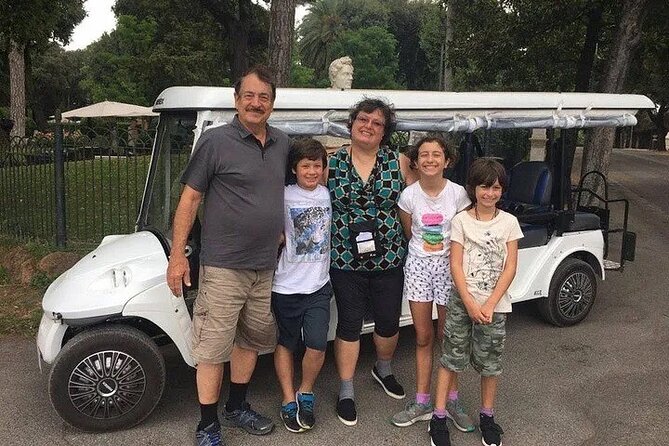
Rome goes faster than you expect in a golf cart. This 3-hour small-group tour threads through classic sights with an English-speaking driver guide and commentary that helps you spot what you’re looking at. It’s a good way to get oriented early, without spending the whole day parked in the sun.
I especially like the rhythm of the route: short, purposeful stops where you can step out, take photos, and move on before the crowd energy takes over. And you get payoff views right away, including the Villa Borghese area with famous park panoramas over the city.
One drawback to plan for: the timing is tight. Many highlights are brief photo-and-look moments, so if you want long, slow museum time, this won’t feel like that kind of tour.
In This Review
- Key highlights at a glance
- Why this Rome golf cart route works for your first hours in town
- Villa Borghese start: park views and a calmer opening
- Piazza del Popolo and the gateway feeling of the north side
- Mausoleum of Augustus and the Column of Marcus Aurelius: imperial power in stone
- Piazza Venezia and the Ancient City area: quick hits before you get tired
- Circo Massimo to the Orange Garden: big-open Rome and a view break
- Bocca della Verità to Forum Boarium temples: legends and the oldest stone
- Pantheon, Piazza Navona, Campo de’ Fiori, Trevi, and the Spanish Steps: classic Rome, packed in
- How the guide and small-group size shape the experience
- Price and value: what you’re paying for at $171.68 per person
- Practical expectations: how to enjoy it without feeling rushed
- Should you book the Rome Golf Cart Tour from Villa Borghese Gardens?
- FAQ
- FAQ
- How long is the Rome Golf Cart Tour from Villa Borghese Gardens?
- What language is the tour offered in?
- How many people are in the group?
- Where is the meeting point and where does the tour end?
- What sites are included during the 3-hour route?
- Are there admission tickets you need to buy for the stops?
- Is the tour suitable for people who don’t want to walk far?
- Will I be able to take photos during the stops?
- How far in advance should I book?
- What is the cancellation policy?
Key highlights at a glance
- Up-close Rome in 3 hours without the stamina tax of nonstop walking
- English commentary on board so landmarks make sense while you’re moving
- Max 7 people for a calmer pace and a more personal feel
- Free-entry stops listed across the route, so you’re not juggling extra tickets
- High-demand sights plus underappreciated corners, from Circo Massimo to the Orange Garden
- Guides who handle heat and photos, with mentions of water and careful parking choices
Why this Rome golf cart route works for your first hours in town
Rome is big, spread out, and built in layers. On foot, that reality can slow you down fast. On a golf cart loop like this, you trade some wandering for something more useful: you get bearings quickly. You’ll see a concentration of major landmarks in one afternoon, then know where to return later if you want deeper time.
The best part is that the tour isn’t just driving past things. The guide commentary gives you a map inside your head. When you roll up to a square, column, or domed church, you’re not stuck guessing what the feature is or why it matters. That turns random sights into a story you can follow.
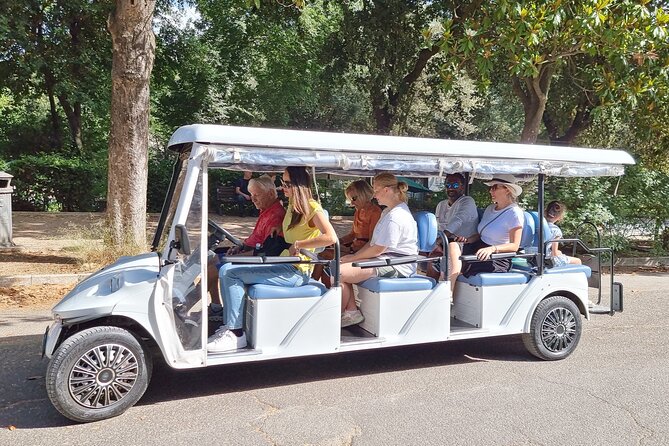
It also helps that the pace is built for real bodies. The carts handle the longer transfers between areas, while you still get moments to step out for photos and short looks. If you’re traveling with kids, traveling with limited mobility, or simply trying to save your feet for the rest of your trip, this format is practical.
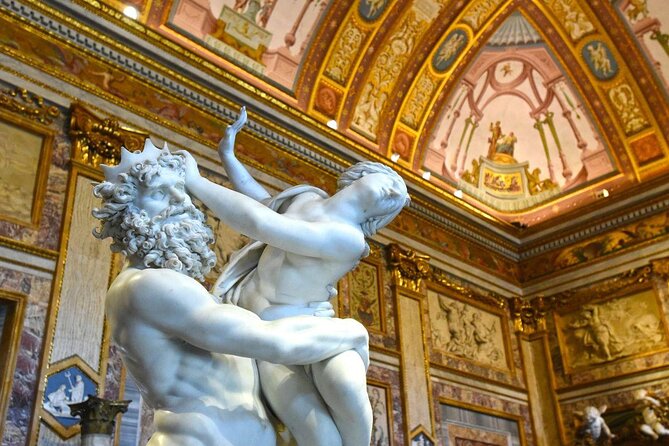
More Bernini and Caravaggio at the Borghese
- Rome: Borghese Gallery Skip-the-Line Ticket & Audioguide
★ 4.3 · 4,318 reviews - Rome: Borghese Gallery Ticket + Audioguide or Guided Tour
★ 4.6 · 3,219 reviews - Rome: Borghese Gallery Guided Tour with Skip-the-Line Entry
★ 4.8 · 2,649 reviews - Rome: Borghese Gallery Skip-the-Line Tickets with Audioguide
★ 4.6 · 2,562 reviews
Villa Borghese start: park views and a calmer opening
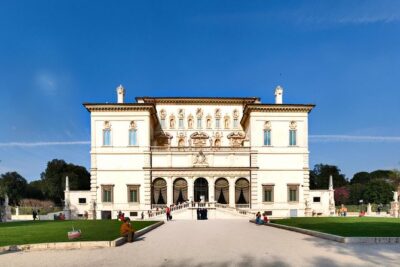
The tour begins near Villa Borghese Gardens, in the park area. Villa Borghese is one of the largest urban parks in Europe, and it went through a major transformation in the 19th century. The change pushed the park toward an English-style layout, with ponds and fountains that make it feel like a world of its own inside the city.
Your stop here is short—about 15 minutes—but it’s timed well. This is one of the best places to get your first skyline glance of Rome. Even if you don’t spend hours in the park itself, stepping out for a quick look helps you understand where you are and what views you’re about to chase later.
What you’ll like: it’s a softer start than the Roman Forum grind.
What to watch: you won’t “tour” Villa Borghese in 15 minutes. Think of it as an orientation stop with scenery.
If your guide is the type who knows people like Marco, Paul, or Nikolai (names seen in past groups), you’ll likely get helpful context early—especially around what you’re seeing and how to photograph it from the best angles.
Piazza del Popolo and the gateway feeling of the north side
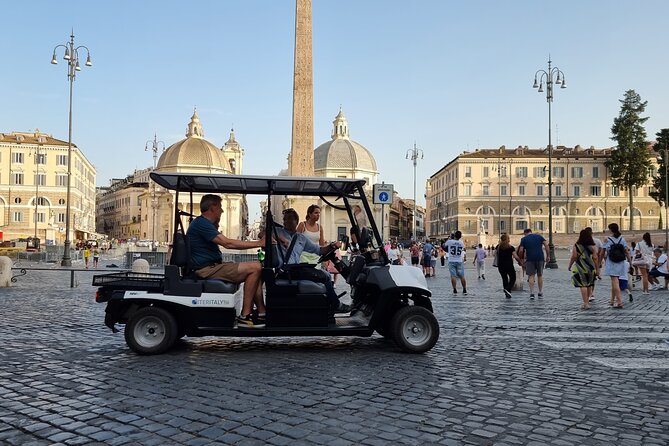
From Villa Borghese, you move toward Piazza del Popolo, a famous square tied to the Porta Flaminia area on Rome’s north side. This is one of those places where Rome feels like a stage set: big open space, major streets feeding into it, and clear sightlines.
Your time here is around 10 minutes, which means you’ll get a look and a few photos, not a full wander. But Piazza del Popolo is worth the stop because it resets your sense of scale. Rome’s monuments don’t always feel “monumental” when you’re in cramped streets. This square helps.
Practical tip: when your stop time is short, aim to pick your “one angle” for photos instead of trying to shoot everything. The cart makes it easy to move, but your real limit is the clock.
Mausoleum of Augustus and the Column of Marcus Aurelius: imperial power in stone
Two of the most compelling stops are the Mausoleum of Augustus and the Column of Marcus Aurelius.
At the Mausoleum of Augustus, you’re looking at a large circular tomb that matters for more than just the original Roman build. It has a long, complex afterlife—reuse, reinterpretation, and rediscovery of antiquities over time. That kind of story is why this stop can feel more interesting than it looks at first glance. You’re seeing how Rome keeps changing its own past.
Then you hit the Column of Marcus Aurelius and Faustina in Piazza Colonna. Around 10 minutes is enough to notice the column’s presence and the carving work that runs up it. The column is thought to have been erected around 180 CE, and the reliefs depict successful military campaigns against the Quadi across the Danube between 172 and 175 CE. If the guide points out what to look for while you’re there, this becomes one of those “wait, that’s the point” monuments.
Value for you: these aren’t just pretty stone. With commentary timed to the stop, you get a quick lesson in Roman messaging—how rulers used art and architecture to claim legitimacy.
Possible drawback: if you’re the type who loves reading every inscription and studying carvings, you may want more time than 10 minutes. The tour is designed to show, not to study.
Cover more ground by golf cart
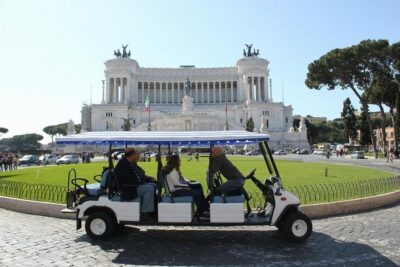
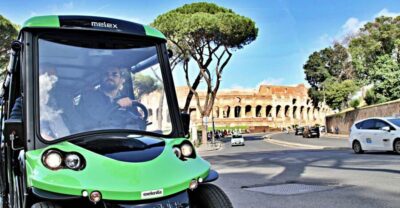
Piazza Venezia and the Ancient City area: quick hits before you get tired
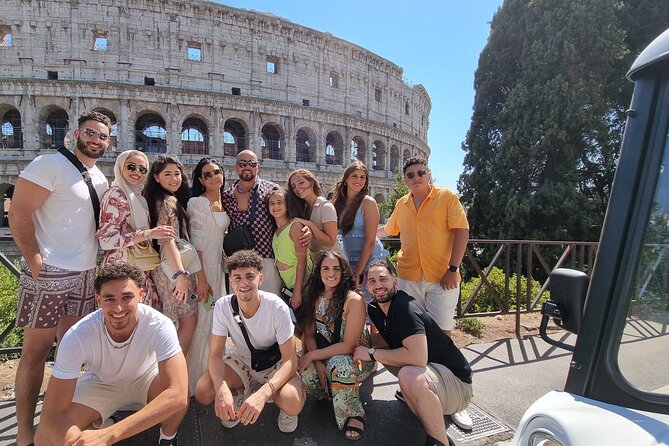
Next comes Piazza Venezia / Ancient City, located between Via del Corso and Via dei Fori Imperiali. The shape of the area reflects the remaking of the space in the turn of the 19th and 20th centuries for the Monumento a Vittorio Emanuele II.
This stop is around 10 minutes. That might sound short, but it’s smart: the cart route is trying to keep you moving while you’re still fresh enough to appreciate what you see. Piazza Venezia is also a useful “hub” stop because it sits close to the ancient core of the city.
From there, the tour includes the Trajan’s Markets (Mercati di Traiano) and an introduction to the Imperial Forums using multimedia displays, explanatory panels, and a smattering of archaeological artifacts. You don’t need to already be a Forum expert to get value here. This is the kind of stop that can make the rest of the ancient sites click.
Why it’s worth it: the forums and their surroundings can feel like confusing rubble if you only see them on your own. A quick museum-style orientation—especially with visuals and explanation—helps you connect the dots faster.
Circo Massimo to the Orange Garden: big-open Rome and a view break
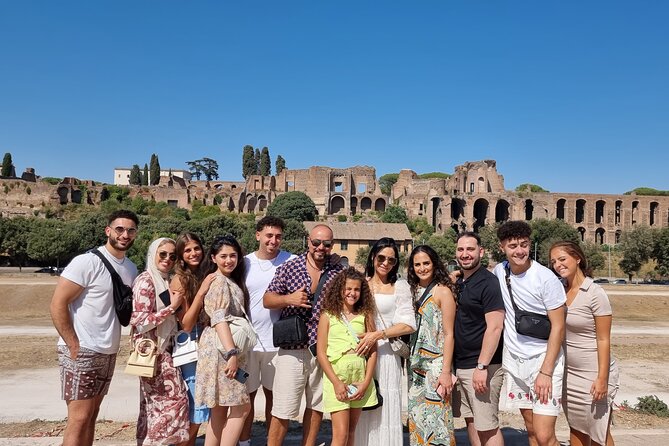
When the route reaches Circo Massimo, you’re seeing an enormous ancient precinct with room for about 300,000 spectators. Even if you’ve only heard the name, seeing the space in person gives you a better sense of Roman scale and entertainment culture. Your time is about 5 minutes, so think of it as a “spot it and absorb it” pause.
Then comes one of the most-loved natural stops: Giardino degli Aranci (Orange Garden) on the Aventine hill. This park covers almost 8,000 square meters, and the main reason people love it is the panorama over Rome. The stop is about 15 minutes, which is enough to walk a little and find a viewpoint that feels worth the photo.
There’s also a bonus possibility if there’s time: the Keyhole of Rome. It’s the kind of small, oddly specific sightseeing target that can make a tour feel fun and local, not just checklist tourism.
What you’ll like: a mental reset from stone corridors.
What to watch: don’t plan on a long stroll. This is a viewpoint stop, not a full garden afternoon.
Bocca della Verità to Forum Boarium temples: legends and the oldest stone

You’ll then shift from panoramas to legend at Bocca della Verità (Mouth of Truth). This ancient carving is famous in part because of the myth attached to it—long before modern lie-detector tech, people believed the mouth would bite the hands off liars. Your stop is brief, about 5 minutes, so it’s more about the moment and the fun than deep study.
After that, the route goes into the Forum Boarium area near the Tiber. Two temple stops are included:
- Temple of Hercules, described as the only surviving sacred structure in ancient Rome made of Greek marble. It’s among the oldest extant buildings in the city and is thought to be tied to a Greek architect named Hermodoros of Salamina.
- Temple of Portunus, a well-preserved Roman temple that overlooked the fluvial port of Rome, watching over goods entering the city.
You’ll also see the Theatre of Marcellus, completed in the late 1st century BCE during Augustus’ reign. The architecture influenced theatres across the empire, including facades like the Colosseum.
How this part feels on the cart: it’s a shift from the major “postcard Rome” clusters into a more grounded, tactile old-city vibe. The commentary helps because these sites can look similar at a distance if you don’t know what you’re looking at.
Pantheon, Piazza Navona, Campo de’ Fiori, Trevi, and the Spanish Steps: classic Rome, packed in
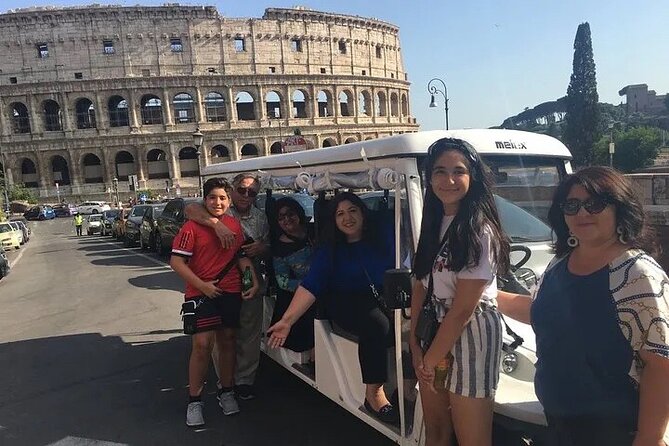
This is where the tour hits the big, recognizable center of town.
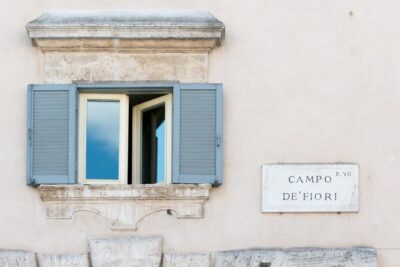
First comes the Navona / Pantheon / Campo de’ Fiori area. Piazza Navona is famous for its elongated shape, originally tied to its past as a stadium for athletics competitions (Circus Agonalis). Then you reach the Pantheon, one of Rome’s best-preserved historic buildings. It’s dated to the early 2nd century AD, and the dome’s central opening—the oculus—is a famous architectural achievement.
Your Pantheon stop time is listed at about 15 minutes. That’s usually enough to see the structure clearly, understand why people talk about the dome, and get a few solid photos—especially if your guide helps you time the viewing so you’re not fighting crowds the whole time.
From there you continue to:
- Fontana di Trevi, a late Baroque masterpiece designed by Nicola Salvi and completed in 1762. The famous legend about tossing coins is part of its cultural spell. Your stop is about 10 minutes.
- Piazza di Spagna, including the Spanish Steps area. Your stop is around 5 minutes, so it’s best for a quick sit-down-and-look or a photo, not a linger.
Key reality check: this portion is intense. You’ll cover the headline sites you probably came for, but the tradeoff is that each stop is relatively short. If you want to linger in any one place, you’ll likely want to return later on your own with a plan.
How the guide and small-group size shape the experience
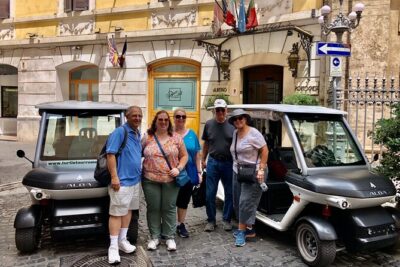
This tour caps at 7 travelers, and that small limit matters more than it sounds. In Rome, crowds and narrow streets can make large-group sightseeing feel chaotic. A smaller group tends to make the timing smoother: you can actually hear the guide, you can ask questions, and you’re less likely to feel like you’re being shoved along.
The guide style also shows up in the reviews. People highlight drivers and guides like Jean Luca / Gian-Luca, Sabrina, Marco, Nikolai, Pietro, and Paul. Across those names, the repeated strengths are:
- Clear historical explanations timed to what you’re seeing
- Patience, especially for people who need a slower cadence
- Extra help with photos, with some guides taking pictures for the group
- Practical care in hot weather, including avoiding long sun exposure while waiting
One review even mentioned water being provided, and another mentioned a guide who took health seriously by not parking under the sun during high heat. That’s not something you should assume every day, but it’s a good sign that the operator trains guides to think about comfort, not just schedules.
Who this suits best
- First-time Rome visitors who want orientation fast
- Families with kids who need fewer long walking stretches
- Anyone who wants major sites with less fatigue
- People who like structure and context more than independent wandering
Price and value: what you’re paying for at $171.68 per person
At $171.68 per person for about 3 hours, you’re paying for three things: the cart itself, the guided commentary, and the efficient route that strings together far-flung areas.
Here’s the value logic I’d use:
- If you’d otherwise spend the day hopping between distant neighborhoods on foot (and losing time to heat and navigation), the cart can save real energy.
- If you want the ancient sights plus modern landmarks like Trevi and the Spanish Steps without building a complicated self-guided route, the guide reduces stress.
- If you’re traveling with limited mobility or just don’t want to wear out your legs, the golf cart changes the game. Multiple reviews explicitly praise the cart as the best way to get around when walking is difficult.
So is it expensive? It can be, depending on your travel style. But for many people, it feels like a smart use of limited vacation time: you buy a fast, organized Rome preview, then choose what to revisit later.
Practical expectations: how to enjoy it without feeling rushed
A few simple mindset shifts make the experience better.
First, treat the tour like a high-quality sampler, not a full museum marathon. You’ll see a lot of top-tier sights, but most stops are designed to be short.
Second, be ready for frequent photo moments rather than long “sit and study” time. If you come prepared—comfortable shoes for the quick steps off the cart, phone ready, and an idea of which sight you want your best shot at—you’ll feel more satisfied.
Third, come with curiosity. The route includes major names, but also places that many people skip on a first day. The commentary is what turns those into memorable stops.
Finally, don’t underestimate the comfort factor. Multiple comments point out that the cart helps with heat and tired legs. Even if you’re not mobility-limited, it’s a real advantage in Roman summer conditions.
Should you book the Rome Golf Cart Tour from Villa Borghese Gardens?
Book it if you want a structured introduction to Rome that hits the headline sights and gives you enough context to understand what you’re seeing. It’s a particularly good choice for first-day orientation, families, and anyone who doesn’t want to spend hours walking between far-apart areas.
Skip it if your ideal Rome day is slow, deep, and museum-heavy. This route is built for movement and quick stops, so if you want long indoor time at any one site, you’ll need extra days to pair it with independent exploring.
FAQ
FAQ
How long is the Rome Golf Cart Tour from Villa Borghese Gardens?
The tour is approximately 3 hours.
What language is the tour offered in?
It is offered in English.
How many people are in the group?
The maximum group size is 7 travelers.
Where is the meeting point and where does the tour end?
Meet at Pic Nic – Just Amir srl, Piazzale delle Canestre, SNC, 00197 Roma RM, Italy. The tour ends back at the meeting point.
What sites are included during the 3-hour route?
The route includes Villa Borghese, Piazza del Popolo, the Mausoleum of Augustus, the Column of Marcus Aurelius, Piazza Venezia / Ancient City, Trajan’s Markets and an introduction to the Imperial Forums, Circo Massimo, Giardino degli Aranci (with the Keyhole of Rome if there is time), Bocca della Verità, the Temple of Hercules, the Temple of Portunus, the Theatre of Marcellus, plus Piazza Navona, the Pantheon, Campo de’ Fiori, Fontana di Trevi, and Piazza di Spagna.
Are there admission tickets you need to buy for the stops?
The stops are listed with admission ticket free.
Is the tour suitable for people who don’t want to walk far?
Yes. The tour is designed as a golf cart way to see major sites with reduced walking, and most travelers can participate.
Will I be able to take photos during the stops?
Yes. The itinerary includes short stops where you can admire the sights and take photos.
How far in advance should I book?
On average, it’s booked 43 days in advance, so booking ahead is a good idea.
What is the cancellation policy?
Free cancellation is available up to 24 hours in advance for a full refund. If you cancel less than 24 hours before the start time, the amount paid is not refunded.
More Tour Reviews in Rome
- Vatican Museums, Sistine Chapel & St. Peter’s Basilica Tour
★ 4.3 · 73,970 reviews - Vatican Museums, Sistine Chapel & St Peter’s Basilica Guided Tour
★ 4.5 · 39,149 reviews - Rome: Colosseum, Palatine Hill and Roman Forum Guided Tour
★ 4.8 · 32,814 reviews - Rome: Guided Tour of Colosseum, Roman Forum & Palatine Hill
★ 4.7 · 27,897 reviews - Rome: Colosseum & Forum with Audio Guide App -Optional Arena
★ 4.2 · 24,770 reviews - Rome: Colosseum, Roman Forum and Palatine Hill Guided Tour
★ 4.5 · 23,903 reviews
More Golf Cart Rides
- Rome by Golf Cart Private Tour: Beyond the Landmarks
★ 5.0 · 4,361 reviews - Rome on a Golf Cart Semi-Private Tour Max 6 with Private Option
★ 5.0 · 2,502 reviews - Rome Highlights by Golf Cart Private Tour
★ 5.0 · 2,379 reviews - Rome: Golf Cart Tour with Artisanal Gelato Tasting
★ 4.8 · 1,396 reviews - Rome Highlights City Tour by Golf Cart with Gelato
★ 5.0 · 1,088 reviews - Rome: Imperial City Tour by Golf Cart with Optional Transfer
★ 4.8 · 1,024 reviews
More Rooms at the Borghese
- Rome: Borghese Gallery Skip-the-Line Ticket & Audioguide
★ 4.3 · 4,318 reviews - Rome: Borghese Gallery Ticket + Audioguide or Guided Tour
★ 4.6 · 3,219 reviews - Rome: Borghese Gallery Guided Tour with Skip-the-Line Entry
★ 4.8 · 2,649 reviews - Rome: Borghese Gallery Skip-the-Line Tickets with Audioguide
★ 4.6 · 2,562 reviews - Rome: Borghese Gallery & Gardens Small Group Guided Tour
★ 4.5 · 2,190 reviews - Rome: Borghese Gallery Guided Tour with Tickets
★ 4.9 · 1,880 reviews
Just added to our Rome reviews





Borghese Gallery Tours, compared.
 ★ 4.3Borghese Gallery Skip-the-Line Ticket & AudioguideFrom $504,318 reviews
 ★ 4.6Borghese Gallery Ticket + Audioguide or Guided TourFrom $533,219 reviews
 ★ 4.8Borghese Gallery Guided Tour with Skip-the-Line EntryFrom $842,649 reviews
 ★ 4.6Borghese Gallery Skip-the-Line Tickets with AudioguideFrom $532,562 reviews
 ★ 4.5Borghese Gallery & Gardens Small Group Guided TourFrom $472,190 reviews
 ★ 4.9Borghese Gallery Guided Tour with TicketsFrom $571,880 reviews
 ★ 4.3Borghese Gallery Skip the line ticket and AudioguideFrom $531,535 reviews
 ★ 4.5Borghese Gallery, Canova’s Masterpieces Skip-the-Line Guided TourFrom $591,162 reviews
Browse the lists this tour appears in