
Reviewed · ROME VESPA TOURS
Vespa Sidecar Tour: Highlights of Rome
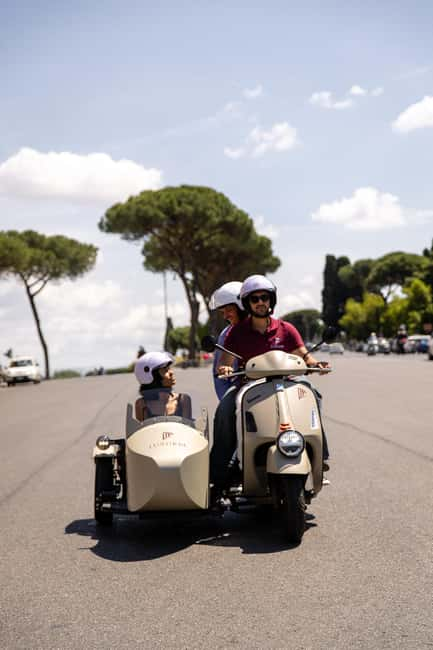
Three hours on a Vespa gives instant Rome. I love the quick, street-level way you zip between famous sights on a Vespa sidecar, and I love that the stories come through earphones so you don’t miss a thing. The tradeoff is short stops, so this is for big first impressions and photos, not slow inside-the-church or long museum time.
You start at Piazza del Popolo, and in one loop you’ll get your bearings around the city’s most recognizable corners: Trevi Fountain, the Pantheon dome, Piazza Navona, the Monument to Vittorio Emanuele II, the Colosseum area, Rome’s Jewish Ghetto, the viewpoint from Gianicolo, St. Peter’s Basilica area in Vatican City, and then Trastevere’s cobbled lanes. Guides like Matteo and Dan are often cited for friendly humor and clear pacing, which matters a lot when your time window is tight.
In This Review
- Key things I’d note before you book
- Why a Vespa sidecar tour feels different in Rome
- Meeting at Piazza del Popolo: the start point and what to expect
- Piazza del Popolo: symmetry, an Egyptian obelisk, and your first big view
- Trevi Fountain: Baroque theater plus a ritual you’ll actually see
- The Pantheon: fast stop, huge payoff from the dome and oculus
- Piazza Navona: fountains, domed cafes, and Roman stadium bones
- Monument to Vittorio Emanuele II: the big crossroads between Rome eras
- Colosseum photo stop: the iconic exterior moment, without included tickets
- The Ghetto: a different side of Rome’s street-level identity
- Colle del Gianicolo: the noon cannon and one of Rome’s best “big picture” moments
- Vatican City: St. Peter’s Basilica time without included admission
- Trastevere: cobblestones, alleys, and a calmer kind of Rome
- Safety and comfort on the Vespa sidecar: what’s included, and what to watch for
- Price and value: $114.12 for three hours of guided Rome movement
- Who this tour suits best (and who might choose differently)
- Should you book the Vespa Sidecar Tour of Rome highlights?
- FAQ
- How long is the Vespa Sidecar Tour in Rome?
- Where does the tour start and where does it end?
- Is pickup available?
- Do I need to pay admissions during the tour?
- What language is the tour offered in?
- How many people are on the tour?
- Is the Vespa driver included, or do I drive?
- Is there safety equipment provided?
- Does the tour require good weather?
- Can I cancel for a refund?
Key things I’d note before you book
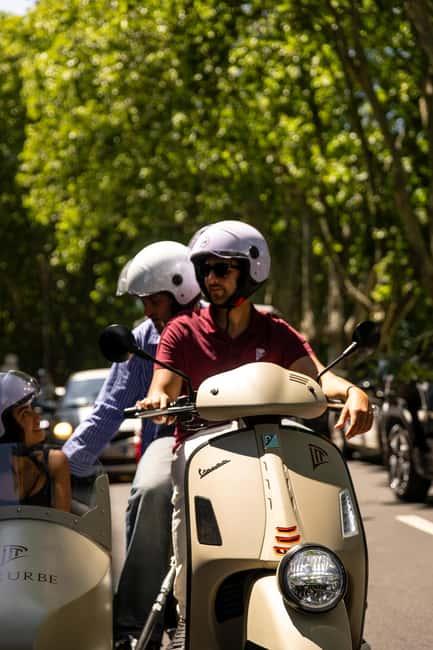
- Small group (max 10 people) keeps the ride personal and makes stops feel smoother.
- Earphones + helmet setup means you’re not shouting to hear your guide.
- Photo stops at iconic points help you leave with proof you were really there.
- A route designed for “Rome highlights in one sitting” (Piazza del Popolo to Trastevere).
- Two big admissions are not included (Colosseum and St. Peter’s Basilica area), so plan for that cost.
- Good weather matters since this is a ride-first experience on open streets.
Why a Vespa sidecar tour feels different in Rome
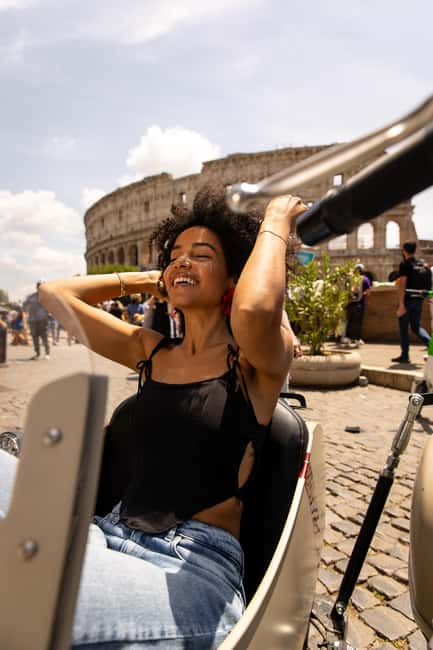
Rome can be overwhelming fast. Big crowds. Big monuments. Big walking distances. This tour attacks that problem in a very practical way: you get transported by Vespa while your guide strings the sights together with context you can actually remember.
The sidecar also changes your relationship to the streets. You’re not stuck behind a windshield. You’re higher than a pedestrian and close to the buildings. That makes small details pop—street layout, the way piazzas open up, and how Roman monuments sit inside modern neighborhoods.
I also like the pace philosophy. You don’t try to “win Rome” by seeing everything slowly. You do the opposite: you get the recognizable landmarks first, then you’ll know exactly where to return on your own.
More of Rome from the sidecar
- Vespa Sidecar Tour By Night with Pickup
★ 5.0 · 1,803 reviews - Rome Morning Vespa Sidecar Tour in Rome with Cappuccino
★ 5.0 · 1,771 reviews - Rome: Explore the City by Vespa with an Optional Photoshoot
★ 5.0 · 1,103 reviews - Rome Vespa Scooter Tour with Professional Photographer
★ 5.0 · 857 reviews
Meeting at Piazza del Popolo: the start point and what to expect
Your tour starts at Piazza del Popolo, 11, and you end right back there. That matters. You’re not stranded across town when the ride is over.
Pickup is offered, and if you’re picked up from your accommodation, you’ll be waiting at street level outside your main entrance. The driver is expected at the scheduled time or within a 10-minute waiting window—so I’d treat it like a “show up slightly early” situation, not a “wait until it’s convenient” situation.
The operator keeps the group capped at 10 travelers, and the ride is driven by an employee guide (you’re a passenger, not a driver). That’s an underrated comfort factor. You get to focus on the route and the sights instead of managing controls.
Piazza del Popolo: symmetry, an Egyptian obelisk, and your first big view
The loop opens at Piazza del Popolo, one of the most famous squares that historically acted as a main entry point into the city from the north. In the center is an ancient Egyptian obelisk brought to Rome under Emperor Augustus.
Look around for the reason this square photographs so well: two matching church facades—Santa Maria in Montesanto and Santa Maria dei Miracoli—frame the obelisk. It’s one of those Rome scenes where symmetry becomes a real landmark.
From above, the Pincio viewpoint is part of the mental picture you’ll carry for the rest of the day. Even if you don’t spend a long time up there, this stop helps you understand how Rome is layered—valleys, ridgelines, and monumental focal points.
Trevi Fountain: Baroque theater plus a ritual you’ll actually see
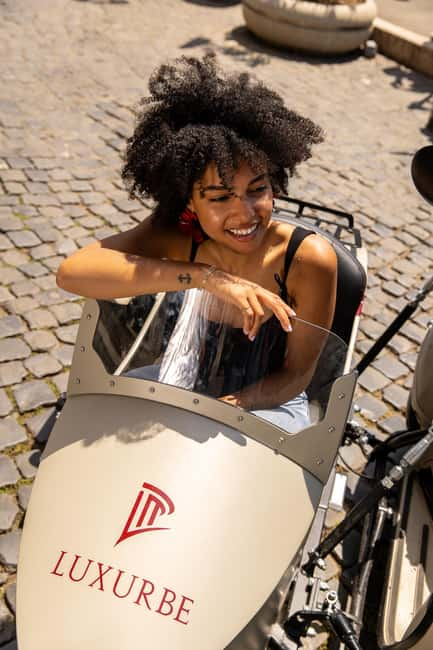
Next up is Trevi Fountain, a Baroque masterpiece designed in the 18th century by Nicola Salvi. The centerpiece image is the god Ocean on a shell-shaped cart pulled by sea horses—very dramatic, very Rome.
The tour follows the famous tradition: tossing a coin into the fountain over your right shoulder with your left hand (or at least, that’s the widely repeated ritual form). You’ll notice the crowd energy immediately. It’s not quiet, and that’s part of the point. This is one of the city’s most social rituals.
What I like here is that you get a guided “why it looks like this” moment rather than just a pile of postcards. The fountain is famous for a reason, and you learn how the sculpture is built to feel like motion frozen in marble and stone.
Worth a look next to this Rome booking:
The Pantheon: fast stop, huge payoff from the dome and oculus
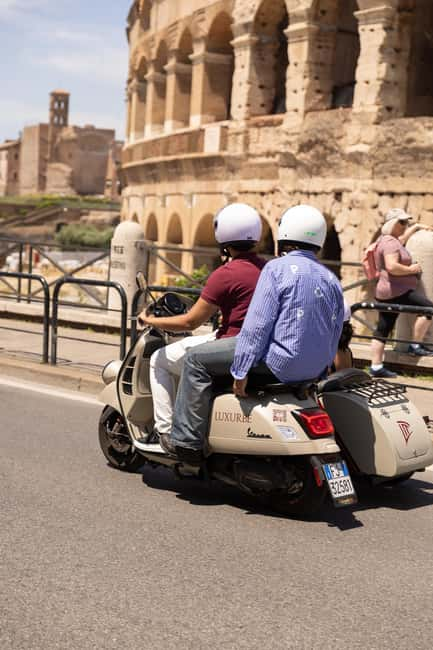
Then comes the Pantheon, built over two millennia ago and still one of the best-preserved monuments from ancient Rome. Today it functions as a church, but the architecture is still the star.
The highlight is the massive dome and the oculus (that open circle at the center). Natural light filters in through it, and even in a short stop you can feel the interior atmosphere. The “wow” comes from scale and engineering, not decorations.
Since your time here is not a long deep dive, treat it like this: stand somewhere you can see the oculus and the dome curve, let your eyes adjust, then look for small cues—how light changes the space, and how ancient building methods still dominate the room.
Piazza Navona: fountains, domed cafes, and Roman stadium bones
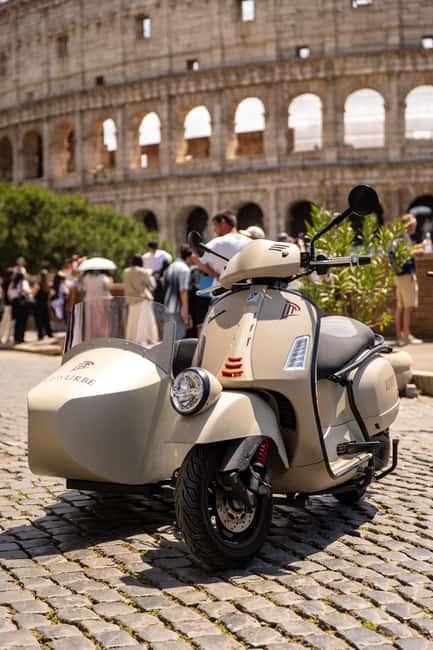
Piazza Navona is one of the most attractive squares for a quick “Rome feeling” stop. It sits on the ancient Stadium of Domitian, so under today’s piazza layout is an older sports venue identity.
The square’s headline is the three fountains, including Bernini’s Fountain of the Four Rivers. The idea is clever: the sculpture represents the great rivers known in the 17th century, which is why the art feels both theatrical and political.
This is the stop where you’ll start noticing café life, street performers, and that Rome rhythm where stone squares become stages. Even if your visit is just long enough for photos and a short walk, you’ll likely want to come back later on your own.
Monument to Vittorio Emanuele II: the big crossroads between Rome eras
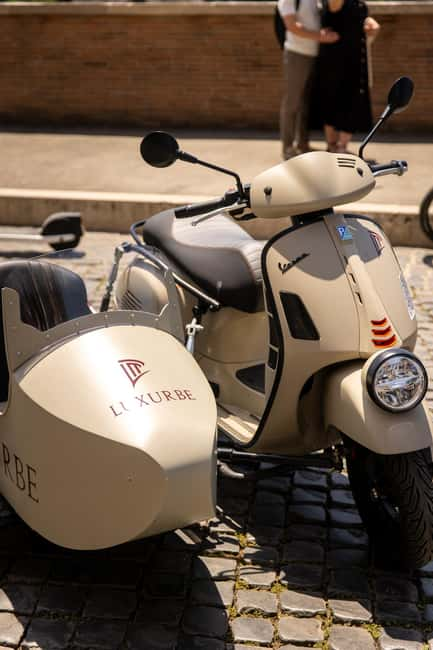
After the fountain energy, you hit the heart of a different kind of Rome: monumental nation symbolism and imperial-to-modern connections.
You’ll pass through a major crossroads dominated by the Monument to Vittorio Emanuele II, often called the Altar of the Fatherland. Nearby is Palazzo Venezia, which is connected to papal residence history and later served as Mussolini’s headquarters during World War II.
This stop is short, but it’s useful. It’s a reminder that Rome isn’t only ancient ruins and Renaissance domes. It’s also modern political statements written in stone, right in the middle of the historic core.
Colosseum photo stop: the iconic exterior moment, without included tickets
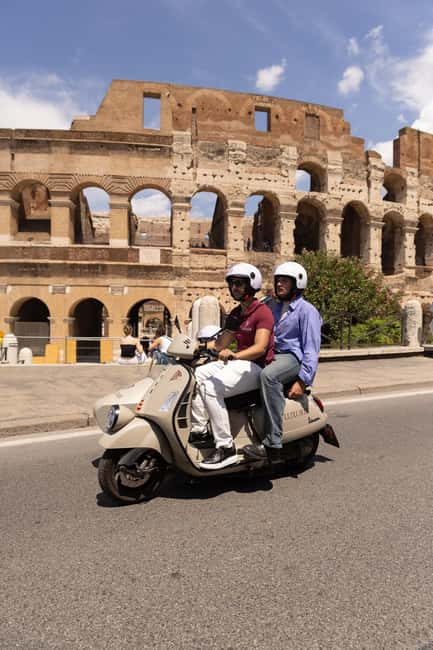
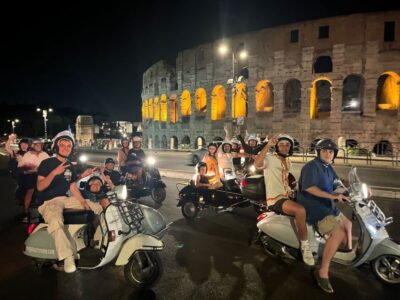
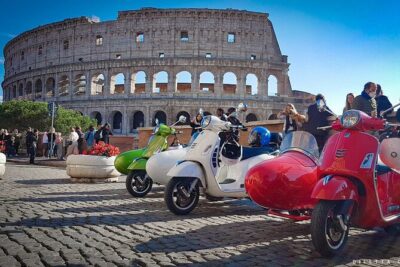
Your Colosseum stop is a quick one, and that’s important to understand upfront. The Colosseum is one of the ancient world’s most recognizable structures, built in the first century AD and designed to hold over 50,000 spectators for games, hunts, and public events.
But admission here is not included, so you’re not going to get a full interior visit as part of the ride. Instead, expect an exterior-focused experience with time for photos and the big-picture context your guide provides.
If you want more than the outside view, you’ll need to plan a separate ticket and return on another day. The value of this part of the tour is that you’ll leave oriented and motivated—you’ll know where you want to stand for a return visit.
The Ghetto: a different side of Rome’s street-level identity
Next is the Ghetto area, where the feel changes. This neighborhood is tied to the Roman Jewish community, and you can look for ancient Roman remains, traditional shops, and the impressive synagogue.
It’s not just “another stop.” It’s a reminder that Rome’s layers include community stories, not only stone monuments. This is also the kind of neighborhood where your guide’s tone matters: a respectful pace helps the area feel human instead of like a checklist item.
Because the time is brief, I recommend treating it like this: walk slowly for a minute or two, absorb the street texture and storefront character, then take one or two photos you’d actually use later when you’re mapping your own itinerary.
Colle del Gianicolo: the noon cannon and one of Rome’s best “big picture” moments
Now you get one of the most satisfying parts of the whole route: Colle del Gianicolo. This is a famous viewpoint, and the tour gives you a chance to take in broad views across the city.
Gianicolo is also tied to Italy’s unification story, with battles led by Giuseppe Garibaldi. One tradition connected to this place is the daily cannon fire at noon, a custom that has continued since 1847.
That noon detail is the kind of fact that makes a short viewpoint stop feel like more than just a photo. It links the view to a lived routine—timekeeping, civic ritual, and national history all in one place.
Vatican City: St. Peter’s Basilica time without included admission
The tour includes Citta del Vaticano and specifically references St. Peter’s Basilica as the heart of Catholic Christianity. The surrounding Vatican Museums are also part of what the tour points toward, though admission is not included.
So what do you get? A guided exterior-and-area experience, plus context so you understand what you’re looking at before you decide whether you want a separate museum or basilica ticket later.
If you plan a return, the best move is to think of this stop as a “pre-read.” It helps you spot the main visual priorities so your next visit feels purposeful rather than chaotic.
Trastevere: cobblestones, alleys, and a calmer kind of Rome
Finally, you reach Trastevere, often one of the most loved neighborhoods because it feels like Rome lived in. Expect cobbled streets, narrow alleys, and lively squares.
This is where the Vespa part ends and your senses can slow down. Even with a short stop, it’s a place where you can walk a few blocks and still feel like you’re in another world compared to the larger monument clusters.
If you’re the type who likes to linger, consider using this as your “walk-back” anchor afterward. Get your photos, then plan a longer evening stroll nearby.
Safety and comfort on the Vespa sidecar: what’s included, and what to watch for
On paper, the setup is solid. You get helmets approved for maximum safety, plus earphones to clearly hear the guide, and insurance for passengers. There are also helmets certificates, which suggests the operator takes the gear seriously.
Still, ride comfort is personal. One important consideration: the sidecar ride requires you to hold on securely while in motion, and if you have trouble with the physical aspect of riding, you may want to be cautious. I’d come in with the mindset that you’re participating in a moving ride, not just sitting casually.
Also remember: this is a city streets experience. Delays can happen, and a delayed start can reduce how much time you get at each place. If you have a strict dinner reservation or another event soon after, build in buffer.
Price and value: $114.12 for three hours of guided Rome movement
At $114.12 per person, you’re paying for several things beyond sightseeing: the Vespa sidecar with an expert driver/guide, earphones, helmets, insurance, and organized photo stops at the iconic points.
Here’s the practical value math:
- You’re not paying for admissions as part of the included price at every stop.
- Two major sites are specifically marked not included (Colosseum and St. Peter’s Basilica/Vatican area).
- You’re paying for transportation + interpretation + time-saving sequencing.
For me, that’s a fair trade when you want a guided sampler of Rome’s best-known spaces, then you’ll return later for deeper visits. If you’re already confident navigating and you’re focused on long museum time, this might feel too fast. But if you want orientation and storytelling in one compact window, it’s a good use of money.
Who this tour suits best (and who might choose differently)
This tour is ideal if you:
- want to cover a lot of Rome highlights in about three hours
- prefer sitting back while someone else handles traffic and routing
- like guided context delivered clearly through earphones
- want small-group pacing (max 10)
You might choose something else if you:
- need long, slow time in major interiors like Colosseum and Vatican spaces, since admissions are not included and stops are short
- have concerns about physical comfort during a moving sidecar ride
- have tight time commitments right after the tour and can’t handle possible schedule disruption
Should you book the Vespa Sidecar Tour of Rome highlights?
My practical verdict: book it if you want an efficient, high-reward first pass at Rome, with clear guiding and a fun transport twist that keeps you from walking the whole day.
I’d only hesitate if your top priority is inside access and long stays at Colosseum and Vatican spaces, because this is designed for quick stops and photo-ready moments—not a full ticketed deep visit. If you’re okay treating it as the start of your Rome story (then returning later for the parts that pull you in), this is a strong value way to get your bearings fast.
FAQ
How long is the Vespa Sidecar Tour in Rome?
The tour lasts about 3 hours.
Where does the tour start and where does it end?
It starts at Piazza del Popolo, 11, 00187 Roma RM, Italy and ends back at the same meeting point.
Is pickup available?
Pickup is offered. If you request hotel pickup and drop-off, it is available on request with a supplement. Otherwise, guests wait at street level outside the main entrance of their accommodation.
Do I need to pay admissions during the tour?
Some stops are free, but admission is not included for the Colosseum and the Vatican City/St. Peter’s Basilica area.
What language is the tour offered in?
The tour is offered in English.
How many people are on the tour?
This tour has a maximum of 10 travelers.
Is the Vespa driver included, or do I drive?
The guide is an employee of the company, and you cannot drive the Vespa.
Is there safety equipment provided?
Yes. You get approved helmets for maximum safety, earphones, and passenger insurance.
Does the tour require good weather?
Yes. It requires good weather, and if it is canceled due to poor weather you’ll be offered a different date or a full refund.
Can I cancel for a refund?
Yes. You can cancel for a full refund if you cancel up to 24 hours in advance of the experience start time.
More Tours in Rome
- Vatican Museums, Sistine Chapel & St. Peter’s Basilica Tour
★ 4.3 · 73,970 reviews - Vatican Museums, Sistine Chapel & St Peter’s Basilica Guided Tour
★ 4.5 · 39,149 reviews - Rome: Colosseum, Palatine Hill and Roman Forum Guided Tour
★ 4.8 · 32,814 reviews - Rome: Guided Tour of Colosseum, Roman Forum & Palatine Hill
★ 4.7 · 27,897 reviews - Rome: Colosseum, Roman Forum and Palatine Hill Guided Tour
★ 4.5 · 23,903 reviews - Rome: Colosseum Arena Floor, Palatine & Forum Guided Tour
★ 4.5 · 20,180 reviews
More Tour Reviews in Rome
- Vatican Museums, Sistine Chapel & St. Peter’s Basilica Tour
★ 4.3 · 73,970 reviews - Vatican Museums, Sistine Chapel & St Peter’s Basilica Guided Tour
★ 4.5 · 39,149 reviews - Rome: Colosseum, Palatine Hill and Roman Forum Guided Tour
★ 4.8 · 32,814 reviews - Rome: Guided Tour of Colosseum, Roman Forum & Palatine Hill
★ 4.7 · 27,897 reviews - Rome: Colosseum & Forum with Audio Guide App -Optional Arena
★ 4.2 · 24,770 reviews - Rome: Colosseum, Roman Forum and Palatine Hill Guided Tour
★ 4.5 · 23,903 reviews
More Vespa Days in Rome
- Vespa Sidecar Tour By Night with Pickup
★ 5.0 · 1,803 reviews - Rome Morning Vespa Sidecar Tour in Rome with Cappuccino
★ 5.0 · 1,771 reviews - Rome: Explore the City by Vespa with an Optional Photoshoot
★ 5.0 · 1,103 reviews - Rome Vespa Scooter Tour with Professional Photographer
★ 5.0 · 857 reviews - Rome: Highlights Vespa Sidecar Tour with Coffee and Gelato
★ 4.9 · 747 reviews - Rome: Vespa Ride with Pictures and Sweet Tastings
★ 5.0 · 723 reviews
Just added to our Rome reviews





Rome Vespa Tours, compared.
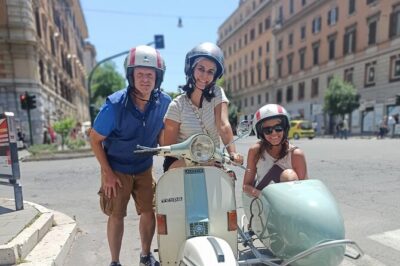 ★ 5.0Vespa Sidecar Tour By Night with PickupFrom $1461,803 reviews
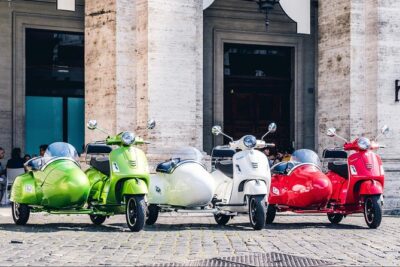 ★ 5.0Rome Morning Vespa Sidecar Tour in Rome with CappuccinoFrom $1631,771 reviews
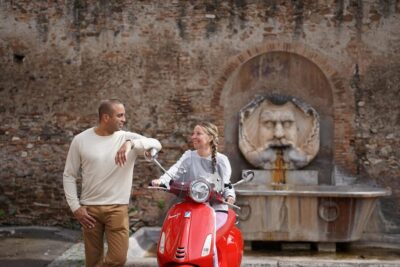 ★ 5.0Explore the City by Vespa with an Optional PhotoshootFrom $371,103 reviews
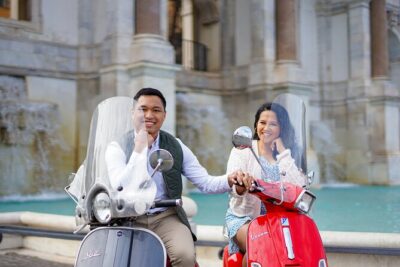 ★ 5.0Rome Vespa Scooter Tour with Professional PhotographerFrom $66857 reviews
 ★ 4.9Highlights Vespa Sidecar Tour with Coffee and GelatoFrom $141747 reviews
 ★ 5.0Vespa Ride with Pictures and Sweet TastingsFrom $34723 reviews
 ★ 5.0Rome Afternoon Sightseeing Vespa Sidecar Tour with Gourmet GelatoFrom $163692 reviews
Pro Photoshoot include free transport with VESPAFrom $33501 reviews
Browse the lists this tour appears in