
A Vespa ride makes Rome feel close-up. This 90-minute guided loop mixes safe Vespa riding with real stories and photo stops that range from the Colosseum to quieter viewpoints, led by friendly pros like Ali and Esso.
I love two things most: the drivers keep it comfortable and controlled, and the guide’s talk is interactive, with quick questions and helpful context as you pass landmarks.
One catch to plan for: you don’t drive. If you’re hoping to take the wheel, this isn’t that kind of experience, and there’s also a strict weight limit (90 kg / 200 lbs) for safety.
In This Review
- Key highlights worth your attention
- How the Vespa Tour Works: Sit Back, Follow, Photograph
- Safety and Comfort: Why the Drivers’ Style Matters
- Colosseum Stop: Feeling the Scale Beyond the Postcards
- Giardino degli Aranci: Orange Trees, Panoramic Views, and an Optical Trick
- Circus Maximus Area: Imagining Chariot-Race Energy
- Fontana dell’Acqua Paola: A Short Stop That Works Like a Reset
- Janiculum Terrace: Viewpoints That Make Rome Feel Wide
- Trevi Fountain Timing and Photo Moment: Classic Rome, Quick and Practical
- Price and Value: Why $35 Can Make Sense in Rome
- What’s Included vs. Not: Know the Boundaries Up Front
- Who This Tour Fits Best (and Who Should Skip It)
- Should You Book This Rome Vespa Tour?
- FAQ
- How long is the Rome Vespa guided tour?
- How much does it cost?
- Can I drive the Vespa myself?
- Is there a weight limit?
- Is the tour suitable for children?
- What languages are available for the live guide?
- Where do I get picked up and dropped off?
- What if I need to cancel?
Key highlights worth your attention
- Professional drivers run the Vespa so you can focus on the sights and photos
- Small-group feel keeps the tour from turning into a stampede
- Guided photo breaks at each stop with assistance for better angles
- Colosseum + viewpoints + Rome’s quieter corners in one fast overview
- Orange Garden panoramas and optical illusion moments built into the route
- English, Russian, and Italian for straightforward, on-the-ground explanations
How the Vespa Tour Works: Sit Back, Follow, Photograph
This is a guided Vespa experience where the vehicle is operated by the tour driver. You’ll get a briefing before you ride, including safety rules and how the day flows, so you’re not guessing what happens next.
That setup matters in Rome. Streets can look chaotic from the sidewalk. On this tour, you’re not navigating traffic or timing crossings yourself—you’re riding with an experienced driver while your guide handles the story and the stops.
Expect photo pauses. The guide doesn’t just point at things; they help you time pictures so you’re not wandering off or missing the moment.
More of Rome from the sidecar
- Vespa Sidecar Tour By Night with Pickup
★ 5.0 · 1,803 reviews - Rome Morning Vespa Sidecar Tour in Rome with Cappuccino
★ 5.0 · 1,771 reviews - Rome: Explore the City by Vespa with an Optional Photoshoot
★ 5.0 · 1,103 reviews - Rome Vespa Scooter Tour with Professional Photographer
★ 5.0 · 857 reviews
Safety and Comfort: Why the Drivers’ Style Matters
From the start, the emphasis is comfort and control. You’ll hop onto the Vespa after the team explains the basics, and then you spend the next 90 minutes riding with professional drivers.
In real reviews, you’ll see the same theme: guides like Esso and Ali were praised for careful driving and making people feel at ease, even if someone was initially nervous. That’s a big deal because the biggest stress for first-timers is usually the ride itself.
If you catch cooler weather, keep this in mind. One review notes Ali offered his jacket to a cold family member. So if you run cold, bring a layer, and also know the team may help if someone needs it.
Colosseum Stop: Feeling the Scale Beyond the Postcards
The tour begins with the Colosseum, Rome’s most recognizable symbol for a reason. You’ll get around 10 minutes of guided time here, long enough to notice scale, details, and the atmosphere without spending your whole morning inside.
The guide ties what you see to gladiator-era imagination—explaining what the arena was for and why it mattered. Even if you’ve seen photos before, the Colosseum is one of those places where your brain needs a real sense of size.
Practical note: this stop works best if you’re ready to look up and around. The point isn’t to memorize every fact; it’s to walk away with a clearer mental map of what you’re seeing across the rest of Rome.
Giardino degli Aranci: Orange Trees, Panoramic Views, and an Optical Trick
Next is Giardino degli Aranci (the Orange Garden), where the mood shifts from the big arena energy to something calmer and more photogenic. You’ll have about 20 minutes here, guided, with time to stroll among orange trees and soak in city views.
What I like about this stop is that it gives you a break from constant “major monument” focus. The guide adds a fun detail tied to the gardens’ optical illusion, so it feels like more than just a pretty viewpoint.
It’s also a smart pacing choice. The Colosseum can be overwhelming. This garden stop resets your eyes, gives your camera a better background, and makes the rest of the route feel easier to follow.
Worth a look next to this Rome booking:

Circus Maximus Area: Imagining Chariot-Race Energy
After the Orange Garden, the tour moves toward the ancient racecourse area—Circus Maximus. Even when you’re not surrounded by walls and arches the way you are at the Colosseum, the guide helps you picture the excitement that once played out there.
This is one of the “context” stops that makes a short tour feel richer. You’re not trying to read a textbook. You’re being guided to notice what the place would have looked and felt like, and that changes how you perceive the street-level city around you.
If you like history because it makes you see the present differently, this part is a strong payoff. It’s Rome’s stories, not just Rome’s photos.
Fontana dell’Acqua Paola: A Short Stop That Works Like a Reset
The route includes a quick guided moment at Fontana dell’Acqua Paola, scheduled for about 5 minutes. That short timing is intentional.
You’ll get just enough explanation to appreciate what you’re looking at, then you’re moving again—so the day stays energetic and you don’t lose momentum. In a 90-minute tour, these “quick stops” are often where you learn the most, because the guide can keep things focused.
Janiculum Terrace: Viewpoints That Make Rome Feel Wide
Next up is Janiculum Terrace, with about 15 minutes on the guided side. This is where you see Rome from a distance, which helps you understand how the city stretches.
The value here is not only the view. It’s how the guide uses that viewpoint to connect landmarks and neighborhoods you’ve been riding past. You start recognizing the city as a whole, not a series of separate stops.
This is also a strong photo window. You’re not fighting for space in the middle of the most crowded monument zone—you’re taking in wide scenery and letting the light and angles do the work.
Trevi Fountain Timing and Photo Moment: Classic Rome, Quick and Practical
Trevi Fountain is on the schedule as another guided stop with photo opportunities. The exact guided time listed is inconsistent in the details you were given, so I won’t pretend it’s a long visit. What matters for your planning: it’s included as a key photo and landmark moment.
This is a good stop to approach with a simple plan: be ready for photos fast, listen for what the guide points out, and then enjoy the fountain’s presence without turning it into a time sink.
If Trevi is on your must-see list, having it built into a Vespa circuit is useful. It saves you from doing a whole separate trek just to check it off.
Price and Value: Why $35 Can Make Sense in Rome
At $35 per person for a 90-minute guided Vespa ride, this can be good value—especially as a first or second activity in Rome.
Here’s why the math works in real life:
- You’re paying for expert drivers plus a live guide who talks as you ride, so you’re getting more than transport.
- You get structured stops and photo breaks, which reduces the usual Rome hassle of trying to coordinate viewpoints on your own.
- It’s a small-group setup, meaning you’re more likely to get your questions answered and have time to reposition for pictures.
It’s also a smart option if you want an overview without committing to a full day walking. You’re still seeing major places, but you’re moving between them efficiently.
The trade-off is simple: you’re not driving. If you want the control of renting a Vespa and setting your own route, that’s not what this tour is built for. But if you want the fun and the sights with less stress, the price lines up well.
What’s Included vs. Not: Know the Boundaries Up Front
Included in the experience are the guided Vespa tour, a professional guide, stops at major landmarks, and photo opportunities at each stop with guide assistance. It’s also described as a small group experience.
What isn’t included matters mainly because it changes expectations: you can’t drive the Vespa yourself, since it’s operated by the tour guide. Plan to be a passenger, not a rider-in-command.
Who This Tour Fits Best (and Who Should Skip It)
This tour is a great fit if you want:
- A quick Rome orientation with major stops
- A fun transportation method that reduces walking fatigue
- Photo-friendly pacing with help timing your shots
- Live guidance in English, Russian, or Italian
It’s also especially useful early in your trip. Getting the layout fast helps your later museum and neighborhood exploring feel less random.
Skip this tour if:
- You’re under 10 years old (not suitable)
- You’re over 90 kg / 200 lbs (safety limit)
- You really want to drive the Vespa yourself (this tour doesn’t offer that)
Should You Book This Rome Vespa Tour?
If you’re looking for a fun, guided introduction to Rome that hits big landmarks and quieter viewpoints, I think it’s an easy yes. The combination of professional drivers, guided context at each stop, and photo breaks with assistance makes it feel like time spent efficiently, not rushed.
Book it if you value safety and structure and you’d rather enjoy the ride than figure out streets on your own. I’d pass if you’re over the weight limit or you want to drive.
If you’re choosing between this and a walking tour, consider your style. This one trades walking time for a more playful route and faster connections between places. In a city this big, that can be exactly what you need.
FAQ
How long is the Rome Vespa guided tour?
The tour lasts 90 minutes.
How much does it cost?
It’s $35 per person.
Can I drive the Vespa myself?
No. The Vespa cannot be driven by the customer. it’s operated by the tour guide.
Is there a weight limit?
Yes. For safety reasons, participants over 90 kg cannot ride on a Vespa. The information also states it’s not suitable for people over 200 lbs (91 kg).
Is the tour suitable for children?
No. It’s not suitable for children under 10 years old.
What languages are available for the live guide?
The live tour guide is available in English, Russian, and Italian.
Where do I get picked up and dropped off?
The starting or pickup location depends on the selected option. There are two drop-off locations: Via Cavour, 207 and Via del Colosseo, 31.
What if I need to cancel?
Free cancellation is available up to 24 hours in advance for a full refund.
More Tours in Rome
- Vatican Museums, Sistine Chapel & St. Peter’s Basilica Tour
★ 4.3 · 73,970 reviews - Vatican Museums, Sistine Chapel & St Peter’s Basilica Guided Tour
★ 4.5 · 39,149 reviews - Rome: Colosseum, Palatine Hill and Roman Forum Guided Tour
★ 4.8 · 32,814 reviews - Rome: Guided Tour of Colosseum, Roman Forum & Palatine Hill
★ 4.7 · 27,897 reviews - Rome: Colosseum, Roman Forum and Palatine Hill Guided Tour
★ 4.5 · 23,903 reviews - Rome: Colosseum Arena Floor, Palatine & Forum Guided Tour
★ 4.5 · 20,180 reviews
More Tour Reviews in Rome
- Vatican Museums, Sistine Chapel & St. Peter’s Basilica Tour
★ 4.3 · 73,970 reviews - Vatican Museums, Sistine Chapel & St Peter’s Basilica Guided Tour
★ 4.5 · 39,149 reviews - Rome: Colosseum, Palatine Hill and Roman Forum Guided Tour
★ 4.8 · 32,814 reviews - Rome: Guided Tour of Colosseum, Roman Forum & Palatine Hill
★ 4.7 · 27,897 reviews - Rome: Colosseum & Forum with Audio Guide App -Optional Arena
★ 4.2 · 24,770 reviews - Rome: Colosseum, Roman Forum and Palatine Hill Guided Tour
★ 4.5 · 23,903 reviews
More Vespa Days in Rome
- Vespa Sidecar Tour By Night with Pickup
★ 5.0 · 1,803 reviews - Rome Morning Vespa Sidecar Tour in Rome with Cappuccino
★ 5.0 · 1,771 reviews - Rome: Explore the City by Vespa with an Optional Photoshoot
★ 5.0 · 1,103 reviews - Rome Vespa Scooter Tour with Professional Photographer
★ 5.0 · 857 reviews - Rome: Highlights Vespa Sidecar Tour with Coffee and Gelato
★ 4.9 · 747 reviews - Rome: Vespa Ride with Pictures and Sweet Tastings
★ 5.0 · 723 reviews
Just added to our Rome reviews





Rome Vespa Tours, compared.
 ★ 5.0Vespa Sidecar Tour By Night with PickupFrom $1461,803 reviews
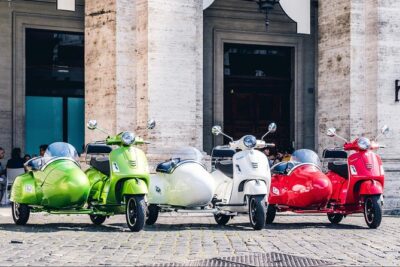 ★ 5.0Rome Morning Vespa Sidecar Tour in Rome with CappuccinoFrom $1631,771 reviews
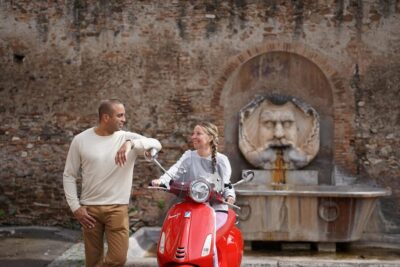 ★ 5.0Explore the City by Vespa with an Optional PhotoshootFrom $371,103 reviews
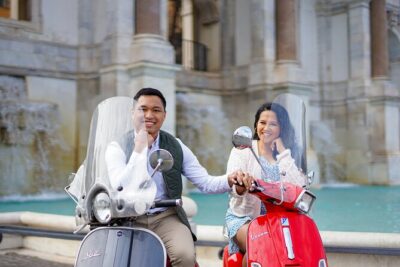 ★ 5.0Rome Vespa Scooter Tour with Professional PhotographerFrom $66857 reviews
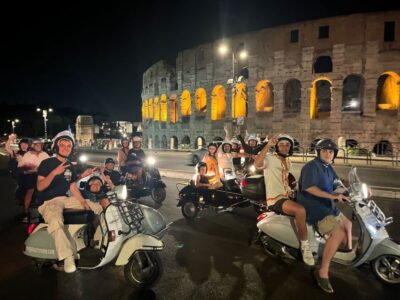 ★ 4.9Highlights Vespa Sidecar Tour with Coffee and GelatoFrom $141747 reviews
 ★ 5.0Vespa Ride with Pictures and Sweet TastingsFrom $34723 reviews
 ★ 5.0Rome Afternoon Sightseeing Vespa Sidecar Tour with Gourmet GelatoFrom $163692 reviews
Pro Photoshoot include free transport with VESPAFrom $33501 reviews
Browse the lists this tour appears in