
Reviewed · TRASTEVERE TOURS
Trastevere and the Jewish Ghetto: The Heart of Rome
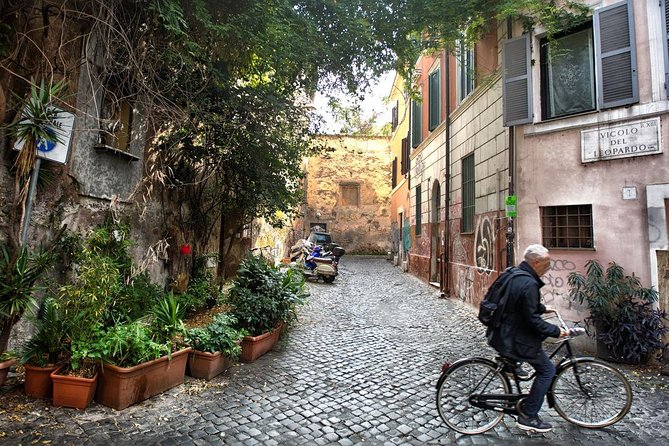
That river-side route changes how you see Rome. This private walk stitches together Trastevere and the Jewish Ghetto, plus a crossing on Isola Tiberina, so you get old Rome, Catholic Rome, and everyday street life in the same afternoon. It is not the usual route of big monuments only. It’s the neighborhoods that shaped people.
Two things I really like: first, the guide-led storytelling is built around real places, from the Ghetto area near the Tiber to Trastevere’s churches and plazas. Second, it’s structured for you to slow down—private pacing and a dedicated guide means you can ask questions instead of scanning a placard. A possible drawback: this route covers centuries of faith, power, and persecution, so it can feel emotionally heavy even when the walk itself is lively.
If you want Rome’s texture—stone streets, lived-in history, and art in context—this tour is a strong pick.
In This Review
- Key things that make this tour worth your time
- A Rome neighborhood tour that feels like a story, not a checklist
- How the private format changes your Trastevere + Ghetto experience
- Stop 1: Antico Quartiere Ebraico and the Jewish Museum of Rome
- Jewish Museum of Rome: why this stop lands
- How long to expect here
- What you’ll see while moving through the ghetto area
- Crossing the Tiber on Isola Tiberina (and why it matters)
- Stop 2: Trastevere highlights like Piazza Trilussa and Santa Maria in Trastevere
- Piazza Trilussa: a plaza you can orient from
- Santa Maria in Trastevere and its glittering mosaics
- Churches you might also hit: Santa Cecilia
- Admission included again
- The guide experience: what Giuseppe’s style does for you
- Price and value: is $735.22 per person reasonable here?
- Practical tips so your day runs smoothly
- Who should book this tour?
- Should you book Trastevere and the Jewish Ghetto?
- FAQ
- How long is the Trastevere and Jewish Ghetto tour?
- What does the tour cost?
- Is pickup and drop-off included?
- Is this tour private?
- Are admission tickets included?
- Do you get a mobile ticket?
- Is there free cancellation?
- Is service allowed on the tour?
Key things that make this tour worth your time
- A guided route through two eras of Rome: the Jewish community area and Trastevere, linked by the Tiber.
- Isola Tiberina in the mix: the crossing adds a breather and a different view of the city.
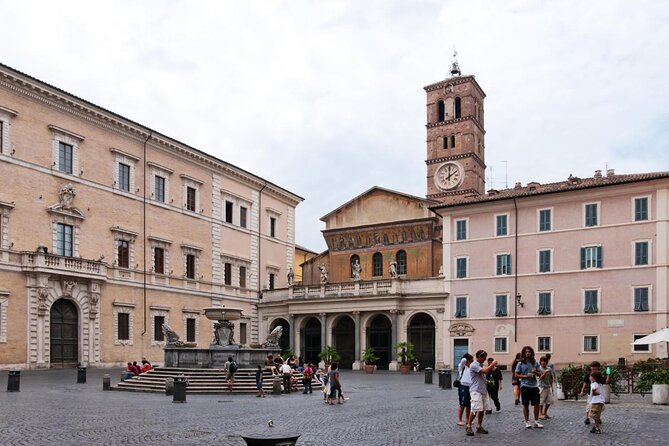
- Big-name stops you can actually place: Piazza Trilussa, Santa Maria in Trastevere mosaics, Portico d’Ottavia, and Bernini’s Turtle Fountain.
- Jewish Museum of Rome access via the Great Synagogue complex: an important stop, and one that benefits from a real guide.
- Private by design: your group sets the pace, with a guide who can tailor what you focus on.
- Guide spotlight: Giuseppe: repeatedly praised for making the story clear, simple, and current—not just old facts.
A Rome neighborhood tour that feels like a story, not a checklist
Rome can be loud. You can spend a whole trip hitting icons and still feel like you missed the point. This tour is different because it treats Rome like a set of connected neighborhoods—each with its own rules, faiths, art, and everyday rhythm.
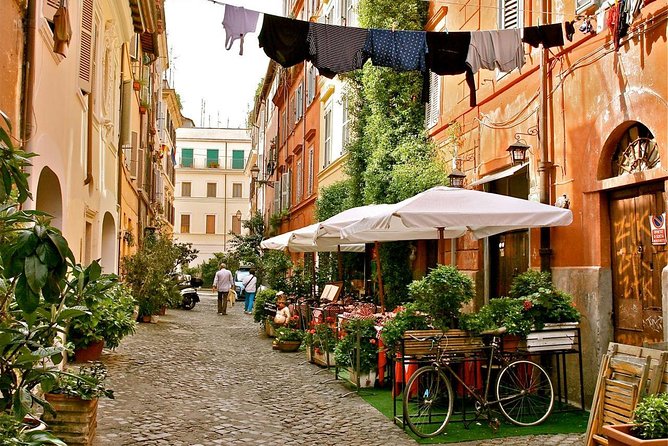
Trastevere, literally the other side of the river, carries that sense of a “different Rome.” You’ll spend time among its church fronts, plazas, and street corners where the city still feels like a local place rather than a museum. Then you shift toward the Antico Quartiere Ebraico, where history is not just in buildings—it’s in the way the streets remember who lived here and what happened over time.
What makes this route work is the bridge between those worlds: you don’t just jump from one “site” to another. You cross the Tiber area (including Isola Tiberina), and the walk itself helps you connect themes—power, community, art, and daily life.
More lanes worth losing an evening in Trastevere
- Winner 2025 Rome Twilight Trastevere Food Tour by Eating Europe
★ 5.0 · 5,157 reviews - Rome Food Tour: Campo de’ Fiori, Ghetto, Trastevere Winner 2024
★ 5.0 · 3,205 reviews - Rome: Guided Food Walking Tour with Wine in Trastevere
★ 4.9 · 3,105 reviews - Rome: Trastevere Food tour with Free-Flowing Fine Wine
★ 5.0 · 2,853 reviews
How the private format changes your Trastevere + Ghetto experience
This is a private walking tour for your group, with a dedicated professional guide. That matters more than it sounds. In this kind of neighborhood history, the details are the whole point. If you only have a standard group tour, you spend energy keeping up. With a private format, you can actually follow the story.
You also get freedom with pacing and route focus. The highlights include big anchor sights, but the tour is set up so the guide can adjust to your interests—whether you’re more into architecture and art, or more into how the Jewish community’s history ties into the papacy and Roman Catholic power.
And yes, it helps that the guides assigned to this route are known for being clear and engaging. Multiple accounts mention Giuseppe specifically, with a style that connects historical context to present-day understanding.
Stop 1: Antico Quartiere Ebraico and the Jewish Museum of Rome
The heart of this tour starts with the Jewish Ghetto area near the Tiber. This is where you learn why the neighborhood matters, not just what’s there.
You’ll hear how Rome’s Jewish community is one of the oldest in the world, and how its story became intertwined with the events of the Roman Catholic Church and the papacy. The tour framing is not one-note. It recognizes that for centuries the papacy could play both protector and persecutor—an important detail because it explains why the neighborhood’s history feels complex rather than simple.
From there, you focus on the Ghetto itself—described as the small patch of land where the community was confined under Pope Paul IV. This is a key moment in the story, because it turns the neighborhood from background into consequence. Streets here are not just pretty. They are evidence.
Jewish Museum of Rome: why this stop lands
Right in the Ghetto is the Jewish Museum of Rome, housed in the complex of the Great Synagogue. The tour treats this as more than a checkmark. A museum visit works best when a guide can point out what to look for and why it matters.
Even if you think you know the basics, a guided visit helps you connect artifacts and narratives to the surrounding neighborhood. That’s also where the “past meets present” theme becomes real, because you’re not traveling to history in isolation—you’re standing inside the area where history unfolded.
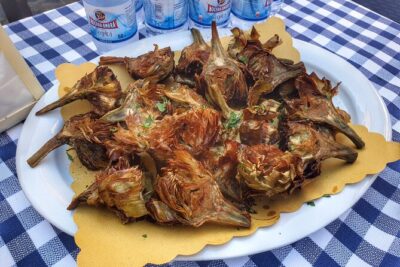
More of the Ghetto's quiet corners

How long to expect here
Stop time is listed as about 2 hours with admission included. In practice, that’s enough time for the main sights without rushing through. If you tend to ask questions, it’s also a comfortable window for the guide to slow down rather than steam ahead.
What you’ll see while moving through the ghetto area
This portion is where several named landmarks help you build a mental map. The highlights include:
- Portico d’Ottavia, a dramatic ancient Roman structure that gives you a tangible sense of layers. This is where you can feel time stacking up rather than separating into neat eras.
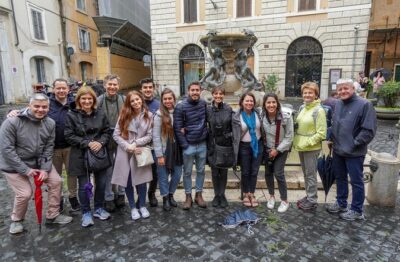
- Bernini’s Turtle Fountain. It’s a small stop, but it’s the kind of detail that makes the walk memorable. When the guide places it in context, it stops being “a fountain” and becomes a piece of Rome’s artistic language.
The big advantage here is that you’re not bouncing randomly. You’re moving with a guide who can connect ancient Rome, Renaissance art, and the Ghetto story into one route you can follow.
Crossing the Tiber on Isola Tiberina (and why it matters)
Between the two neighborhood zones, you cross the Tiber River via Isola Tiberina. This isn’t just a scenic detour. It functions like a “story reset” in walking-tour terms.
After the weightier themes of the Ghetto, crossing on the river island helps break the emotional density with a new perspective. You’ll get a different sense of scale, and the route becomes more than a line on a map—it becomes an experience of how Rome is shaped by water and movement.
The tour also highlights ancient ruins and picturesque lanes around this area. Even if you’re not a ruins superfan, it’s the kind of segment that helps you breathe, take photos, and reset your attention for Trastevere.
Stop 2: Trastevere highlights like Piazza Trilussa and Santa Maria in Trastevere
Once you’re on the Trastevere side, the mood shifts toward streets, plazas, and church art. This is where you get the neighborhood’s public face.
Piazza Trilussa: a plaza you can orient from
You’ll spend time at Piazza Trilussa, one of Trastevere’s key squares. It’s a practical anchor point because it helps you orient yourself: from here, you can picture the neighborhood’s street grid and understand how the walk connects the dots. It’s also a good place for photos because the setting gives you that classic Rome feel without needing a ticketed attraction.
Santa Maria in Trastevere and its glittering mosaics
The tour includes time at Santa Maria in Trastevere, with a specific emphasis on its Byzantine mosaics. This matters because mosaics can look stunning but flat if you only see them as decoration.
With a guide, you learn how to read what you’re seeing—why the style looks the way it does and how that art fits into Rome’s religious visual culture. When you understand the context, the stop becomes more than a photo moment. It becomes a reference point for how Rome’s faith has shown itself in color, pattern, and light.
Churches you might also hit: Santa Cecilia
More than one account mentions Basilica of Santa Cecilia, and that gives you a hint about what this Trastevere portion can include. Santa Cecilia is tied to art and devotion, and it’s exactly the sort of stop where having a guide makes a difference: you’re not just walking into a church. You’re learning how to look.
Admission included again
Stop time is again listed as about 2 hours with admission tickets included. That combination of time plus ticketed sights is important if you want a true walking tour rather than a “photo and then run” format.
The guide experience: what Giuseppe’s style does for you
A repeated theme in the feedback for this route is the guide’s ability to explain both old and newer layers. Giuseppe comes up again and again for a style that’s organized, friendly, and detailed without sounding like a lecture.
What I like about this kind of guiding (and what you should look for when booking) is how it balances:
- history (names, eras, and why events happened),
- architecture and art (what you’re seeing and why it looks that way),
- and current context (how the neighborhood’s identity continues today).
If you enjoy learning that connects rather than just dates, this is the right match. You’ll come away with a map in your head, not just a set of photos on your phone.
Price and value: is $735.22 per person reasonable here?
This tour lists a price of $735.22 per person, lasts roughly 3 to 4 hours, and includes pickup/drop-off via luxury transportation plus a private chauffeur. It also includes a private professional guide and admission tickets.
That price can feel steep—until you break down what’s bundled:
- A private guide for the full route (not a quick walk-by)
- Admission tickets included for the sights on the path
- Pickup and drop-off with a luxury transfer and chauffeur
- A private format, meaning your pacing and questions aren’t competing with a big group
So the real value question becomes this: do you want a neighborhood tour with real context and less time spent managing logistics? If you do, this package starts to make sense, especially compared with building the day yourself (separate tickets, figuring routes, and trying to cover multiple themes without a guide).
If you’re traveling solo, you’ll likely feel the cost more sharply. If you’re splitting costs with someone you’d naturally like to talk history with, the price can feel more in line with what you actually get.
Practical tips so your day runs smoothly
A few things that help you get the most out of this kind of walking history:
- Bring comfortable shoes. This is a walking tour, and you’ll spend meaningful time on foot.
- Expect emotion. The Ghetto portion includes centuries of conflict and persecution, so go in mentally prepared for a story that doesn’t sugarcoat.
- Use the guide time wisely. This is not a place for passive listening. Ask about how the papacy and Catholic Rome shaped events, or how art like the mosaics fits the bigger picture.
- Plan your photo breaks. The route includes standout photo areas like Piazza Trilussa and church interiors, plus river views around Isola Tiberina.
Also, because tickets are handled with a mobile ticket, you can keep things simple on your end when you arrive.
Who should book this tour?
This tour fits best if you want:
- Rome beyond the headline monuments. You’ll still see major landmarks, but in a neighborhood context.
- A guided story that ties together Jewish history, Catholic power, and street-level life.
- Art and architecture that you can actually place in time and meaning, especially mosaics at Santa Maria in Trastevere.
- A private experience where the pace can match your curiosity.
It’s also a strong fit for repeat visitors. If you’ve been to Rome before, Trastevere and especially the Ghetto can still feel unfamiliar until a guide hands you the right framework.
Should you book Trastevere and the Jewish Ghetto?
I’d book it if you want a Rome day that feels human—streets with memory, churches with meaning, and a guide who connects past to present without turning everything into a history-drunk classroom.
Skip it (or consider another option) if you mainly want light, fast sightseeing with low emotional weight. This route earns its seriousness. It’s also walking-focused, so you’ll want to be comfortable on foot.
If you’re okay with that balance, this tour is a very solid way to see two of Rome’s most consequential neighborhoods in a single afternoon.
FAQ
How long is the Trastevere and Jewish Ghetto tour?
The tour runs about 3 to 4 hours in total, with the two main areas listed at about 2 hours each.
What does the tour cost?
The price is $735.22 per person.
Is pickup and drop-off included?
Yes. The tour includes pick-up and drop-off with luxury transportation and a private chauffeur.
Is this tour private?
Yes. It’s a private tour/activity, so only your group participates.
Are admission tickets included?
Yes. Admission tickets are included for the stops on the route.
Do you get a mobile ticket?
Yes. The tour includes a mobile ticket.
Is there free cancellation?
Free cancellation is available. You can cancel up to 24 hours in advance for a full refund.
Is service allowed on the tour?
Service animals are allowed.
More Tour Reviews in Rome
- Vatican Museums, Sistine Chapel & St. Peter’s Basilica Tour
★ 4.3 · 73,970 reviews - Vatican Museums, Sistine Chapel & St Peter’s Basilica Guided Tour
★ 4.5 · 39,149 reviews - Rome: Colosseum, Palatine Hill and Roman Forum Guided Tour
★ 4.8 · 32,814 reviews - Rome: Guided Tour of Colosseum, Roman Forum & Palatine Hill
★ 4.7 · 27,897 reviews - Rome: Colosseum & Forum with Audio Guide App -Optional Arena
★ 4.2 · 24,770 reviews - Rome: Colosseum, Roman Forum and Palatine Hill Guided Tour
★ 4.5 · 23,903 reviews
More Around the Jewish Ghetto
- Rome Food Tour: Campo de’ Fiori, Ghetto, Trastevere Winner 2024
★ 5.0 · 3,205 reviews - Jewish Ghetto and Trastevere Tour Rome
★ 4.5 · 1,729 reviews - Rome: Eat Like a Roman Ghetto & Campo de’ Fiori Food Tour
★ 5.0 · 1,037 reviews - Jewish Ghetto and Synagogues with Jewish Roman Guide 3 Hours
★ 5.0 · 907 reviews - Jewish Ghetto & Piazza Navona: Food, Wine & Sightseeing Rome Tour
★ 5.0 · 460 reviews - Rome: Food & Wine Tour of Campo de Fiori, Ghetto, Trastevere
★ 4.8 · 413 reviews
Still in Trastevere? Keep Going
- Winner 2025 Rome Twilight Trastevere Food Tour by Eating Europe
★ 5.0 · 5,157 reviews - Rome Food Tour: Campo de’ Fiori, Ghetto, Trastevere Winner 2024
★ 5.0 · 3,205 reviews - Rome: Guided Food Walking Tour with Wine in Trastevere
★ 4.9 · 3,105 reviews - Rome: Trastevere Food tour with Free-Flowing Fine Wine
★ 5.0 · 2,853 reviews - Rome: Trastevere & Campo de Fiori Street Food Walking Tour
★ 4.9 · 2,768 reviews - Rome: Award Winning Trastevere Group Food Tour with Wine
★ 5.0 · 2,273 reviews
Just added to our Rome reviews





Trastevere Tours, compared.
 ★ 5.0Winner 2025 Rome Twilight Trastevere Food Tour by Eating EuropeFrom $1255,157 reviews
 ★ 5.0Rome Food Tour: Campo de’ Fiori, Ghetto, Trastevere Winner 2024From $883,205 reviews
 ★ 4.9Guided Food Walking Tour with Wine in TrastevereFrom $1003,105 reviews
 ★ 5.0Trastevere Food tour with Free-Flowing Fine WineFrom $1022,853 reviews
 ★ 4.9Trastevere & Campo de Fiori Street Food Walking TourFrom $512,768 reviews
 ★ 5.0Award Winning Trastevere Group Food Tour with WineFrom $812,273 reviews
 ★ 4.8Trastevere Street Food Walking Tour with Local ExpertFrom $571,784 reviews
 ★ 4.5Jewish Ghetto and Trastevere Tour RomeFrom $41,729 reviews
Browse the lists this tour appears in