

Reviewed · WALKING TOURS
Rome: Walking Tour through the Marvel of the city
Six stops, one big Rome story. I like how this evening Rome walking tour strings together major sights in a tight time window, and I love that a Bluetooth headset helps you catch the guide even through the city noise.
You’ll also get a smart mix of free-entry monuments and one big paid-ticket highlight, so your money goes where it matters. The one possible catch: the Pantheon ticket isn’t included, so plan for extra cost and a bit of queue time.
In This Review
- Key highlights worth aiming for
- A 2.5-hour Rome route: from Castel Sant’Angelo to Piazza Venezia
- Price and value: what $47.06 really covers
- Castel Sant’Angelo: Hadrian’s Mausoleum and the Archangel connection
- Piazza Navona’s Fountain of the Four Rivers (plus Sant’Agnese)
- The Pantheon: temple of all the gods and the one paid ticket
- Largo Argentina: cat shelter ruins and Julius Caesar’s assassination site
- Ghetto Ebraico: Rome’s Jewish quarter and community life
- Piazza del Campidoglio: Capitolium Hill, Jupiter’s temple, and city hall
- Why the Bluetooth headset changes the whole experience
- Timing, comfort, and what to expect on a 6:00 pm start
- Should you book this Rome walking tour?
- FAQ
- How long is the Rome walking tour?
- What time does the tour start?
- Where do I meet for the tour?
- Where does the tour end?
- What language is the tour offered in?
- Is a Bluetooth headset included?
- How many people are in the group?
- Is Pantheon admission included?
- Do I need a passport for the tour?
- Is pickup or drop-off included?
- What’s the cancellation policy?
Key highlights worth aiming for
- Bluetooth headset for clear explanations right when streets get crowded
- Five free stops (Castel Sant’Angelo, Piazza Navona, Largo Argentina, Ghetto Ebraico, Piazza del Campidoglio)
- Castel Sant’Angelo’s real origin as Hadrian’s Mausoleum before it became an angel-named fortress
- Largo Argentina’s Roman drama: cat-filled ruins at Julius Caesar’s assassination site
- Ghetto Ebraico’s living legacy as the core Jewish-Roman community
- Small group size (max 15 people) so you actually stay together and hear what’s said
A 2.5-hour Rome route: from Castel Sant’Angelo to Piazza Venezia
This is an efficient evening walk that runs about 2 hours 30 minutes and starts at 6:00 pm. You’ll begin on the river side at Castel Sant’Angelo (Lungotevere Castello 50) and finish near Piazza Venezia. That end point is handy because it puts you close to lots of transport options and other Roman wandering paths.
The route is built for momentum. Each main stop gets around 20 minutes, so you won’t feel stuck in one place for too long. It’s the kind of pacing that helps you see Rome’s big landmarks first, then decide what you want to return to later on your own.
One practical note: because it’s a walking tour, you should expect the usual Rome mix of stone streets and uneven surfaces. The good news is that you’re not doing a long-distance hike. You’re doing a classic city loop, guided and organized.
Worth a look next to this Rome booking:
- Rome: Guided Food Walking Tour with Wine in Trastevere
★ 4.9 · 3,105 reviews - Rome: Trastevere & Campo de Fiori Street Food Walking Tour
★ 4.9 · 2,768 reviews - Rome: Paranormal Night Walking Tour & Secret Backstreets
★ 4.9 · 1,921 reviews - Rome: Trastevere Street Food Walking Tour with Local Expert
★ 4.8 · 1,784 reviews
Price and value: what $47.06 really covers
At $47.06 per person, the value comes from two things: an official guide and a Bluetooth headset. In Rome, that headset matters more than you might think. It lets you hear the explanations while you’re turning your head to read carvings, look at domes, and dodge foot traffic.
You also get a lot of sites marked as free admission on this walk. That lowers the “surprise costs” factor. The one standout that is not included is the Pantheon admission, so you’ll want to budget for that separately.
So the cost isn’t just paying for someone to walk with you. You’re paying for:
- clear context at major monuments
- help navigating busy areas
- audio support through the headset
- time-saving structure so you’re not guessing what matters at each stop
Castel Sant’Angelo: Hadrian’s Mausoleum and the Archangel connection
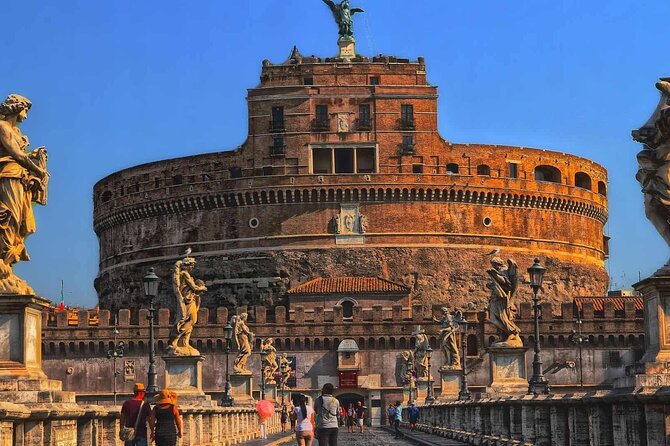
Your first stop is Castel Sant’Angelo, and it’s one of those places where the name alone already pulls you in. It’s tied to Archangel Michael, but it began as the Mausoleum of Emperor Hadrian, built in 139 AD. In other words, you get a shortcut into two eras of Rome: the imperial world that created the structure, and the later story that gave it its angelic reputation.
Even with only about 20 minutes here, you can get a feel for why the building is so strategic. It sits like a landmark on the riverfront, so you can understand how control of water routes mattered. The guide’s job is to point out what to look for fast, without you needing architectural homework.
A good consideration: this is a “first stop” location, so it’s where you’ll likely learn how the rest of the walk is going to flow. If you want the most from it, arrive on time. The tour asks you to be at the meeting point 15 minutes early, which is one of those small habits that keeps the rest of the evening smooth.
Piazza Navona’s Fountain of the Four Rivers (plus Sant’Agnese)
Next up is Piazza Navona, one of Rome’s most famous squares. The main visual is the Fountain of the Four Rivers, and the whole space tends to feel like a stage because of how open it is compared to the narrow streets around it.
This stop is great for a few reasons:
- You can see the fountain up close and get the scale quickly
- The square gives you a sense of where people gather and linger
- The nearby church of Sant’Agnese in Agone adds a strong architectural counterpoint
With about 20 minutes, you’ll probably do a quick circuit: fountain views, then a look toward the church. It’s enough time to enjoy the square without turning it into a long detour.
The one potential drawback here is crowds. Piazza Navona is busy at almost any hour, and an evening start can mean more foot traffic. Your best move is to let the guide set you in a good viewing spot first, then step in for photos rather than trying to fight your way into prime positions.
Worth a look next to this Rome booking:


The Pantheon: temple of all the gods and the one paid ticket
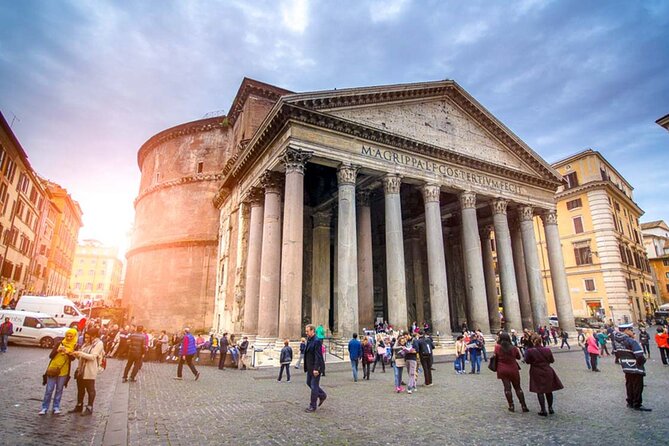
The Pantheon is on the route with an emphasized role: it’s the Temple of all the gods, and it’s one of the most recognizable domed spaces in the city. The big practical thing is that Pantheon admission is not included. That means you should expect an extra cost and some time spent entering.
Why I think it’s worth the separate ticket: the Pantheon is the rare sight that works at three levels at once. You can appreciate it visually even if you know little about Roman religion, understand its engineering basics without a lecture, and still feel the awe factor from how the interior light hits the space.
With only around 20 minutes for the stop, your best strategy is to keep your expectations tight:
- Expect to see the key interior perspective
- Don’t plan to read every label or you’ll run out of time
- Use the guide’s pointers to pick what to look at first
This stop can also set the tone for the rest of the evening. If the Pantheon entrance feels slower than you hoped, the headset and guide help you stay oriented so the walk doesn’t feel rushed later.
Largo Argentina: cat shelter ruins and Julius Caesar’s assassination site
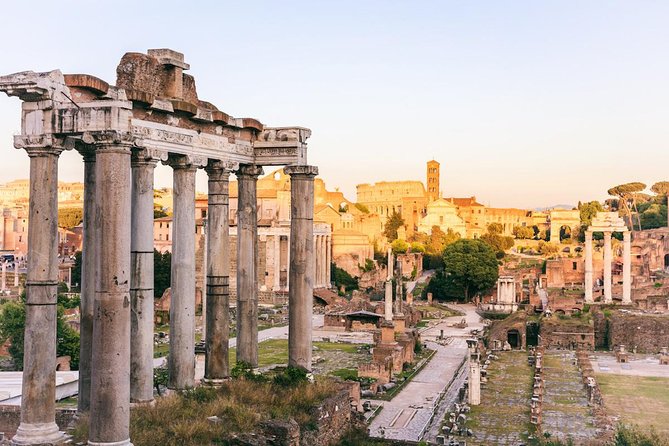
Now you hit a place where Rome gets dramatic in real time. Area Sacra di Largo Argentina is known today for being a popular cat shelter, but it’s also the archaeological area tied to Julius Caesar’s assassination.
What makes Largo Argentina special is the contrast. You’re surrounded by ruins that carry a major historical event, yet you might also notice cats wandering through the edges of the site. The guide’s context is what turns scattered stones into a meaningful story: where the action happened, why the space matters, and how later Rome understood and repurposed older remains.
The stop is free-entry and lasts about 20 minutes, which is just enough for you to grasp the site’s importance and take in the atmosphere. If you’re a person who likes history, this is one of the best places on the walk for that payoff. If you’re more into atmosphere than dates, the cats and ruins mix gives you a human, on-the-ground feel instead of a lecture-only moment.
A small consideration: because it’s an archaeological area, movement can be less straightforward than a normal square. Wear shoes you trust on uneven paths, and don’t rush ahead of the group when the guide is pointing out the key areas.
Ghetto Ebraico: Rome’s Jewish quarter and community life
The walk moves into Ghetto Ebraico, also called the Jewish District. Here, you get something that many Rome sites don’t offer: a sense that the past isn’t just behind glass. The district is described as the oldest Jewish community of the western world, and it’s still the core of the Jewish-Roman community.
This matters because it changes how you experience the area. Instead of treating it like a museum, you’re seeing a neighborhood with ongoing identity. Even if you don’t go inside specific sites during the stop, the guide’s framing helps you read the streets with more care.
The stop is free-entry and timed at about 20 minutes, which keeps it from turning into a rushed drive-by. You’ll likely get a quick orientation: what the district means, why it’s historically significant, and what to pay attention to while you’re walking through.
One practical note: this is a district, not an empty postcard square. You’ll be sharing space with everyday life, so keep your pace considerate and follow the guide when crossing or stopping.
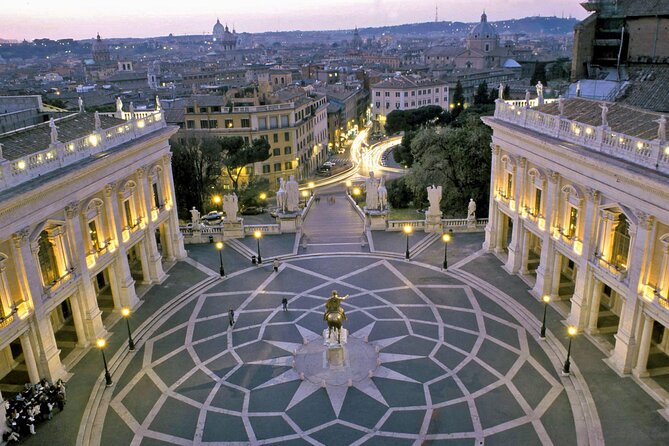
Piazza del Campidoglio: Capitolium Hill, Jupiter’s temple, and city hall
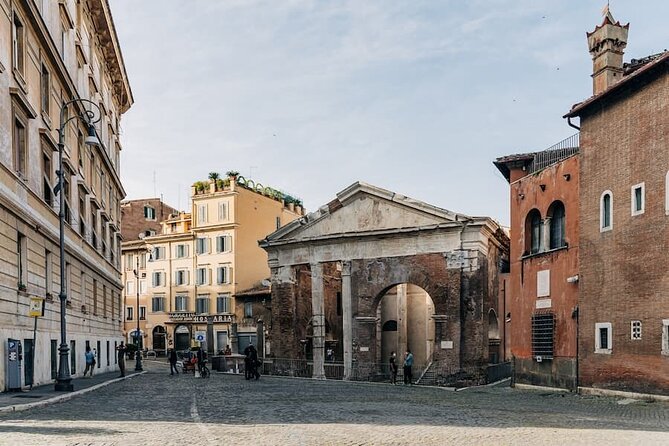
The last major stop is Piazza del Campidoglio, on Capitolium Hill. The area is tied to the word capital, which is a fun linguistic hook and a reminder of how Roman power echoes through modern language.
You’ll hear about the ancient temple of Jupiter in this area, and today the hill also houses Rome’s city hall plus the Musei Capitolini. In other words, you’re ending on a place where layers of Rome stack up: imperial religious meaning, then the modern seat of government, then museum culture.
Ending here is smart. It’s close enough to keep walking easy to the finish area near Piazza Venezia, and it gives you a strong visual “wrap” to the evening. From a planning angle, it also means you’re finishing at a point where you can keep exploring on your own without feeling like you’re stranded across town.
Because the stop is about 20 minutes, aim to absorb the viewpoint and the big-picture layout more than trying to pack in museum-level detail. If you later want Musei Capitolini, you’ll know where to go.
Why the Bluetooth headset changes the whole experience
In Rome, sound is a challenge. Cars, voices, scooters, and street noise can turn classic monuments into background noise if you rely only on your own hearing. That’s exactly where the Bluetooth headset becomes a practical upgrade.
With the headset, the guide can pace your group and explain what you’re seeing without yelling or constantly repeating themselves. It also helps you keep looking at the monuments instead of constantly searching for where the guide stands.
The best part is how it supports short stops. Since you only get around 20 minutes per location, you don’t have time to “catch up later” on your own. The headset helps you catch context quickly so the rest of the walk makes sense.
Also, small groups help. This tour caps at 15 people, which typically means you’re not just another blob in a crowd. You’re more likely to stay in the flow and hear direction when it’s time to move.
Timing, comfort, and what to expect on a 6:00 pm start
Starting at 6:00 pm is a good choice for a walking tour. The city often feels more manageable than peak daytime hours, and the lighting can make Rome’s stone surfaces look extra dramatic. Just remember: it’s still Rome, so street patterns don’t magically become smooth because it’s evening.
This walk requires good weather. If rain is in the forecast, you might see schedule changes or a different date offered. Since it’s a walking route across multiple outdoor sites, weather matters more than it would for an indoor-only plan.
Comfort-wise:
- Plan for a steady walking pace between stops
- Expect to stop often for photos and explanation
- Bring a light layer if evenings feel cool to you
And because this is organized and timed, you’ll get more out of the experience if you show up when they ask. Being at the start location 15 minutes early helps the group launch properly.
Should you book this Rome walking tour?
I’d book it if you want a structured evening that hits Rome’s biggest hits in a sensible order. The value is real: you get an official guide, a Bluetooth headset, and multiple free-entry stops, with only the Pantheon requiring extra admission. It’s also a good fit if you like context, not just sightseeing checklists.
I’d think twice if you’re someone who needs long unstructured time at one site. The stops are short by design, around 20 minutes each, so this isn’t a slow, lingering tour. Also, because Pantheon admission isn’t included, you should be ready to pay that add-on and manage any entry timing.
FAQ
How long is the Rome walking tour?
It’s listed at about 2 hours 30 minutes.
What time does the tour start?
The start time is 6:00 pm.
Where do I meet for the tour?
You meet at Castel Sant’Angelo, Lungotevere Castello, 50, 00193 Roma RM, Italy.
Where does the tour end?
It ends at Piazza Venezia, Roma RM.
What language is the tour offered in?
It’s offered in English.
Is a Bluetooth headset included?
Yes. A Bluetooth headset is included.
How many people are in the group?
The maximum group size is 15.
Is Pantheon admission included?
No. Pantheon admission is not included.
Do I need a passport for the tour?
Yes. A current valid passport is required on the day of travel.
Is pickup or drop-off included?
No. Pick up and drop off are not included.
What’s the cancellation policy?
Cancellation is free, and you can cancel up to 24 hours in advance for a full refund.
More Walking Tours in Rome
- Rome: Guided Food Walking Tour with Wine in Trastevere
★ 4.9 · 3,105 reviews - Rome: Trastevere & Campo de Fiori Street Food Walking Tour
★ 4.9 · 2,768 reviews - Rome: Paranormal Night Walking Tour & Secret Backstreets
★ 4.9 · 1,921 reviews - Rome: Trastevere Street Food Walking Tour with Local Expert
★ 4.8 · 1,784 reviews - Rome: Small-Group Guided Day or Night Walking Tour
★ 4.8 · 1,009 reviews - Rome by Night Walking Tour – Legends & Criminal Stories
★ 4.5 · 1,003 reviews
More Tours in Rome
- Vatican Museums, Sistine Chapel & St. Peter’s Basilica Tour
★ 4.3 · 73,970 reviews - Vatican Museums, Sistine Chapel & St Peter’s Basilica Guided Tour
★ 4.5 · 39,149 reviews - Rome: Colosseum, Palatine Hill and Roman Forum Guided Tour
★ 4.8 · 32,814 reviews - Rome: Guided Tour of Colosseum, Roman Forum & Palatine Hill
★ 4.7 · 27,897 reviews - Rome: Colosseum, Roman Forum and Palatine Hill Guided Tour
★ 4.5 · 23,903 reviews - Rome: Colosseum Arena Floor, Palatine & Forum Guided Tour
★ 4.5 · 20,180 reviews
More Tour Reviews in Rome
- Vatican Museums, Sistine Chapel & St. Peter’s Basilica Tour
★ 4.3 · 73,970 reviews - Vatican Museums, Sistine Chapel & St Peter’s Basilica Guided Tour
★ 4.5 · 39,149 reviews - Rome: Colosseum, Palatine Hill and Roman Forum Guided Tour
★ 4.8 · 32,814 reviews - Rome: Guided Tour of Colosseum, Roman Forum & Palatine Hill
★ 4.7 · 27,897 reviews - Rome: Colosseum & Forum with Audio Guide App -Optional Arena
★ 4.2 · 24,770 reviews - Rome: Colosseum, Roman Forum and Palatine Hill Guided Tour
★ 4.5 · 23,903 reviews
Just added to our Rome reviews





Walking Tours, compared.
 ★ 4.9Guided Food Walking Tour with Wine in TrastevereFrom $1003,105 reviews
 ★ 4.9Trastevere & Campo de Fiori Street Food Walking TourFrom $512,768 reviews
 ★ 4.9Paranormal Night Walking Tour & Secret BackstreetsFrom $341,921 reviews
 ★ 4.8Trastevere Street Food Walking Tour with Local ExpertFrom $571,784 reviews
 ★ 4.8Small-Group Guided Day or Night Walking TourFrom $231,009 reviews
 ★ 4.5Rome by Night Walking Tour – Legends & Criminal StoriesFrom $141,003 reviews
 ★ 4.4Guided City Center Evening Sightseeing Walking TourFrom $46953 reviews
 ★ 4.9Small-Group City Highlights Moonlight Walking TourFrom $29949 reviews
Browse the lists this tour appears in