
Reviewed · APPIAN WAY TOURS
Appian Way and Aqueducts Electric Bike Tour
That first pedal stroke out toward the Appian Way feels like a shortcut to ancient Rome. This electric bike tour strings together major ruins and calmer green space in one smooth, half-day circuit, with an expert guiding you through what you’re actually looking at. I especially like the mix of big-show landmarks (like Circo Massimo and the Circus of Maxentius) and the quieter, more human-scale stops beyond the core sights.
Two things I really liked are the safety-first way the guides manage traffic and group flow, and the quality of the e-bikes. In the reviews, guides like Monica and Adriana are praised for clear English and smart navigation, and that matters because you do leave the city rhythms and then ride on older, more uneven surfaces. The main drawback to plan for is that the route can be bouncy and rocky in spots, so you should expect a physical, hands-on experience even with pedal assist.
In This Review
- Key Points That Make This Tour Worth Your Time
- Why the Appian Way Tour Feels Like Real Rome (Not Just Ruins)
- E-Bikes, Helmets, and Setup That Actually Helps
- Circo Massimo and the Baths of Caracalla: Starting With Scale
- Porta San Sebastiano: One of Rome’s Best-Preserved Gates
- Catacombs of Saint Callixtus and the Circus of Maxentius
- Caecilia Metella and the Quintilii Villa: When the Ticket Is Worth It
- The Aqueduct Parks: Where Riding Turns Into a Sightseeing Superpower
- Parco della Caffarella and Egeria: The Legend Side of Rome
- Terrain, Pace, and What to Expect From the “Moderate Fitness” Call
- Guides, Group Size, and Why English Matters Here
- Value for $90.02: What You’re Really Paying For
- Who Should Book This (and Who Should Skip It)
- Should You Book the Appian Way and Aqueducts Electric Bike Tour?
- FAQ
- How long is the Appian Way and Aqueducts electric bike tour?
- What language is the tour offered in?
- Is the tour suitable for kids?
- Do I need to know how to ride a bike?
- Are admissions included for all the stops?
- Can I get a refund if I cancel?
Key Points That Make This Tour Worth Your Time
- Electric bikes that make the Appian route feel doable, even if you’re not a hardcore cyclist
- Small group size (max 10) for better pacing and easier guidance on rougher patches
- A guide-led history route that ties together arenas, baths, tombs, parks, and the legend of Egeria
- Mostly free stops, with only a few major sites requiring extra admission
- Green, outside-the-center riding, so the day doesn’t feel like another museum crawl
Why the Appian Way Tour Feels Like Real Rome (Not Just Ruins)
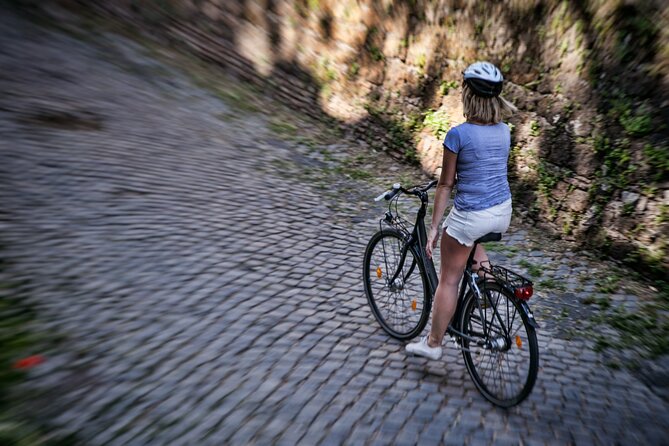
Rome has plenty of dramatic ruins packed into tight blocks. The Appian Way is different. It’s the kind of place where the city thins out, the air changes, and the monuments start to feel connected to the road itself rather than trapped behind ticket lines.
This tour is built around that idea: you ride from iconic ancient spaces into parks and countryside edges within Rome. That’s exactly why it works so well for first-time visitors who want more than the usual landmarks, and also for repeat visitors who want to see Rome’s layers without spending the whole day indoors. A small group helps here. When there are only about 10 people, it’s easier for your guide to keep everyone together and point out what matters without rushing.
Keep going down the Appian Way
- Rome EBike Tour: Appian Way, Catacombs & Roman Aqueducts
★ 5.0 · 1,766 reviews - Rome: Appian Way & Aqueducts E-Bike Tour (Catacombs & Food)
★ 4.9 · 1,498 reviews - Rome: Appian Way, Catacombs, & Roman Aqueducts E-bike Tour
★ 4.9 · 1,421 reviews - Rome Underground: Catacombs Tour, Aqueducts and Appian Way
★ 5.0 · 1,007 reviews
E-Bikes, Helmets, and Setup That Actually Helps
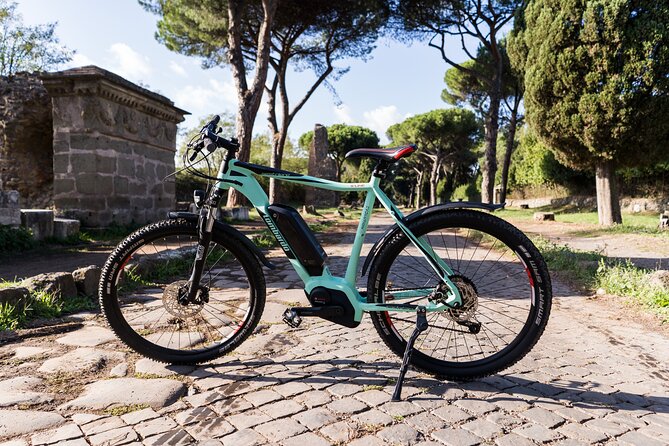
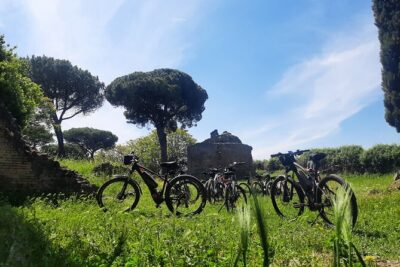
You’ll start with an e-bike in several sizes, plus a helmet and a phone holder. That sounds basic, but it’s practical. The phone holder matters because you’ll want to reference maps or photos while you’re learning the route, and a helmet is just the smart default for riding on older stone and mixed terrain.
If it’s your first time on an e-bike, you’re not alone. One reviewer specifically called out their first e-bike experience and said the equipment was easy to use. Still, the tour isn’t for people who don’t know how to ride a bike at all. The support is electric, not magical. You still have to steer, brake, and ride with awareness on surfaces that aren’t like a modern bike lane.
One more real-world tip: plan your clothing and footwear for a mix of paving and rougher sections. Even with assistance, you’ll feel bumps more than you would on smooth pavement.
Circo Massimo and the Baths of Caracalla: Starting With Scale
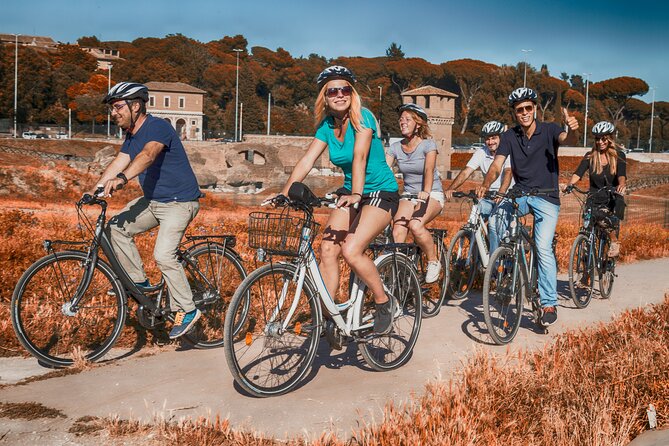
The day kicks off at Circo Massimo, the ancient Roman chariot-racing stadium. This site sits in a valley between the Aventine and Palatine hills, and it’s famous for being the first and largest of its kind in ancient Rome. What’s helpful on a guided ride is that the scale isn’t just a trivia fact. You get the sense of how enormous these spectator spaces were, and how public entertainment shaped daily Roman life.
From there you head toward Terme di Caracalla, the Baths of Caracalla. This is a major thermae complex, built in the early 200s under Septimius Severus and Caracalla, and used for centuries before falling into ruin. The important practical note: the Baths of Caracalla entry isn’t included. So if you want the best experience, factor extra time and bring what you need for admission.
Why these two stops make sense early: they set your “mental volume” for the day. After Circo Massimo’s stadium scale, the baths give you a different angle on Roman power—organized leisure, social space, engineering, and status.
Porta San Sebastiano: One of Rome’s Best-Preserved Gates
Porta San Sebastiano is the largest and one of the best-preserved gates in the Aurelian Walls. It’s the kind of stop that rewards slow attention. With gates, you’re looking at fortification logic—how Rome controlled movement and protected the city.
Also, it’s a good moment to settle after the big visual hits. You’re not just stacking one monument on another. Instead, you’re learning how Rome worked as a system: movement in and out, borders, and the route that connects everything.
This stop doesn’t cost extra admission on this route, which keeps the day’s pacing smoother.
More of Rome under pedal power
Catacombs of Saint Callixtus and the Circus of Maxentius
Then comes a dramatic shift in mood: the Catacombs of Saint Callixtus. The key detail here is that you’re in a very nice, mostly pedestrian area near the catacombs on the Appian corridor. That matters because catacombs can feel chaotic in bad conditions, but this part of the route is easier to navigate and focus on.
Again, you won’t pay extra for this stop as part of the tour route. That’s a big value point, especially since catacombs-style sites can be pricey depending on where you book.
From there you ride to the Circus of Maxentius, part of a complex built by Emperor Maxentius on the Via Appia in the late early 300s. This is another “arena with purpose” moment. You’ll see how Rome kept using public spectacle for identity and control. And it’s also a nice contrast to the catacombs: public crowds and quiet ritual spaces living on the same road network.
Caecilia Metella and the Quintilii Villa: When the Ticket Is Worth It
A couple of the most famous ancient stops along the Appian Way come with additional admission. Two you should expect are:
- Mausoleo di Cecilia Metella e Castrum Caetani (extra admission not included)
- Villa dei Quintili e Santa Maria Nova / Villa of the Quintilii (extra admission not included)
The Tomb of Caecilia Metella is one of the best-preserved monuments on the Appian corridor. It was built in the 1st century BC to honor Caecilia Metella, daughter of Quintus Caecilius Metellus Creticus. Even without getting lost in dates, the structure’s survival makes it easier to picture the road’s ceremonial and family power.
The Villa of the Quintilii is beyond the fifth milestone along the Via Appia Antica, built by the rich and influential brothers Sextus Quintilius Valerius Maximus and Sextus Quintilius Condianus. Why this matters for you: villas are how you see wealth in stone and planning, not just in monuments built for crowds.
If you don’t love ticketed stops, you can still enjoy the rest of the route. But if you do like detailed viewing, these two are the places where paying extra typically feels most satisfying.
The Aqueduct Parks: Where Riding Turns Into a Sightseeing Superpower
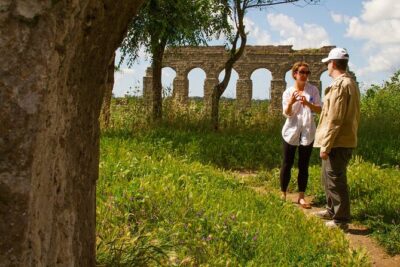
This is the part many people remember most: Parco degli Acquedotti (the Aqueducts Park). The park is named for the aqueducts running through it, including the Aqua Felix, plus parts of the Aqua Claudia. You also see remains connected to Villa delle Vignacce and a short stretch of the original Roman Via Latina.
This section is special because you’re not just looking at monuments from one angle. You’re moving along the line, with aqueduct structure patterns guiding your eyes as you ride. It’s one of the best ways to understand how Rome engineered water supply and how that infrastructure shaped the landscape over centuries.
Even if you skip all the museum-style stops, the aqueduct park alone can justify an e-bike day. It also adds balance to the route: less crowds, more breathing room, and a ride that feels like an outing rather than an exam.
Parco della Caffarella and Egeria: The Legend Side of Rome
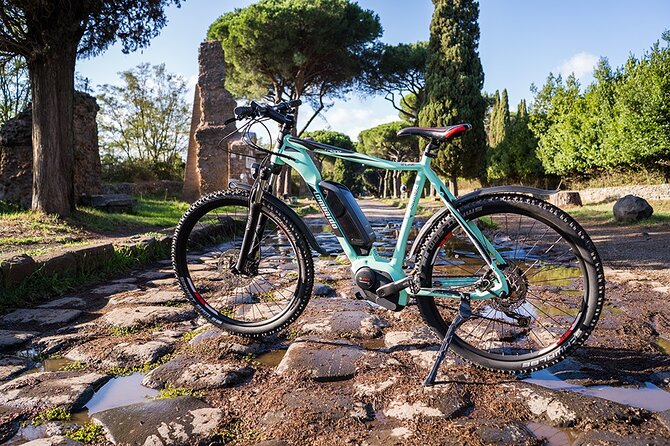
Next up: Parco della Caffarella. It’s a large park in the heart of Rome, part of the Parco Regionale Appia Antica. The Caffarella Valley is bordered by the Via Latina to the north and the Appian Way to the south. In plain terms, this is where Rome’s ancient roads stop feeling like city scenery and start feeling like real routes.
Then the day ends with Ninfeo di Egeria. Egeria is a legendary nymph linked with the early history of Rome, tied to Numa Pompilius as a counselor and source of laws and rituals in Roman religion. Even if you treat the story as legend, the point is that Rome keeps writing mythology onto physical locations. It’s a way of reading the city’s mind-set.
Stops like this are why a guided ride works. Without context, you might see a structure and move on. With context, you start connecting why it mattered to people long ago.
Terrain, Pace, and What to Expect From the “Moderate Fitness” Call
The tour asks for moderate physical fitness, and it’s not recommended for kids under 12. The big reason is the riding itself: you’ll cover ground efficiently, but you’re still handling an e-bike on uneven and older surfaces.
One review flagged that some parts were unexpectedly challenging even for someone in good shape, and they mentioned a minor accident. Another review called out that the Appian Way ride can be bouncy. That doesn’t mean it’s unsafe or unmanageable for everyone. It means you should come ready for a bike outing that includes rougher sections.
My practical advice:
- Wear shoes with grip and ankle support.
- Ride conservatively on rocky patches, even if the assist feels strong.
- Keep your focus on the road, not just the ruins.
Good news: guides are specifically praised for attentive navigation and for helping riders feel safe as they move through more intense areas of Rome’s streets before transitioning outward.
Guides, Group Size, and Why English Matters Here
This is offered in English, and the group size is limited to a maximum of 10 travelers. That combination is a big deal. You’re riding and listening at the same time, and a smaller group lets your guide slow down without losing everyone.
Names that show up in the strongest feedback include Monica, Adriana, Monika, Filipe, and Milton. Across those reviews, the common thread is clear communication and organization. People highlight the guides’ ability to make ancient Rome feel practical and understandable, and to keep the ride moving without feeling chaotic.
If you’re the kind of person who gets impatient when a guide says a lot of abstract stuff, this tour usually lands better than a classic museum experience because you’re seeing the objects and setting in motion.
Value for $90.02: What You’re Really Paying For
At $90.02 per person for about 4 hours, you’re paying for several things at once:
- A quality e-bike rental (with helmet and a phone holder)
- Guided interpretation at multiple major sites
- The convenience of having a planned route that gets you out of the center for half a day
Not included: food and drink, and tips. Also, a few admissions aren’t included, especially at the Baths of Caracalla and at certain major structures along the Appian route. So the true all-in cost can go up a bit depending on what you choose to enter.
Still, the structure makes sense for value. Many stops are free on the route, and the ride time keeps you from spending half your day in transit trying to connect sites on your own.
Who Should Book This (and Who Should Skip It)
This is a strong fit if you:
- Want to see more than the usual central Rome hotspots in a single morning or afternoon
- Like outdoor walking-to-views, but want less fatigue than full-on hiking
- Feel comfortable riding a bike and handling a bit of uneven terrain
- Appreciate expert guiding that makes ruins understandable in context
It’s less ideal if you:
- Don’t know how to ride a bike yet (the tour explicitly isn’t recommended for that)
- Need a very smooth, low-impact route
- Are traveling with very young kids (it’s not recommended for those under 12)
Should You Book the Appian Way and Aqueducts Electric Bike Tour?
Yes, I think you should book it if you want a half-day that mixes Rome’s biggest ancient “systems” with calmer, greener riding. The combination of electric bikes, a small group, and guide-led context is a rare recipe: you get movement plus meaning, not just a list of stops.
Just be honest with your expectations about terrain. If you’re ready for bumpy sections and you ride carefully, you’ll likely end the tour feeling like you saw a Rome that most people miss.
If you want a classic museum day, this won’t replace that. But for an active, story-driven way to experience the Appian Way and aqueducts, it’s one of the smartest values you can book in Rome.
FAQ
How long is the Appian Way and Aqueducts electric bike tour?
It runs for about 4 hours.
What language is the tour offered in?
The tour is offered in English.
Is the tour suitable for kids?
It’s not recommended for kids under 12.
Do I need to know how to ride a bike?
Yes. It’s not recommended for those who don’t know how to ride a bike.
Are admissions included for all the stops?
No. Some sites have additional admission not included, including the Baths of Caracalla and two major Appian Way monuments (the Tomb of Caecilia Metella and the Villa of the Quintilii). Other stops on the route are free.
Can I get a refund if I cancel?
Yes. You can cancel for free up to 24 hours in advance for a full refund.
If you tell me your travel dates and fitness level, I can help you decide whether this route’s terrain sounds like your kind of Rome.
More Tour Reviews in Rome
- Vatican Museums, Sistine Chapel & St. Peter’s Basilica Tour
★ 4.3 · 73,970 reviews - Vatican Museums, Sistine Chapel & St Peter’s Basilica Guided Tour
★ 4.5 · 39,149 reviews - Rome: Colosseum, Palatine Hill and Roman Forum Guided Tour
★ 4.8 · 32,814 reviews - Rome: Guided Tour of Colosseum, Roman Forum & Palatine Hill
★ 4.7 · 27,897 reviews - Rome: Colosseum & Forum with Audio Guide App -Optional Arena
★ 4.2 · 24,770 reviews - Rome: Colosseum, Roman Forum and Palatine Hill Guided Tour
★ 4.5 · 23,903 reviews
Pedal Through More of Rome
- Rome EBike Tour: Appian Way, Catacombs & Roman Aqueducts
★ 5.0 · 1,766 reviews - Rome: Top Highlights & Hidden Gems Tour by Cannondale E-Bike
★ 4.9 · 1,760 reviews - Rome: Appian Way & Aqueducts E-Bike Tour (Catacombs & Food)
★ 4.9 · 1,498 reviews - Rome: Appian Way, Catacombs, & Roman Aqueducts E-bike Tour
★ 4.9 · 1,421 reviews - Rome City Small Group Bike Tour with quality Cannondale EBike
★ 5.0 · 1,380 reviews - Rome by Night – Ebike Small Group Tour – Food and Wine (Option)
★ 5.0 · 1,275 reviews
The Appian Way, Continued
- Rome EBike Tour: Appian Way, Catacombs & Roman Aqueducts
★ 5.0 · 1,766 reviews - Rome: Appian Way & Aqueducts E-Bike Tour (Catacombs & Food)
★ 4.9 · 1,498 reviews - Rome: Appian Way, Catacombs, & Roman Aqueducts E-bike Tour
★ 4.9 · 1,421 reviews - Rome Underground: Catacombs Tour, Aqueducts and Appian Way
★ 5.0 · 1,007 reviews - Appian Way Aqueducts Bike Tour (Catacombs & Lunch Option)
★ 5.0 · 975 reviews - Rome: Appian Way, Aqueducts, and Catacombs Tour
★ 4.7 · 942 reviews
Just added to our Rome reviews





Appian Way Tours, compared.
 ★ 5.0Rome EBike Tour: Appian Way, Catacombs & Roman AqueductsFrom $1021,766 reviews
 ★ 4.9Appian Way & Aqueducts E-Bike Tour (Catacombs & Food)From $881,498 reviews
 ★ 4.9Appian Way, Catacombs, & Roman Aqueducts E-bike TourFrom $851,421 reviews
 ★ 5.0Rome Underground: Catacombs Tour, Aqueducts and Appian WayFrom $651,007 reviews
 ★ 5.0Appian Way Aqueducts Bike Tour (Catacombs & Lunch Option)From $78975 reviews
 ★ 4.7Appian Way, Aqueducts, and Catacombs TourFrom $64942 reviews
 ★ 5.0Appian Way, Catacombs and Aqueducts Park Tour with Top E-BikeFrom $102735 reviews
 ★ 4.6Appian Way E-Bike Tour Catacombs, Aqueducts & PicnicFrom $89727 reviews
Browse the lists this tour appears in