
Reviewed · TRASTEVERE TOURS
Trastevere Tour
Night in Trastevere feels like a movie scene. This guided walk links Roman-era sites to the older Rome-along-the-river story, then winds into Trastevere after dark—so you see famous stones, but with a neighborhood pulse. I like how it mixes big landmarks with street-level human history, and you keep moving just when the city feels at its best.
Two things I really like: first, the route is built around hands-on moments like the Boca de la Verità bit (more on that later), which makes the tour feel less like a lecture and more like a guided walk you’ll remember. Second, the guide style gets strong praise—people mention guides like Ana Sofía and Iván for keeping the group focused and offering practical tips, including where to eat.
One possible drawback: this is a 2–3 hour night walk, so if you’re sensitive to walking after dark or you prefer to stay in one small area, you might find the pacing a lot. Also, the Boca de la Verità moment is optional in practice—just be ready for the warning about using your hand if you’re not confident about the whole honesty thing.
In This Review
- What you’ll remember most
- Night in Rome: why this Trastevere walk works at 7:30 pm
- Meeting by Teatro di Marcello, ending at Piazza Trilussa
- Circus-era Rome and the Boca de la Verità honesty test
- Forum Boarium and the port-before-Rome feeling
- Teatro Marcello and Octavia Portico: Roman power in walking distance
- Jewish history in Rome, from the Jewish Ghetto to Trastevere
- How the guides make or break it (Ana Sofía and Iván)
- Price and time: value for 2–3 hours of Roman night context
- Getting the most from the walk (and keeping it fun)
- Who should book this Trastevere Tour?
- Should you book the Trastevere Tour?
- FAQ
- Where does the tour start and end?
- What time does the tour begin?
- How long is the tour?
- How much does it cost?
- Do I get a mobile ticket?
- How big is the group?
- Is confirmation provided after booking?
- Is free cancellation available?
- Is the tour near public transportation, and are service animals allowed?
- What sites will we pass during the walk?
What you’ll remember most
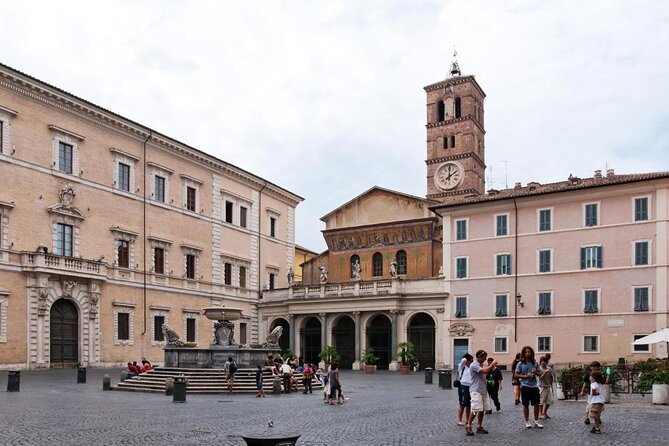
- Teatro Marcello start area: you begin near one of Rome’s most photogenic Roman theater ruins.
- Boca de la Verità moment: a playful stop tied to an honesty legend (with a clear caution).
- Forum Boarium temples and Roman trade-land: you get context for what this space meant before today’s Rome.
- Octavia Portico: a stop that helps you connect emperors and everyday Rome in one line of walking.
- Jewish Ghetto + Trastevere: the tour connects Jewish history in Rome with what you see in the streets.
- Small group (max 30): easier questions, and a better chance the guide can keep things moving.
Night in Rome: why this Trastevere walk works at 7:30 pm
Rome at night is when the city stops feeling like a checklist and starts feeling like a place. This tour starts at 7:30 pm, which is perfect for that shift: street lamps are on, some crowds thin out, and the walking feels smoother than it does in the hot daytime rush.
The best part is how the route is designed to move from monumental Rome to the neighborhood vibe. You start by the Theater of Marcellus area, then you travel through Roman-era sites, and you end in Trastevere near Piazza Trilussa. That flow matters. It helps you understand Rome as layers—history isn’t just behind glass; it’s under your feet and around your evening plans.
One more thing I appreciate: it’s not one-and-done scenery. The tour includes storytelling hooks, so you’re not just collecting photos. You’re learning what you’re looking at while you’re still close enough to notice details.
More lanes worth losing an evening in Trastevere
- Winner 2025 Rome Twilight Trastevere Food Tour by Eating Europe
★ 5.0 · 5,157 reviews - Rome Food Tour: Campo de’ Fiori, Ghetto, Trastevere Winner 2024
★ 5.0 · 3,205 reviews - Rome: Guided Food Walking Tour with Wine in Trastevere
★ 4.9 · 3,105 reviews - Rome: Trastevere Food tour with Free-Flowing Fine Wine
★ 5.0 · 2,853 reviews
Meeting by Teatro di Marcello, ending at Piazza Trilussa
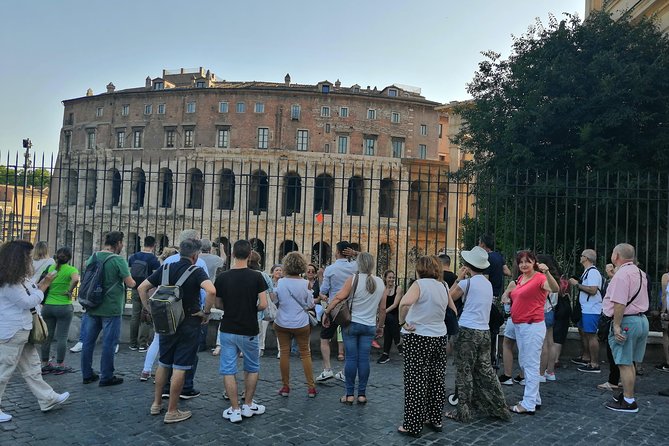
Your start point is Via del Teatro di Marcello, 00186 Roma RM, close to Teatro di Marcello. Your finish is Piazza Trilussa, 35, 00153 Roma RM. That end point is handy because it drops you right in the heart of Trastevere, where it’s natural to continue your night with dinner or a casual walk.
A practical tip: wear shoes you can trust for uneven sidewalks. Rome sidewalks can be patchwork, and you’re out for 2 to 3 hours. If you plan to grab dinner right after, choose a meal spot that’s easy to reach from Piazza Trilussa—your legs will thank you.
Group size is capped at 30, which is the sweet spot for a walking tour. It’s big enough to have energy, small enough that a guide can still manage the pace and point out what matters.
Circus-era Rome and the Boca de la Verità honesty test
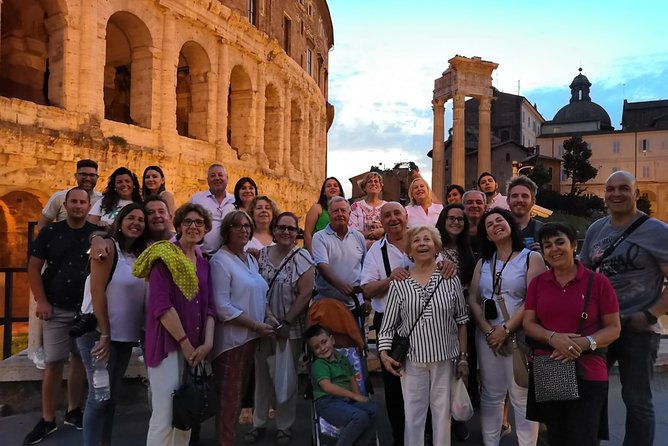
One of the tour’s most memorable stops is built around a legend: you’ll reach Boca de la Verità. The tour also references a classic Roman circus connection, including the area tied to major circus runs associated with Rome’s bigger circus scenes. It’s the kind of stop that turns “ancient history” into a live moment you can react to.
Here’s the practical part: there’s an explicit caution that you should not go for the hand-through-the-mouth moment unless you’re 100% sure of your honesty. Even if you skip the physical bit, the legend still works as a story anchor. It’s a good way to break up the walking and keep everyone’s attention.
Also, don’t treat it like a random tourist prop. This is where the tour’s theme clicks: Rome’s myths, religion, and street-level culture all share space in real neighborhoods. You’ll start to notice how often Romans built meaning into ordinary places—markets, theaters, gates, and even quirky stone faces.
If you’re traveling with kids, this stop often becomes the highlight, but it can work for adults too. It’s playful without needing to be childish.
Forum Boarium and the port-before-Rome feeling
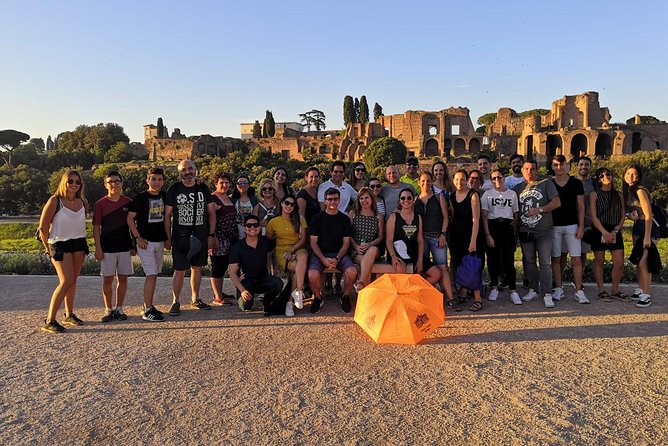
The tour moves into the older landscape of Rome—places tied to life that developed before Rome became the empire-world people picture. You’ll pass through the port area where life existed early, and then you reach the Forum Boarium, known for its ancient temples.
This is one of those Rome stops where context makes the rocks click. Forum Boarium isn’t just “old buildings.” It’s the kind of area that helps you understand how trade and movement shaped the city. It’s also a reminder that Rome’s power didn’t start as a luxury empire. It started as a place people used.
A drawback to keep in mind: if you only want surface-level stops, you might prefer a shorter, more photo-driven walk. The Forum Boarium segment tends to be more about understanding the space. If you like that, you’ll likely enjoy it a lot. If you’re in photo mode only, just be ready to scan and listen selectively.
My advice: ask the guide a question about what you’re looking at right when you reach the temples area. You’ll get the best explanation while you can still see the exact perspective they’re describing.
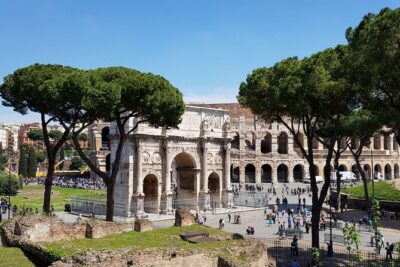
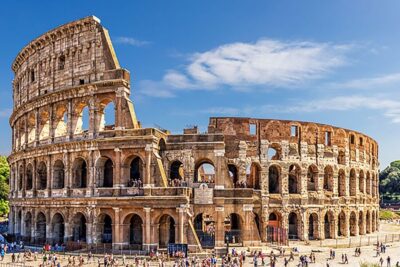
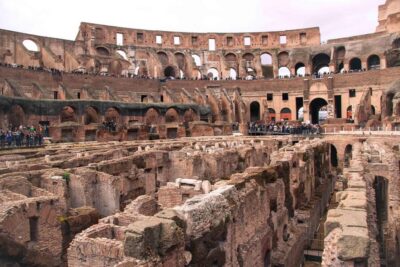
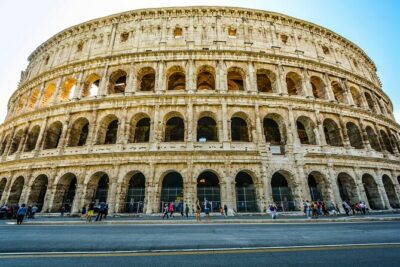
Teatro Marcello and Octavia Portico: Roman power in walking distance
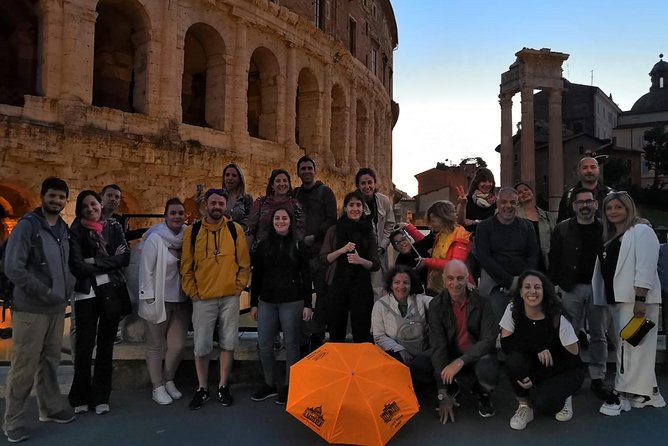
Starting near Teatro Marcello sets up this tour nicely. Teatro di Marcello is one of those ruins that always looks good in any light. At night, it can feel even more dramatic because the shape of the stone stays sharp against the darker streets.
Later, the route includes the Octavia Portico, associated with an emperor. Stops like these are valuable because they connect architecture to politics and personal stories inside the empire’s world. It’s not just “a theater” or “a portico.” You start to understand why Romans built structures that could dominate daily life.
What I’d watch for: this part can move quickly. It’s the kind of route segment where you want to keep your phone camera ready, but also keep your ears open. The value is in how the guide links these sites in your head. If you try to do a perfect photo every five steps, you’ll miss some of the story.
If you’re the type who likes learning while walking, this section is where you’ll feel the tour earn its time.
Jewish history in Rome, from the Jewish Ghetto to Trastevere
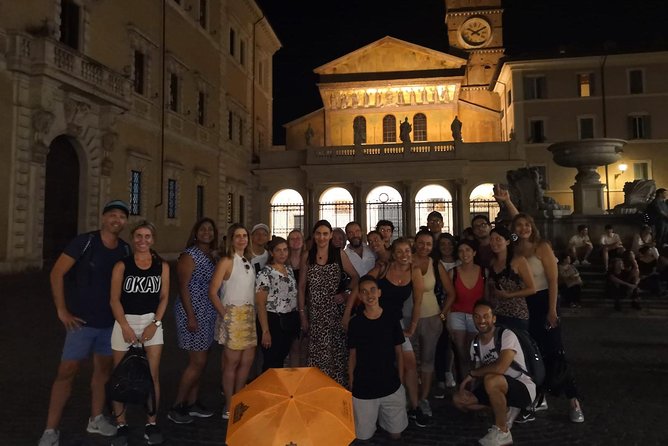
One of the most meaningful parts of this walk is the inclusion of Jewish history in Rome as you pass through the Jewish Ghetto area and then head toward Trastevere.
Even if you’ve read about Jewish Rome before, this approach helps because you see the story mapped onto neighborhoods rather than only in textbooks. It’s easier to remember when you connect history to actual street geography.
I also like that this tour doesn’t treat the topic like a quick stop. It’s built into the route. That makes it more than an add-on. It helps you see how communities and culture shaped Rome’s evolution over time.
Sensitivity note (practical, not preachy): this is history. If you want a strictly fun, zero-heavy-topic evening, you may find parts of the discussion more serious than other nightlife walks. For many people, though, that contrast is exactly what makes the tour feel real.
How the guides make or break it (Ana Sofía and Iván)
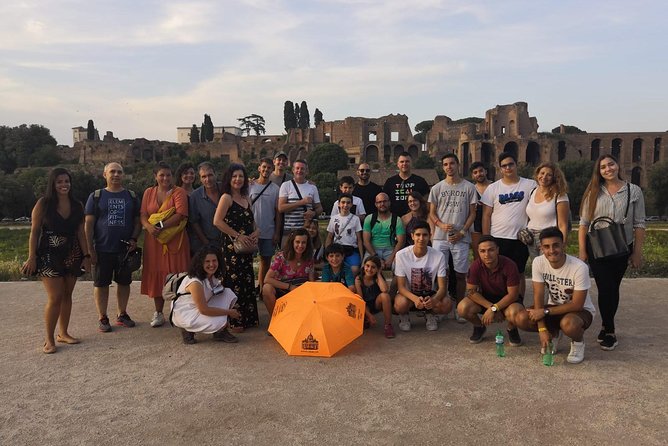
The reviews put a lot of weight on guide quality, and you’ll feel it fast on a walking tour like this. People specifically mention Ana Sofía as exceptional—effective, good at managing a group of up to 30, and able to keep attention. Others highlight Iván for passionate storytelling and for sharing recommendations for where to eat.
That matters for your experience, because this isn’t just a route. It’s interpretation. A strong guide can turn a “we’re walking past buildings” evening into “I get what I’m seeing and why it matters.” When a guide is good with group energy, you also spend less time waiting for people to catch up and more time absorbing the atmosphere.
What you can do to get more out of any guide here:
- Ask a short question when you arrive at a landmark.
- Listen for the explanation that ties multiple stops together.
- If they offer food tips, take them seriously—guides often know the practical side of Trastevere better than guidebooks.
Price and time: value for 2–3 hours of Roman night context
The listed price is $17.38 per person, with an average booking window of 25 days in advance. The tour runs about 2 to 3 hours, so you’re paying for guided time that covers multiple areas rather than spending your evening hopping between neighborhoods on your own.
Is it a bargain? In my view, yes—especially if you’re new to Rome and you want a path through major sites without building your own route. The value comes from two things:
1) you don’t just see monuments; you connect them with story, and
2) you end in Trastevere with your night plan already in motion.
Also, you get a mobile ticket, which reduces friction. No fighting with paper confirmations while you’re trying to meet a group in a lively Roman evening.
One consideration: if you’re the kind of traveler who only wants one or two big-ticket stops, this might feel like a lot of walking for your style. But if you like a paced evening tour with variety, the time-to-sights ratio is solid.
Getting the most from the walk (and keeping it fun)
This tour is designed for night charm, not a slow midday museum pace. So set yourself up for success.
- Dress for walking: you’ll be on your feet for up to 3 hours.
- Plan dinner after Piazza Trilussa: that’s where you finish, and you’ll be in the right zone.
- Be ready for the Boca de la Verità moment: it’s playful, and the caution is part of the story.
- Stay curious at the Jewish Ghetto segment: it’s one of the tour’s heavier themes, and it’s also one of the most important parts of the route.
- Use the guide for practical Rome: the praise includes food tips, and those are usually the best kind of advice—useful right away.
If you prefer privacy or a very quiet pace, you might find any group walk slightly less personal. Still, the capped size helps. It’s not an ocean of people.
Who should book this Trastevere Tour?
I think it’s a great fit if you:
- want to see Trastevere at night without guessing your route,
- like Roman ruins plus neighborhood texture,
- want history explained in a walkable way (including Jewish history in Rome),
- appreciate a guide who can keep a group moving and engaged.
It may be less ideal if you:
- hate walking at night or have mobility limits that make uneven sidewalks hard (most people can participate, but the route is still walking-heavy),
- prefer tours that stay only within one tiny area,
- want zero cultural or historical context and only nightlife vibes.
Also, the tour allows service animals and is near public transportation, so it’s easier to fit into your broader Rome plan.
Should you book the Trastevere Tour?
If you’re trying to build a fun Rome evening that also teaches you something real, I’d say yes. The strongest reason to book is the blend: Roman monuments and legends like Boca de la Verità, plus a route that connects older Rome spaces to Trastevere and includes Jewish history through the Jewish Ghetto area. That makes it more than a generic “Trastevere at night” stroll.
I’d skip it only if you truly want a low-walking, purely lighthearted night. Otherwise, the price, the 2–3 hour duration, the small group size, and the praised guide energy make it a smart way to get your bearings fast and enjoy Rome after dark.
FAQ
Where does the tour start and end?
It starts at Via del Teatro di Marcello, 00186 Roma RM and ends at Piazza Trilussa, 35, 00153 Roma RM near Piazza Trilussa in Trastevere.
What time does the tour begin?
The start time is 7:30 pm.
How long is the tour?
The tour lasts about 2 to 3 hours.
How much does it cost?
The price is $17.38 per person.
Do I get a mobile ticket?
Yes, the tour includes a mobile ticket.
How big is the group?
The tour has a maximum size of 30 travelers.
Is confirmation provided after booking?
Yes, confirmation will be received at time of booking.
Is free cancellation available?
Yes. You can cancel for a full refund up to 24 hours before the experience’s start time.
Is the tour near public transportation, and are service animals allowed?
Yes. It’s near public transportation, and service animals are allowed.
What sites will we pass during the walk?
You’ll visit or pass by major Rome-area stops tied to Roman circus history, the Boca de la Verità, Forum Boarium and its temples, Teatro Marcello, the Octavia Portico, and areas connected to Jewish history in Rome, including the Jewish Ghetto and Trastevere.
More Tours in Rome
- Vatican Museums, Sistine Chapel & St. Peter’s Basilica Tour
★ 4.3 · 73,970 reviews - Vatican Museums, Sistine Chapel & St Peter’s Basilica Guided Tour
★ 4.5 · 39,149 reviews - Rome: Colosseum, Palatine Hill and Roman Forum Guided Tour
★ 4.8 · 32,814 reviews - Rome: Guided Tour of Colosseum, Roman Forum & Palatine Hill
★ 4.7 · 27,897 reviews - Rome: Colosseum, Roman Forum and Palatine Hill Guided Tour
★ 4.5 · 23,903 reviews - Rome: Colosseum Arena Floor, Palatine & Forum Guided Tour
★ 4.5 · 20,180 reviews
More Tour Reviews in Rome
- Vatican Museums, Sistine Chapel & St. Peter’s Basilica Tour
★ 4.3 · 73,970 reviews - Vatican Museums, Sistine Chapel & St Peter’s Basilica Guided Tour
★ 4.5 · 39,149 reviews - Rome: Colosseum, Palatine Hill and Roman Forum Guided Tour
★ 4.8 · 32,814 reviews - Rome: Guided Tour of Colosseum, Roman Forum & Palatine Hill
★ 4.7 · 27,897 reviews - Rome: Colosseum & Forum with Audio Guide App -Optional Arena
★ 4.2 · 24,770 reviews - Rome: Colosseum, Roman Forum and Palatine Hill Guided Tour
★ 4.5 · 23,903 reviews
Still in Trastevere? Keep Going
- Winner 2025 Rome Twilight Trastevere Food Tour by Eating Europe
★ 5.0 · 5,157 reviews - Rome Food Tour: Campo de’ Fiori, Ghetto, Trastevere Winner 2024
★ 5.0 · 3,205 reviews - Rome: Guided Food Walking Tour with Wine in Trastevere
★ 4.9 · 3,105 reviews - Rome: Trastevere Food tour with Free-Flowing Fine Wine
★ 5.0 · 2,853 reviews - Rome: Trastevere & Campo de Fiori Street Food Walking Tour
★ 4.9 · 2,768 reviews - Rome: Award Winning Trastevere Group Food Tour with Wine
★ 5.0 · 2,273 reviews
Just added to our Rome reviews


Trastevere Tours, compared.
 ★ 5.0Winner 2025 Rome Twilight Trastevere Food Tour by Eating EuropeFrom $1255,157 reviews
 ★ 5.0Rome Food Tour: Campo de’ Fiori, Ghetto, Trastevere Winner 2024From $883,205 reviews
 ★ 4.9Guided Food Walking Tour with Wine in TrastevereFrom $1003,105 reviews
 ★ 5.0Trastevere Food tour with Free-Flowing Fine WineFrom $1022,853 reviews
 ★ 4.9Trastevere & Campo de Fiori Street Food Walking TourFrom $512,768 reviews
 ★ 5.0Award Winning Trastevere Group Food Tour with WineFrom $812,273 reviews
 ★ 4.8Trastevere Street Food Walking Tour with Local ExpertFrom $571,784 reviews
 ★ 4.5Jewish Ghetto and Trastevere Tour RomeFrom $41,729 reviews
Browse the lists this tour appears in