
Reviewed · PANTHEON TOURS
Rome Private Walking Tour including Pantheon access
Rome can feel like a museum you’re wandering through. This private walk gives you an order to it, from Piazza del Popolo to the Pantheon, with major landmarks and smart context along the way. I especially like the pace—short stops that keep the day moving—and the fact that you get to ask questions face-to-face with guides like Valerio (and other guides, including Serena). One thing to consider: several sights are exterior or free to view, but a few church and Pantheon entries say the admission ticket is not included.
You’ll also get a very “Rome” mix of grand squares and Baroque details, plus the classic moments: the Spanish Steps and that Trevi Fountain wish coin. The route finishes near Castel Sant’Angelo, which is handy if you want to keep exploring after the tour. The only possible snag is practical: it’s a steady walking day, so you’ll want comfortable shoes and a plan for short pauses where you can.
In This Review
- Key highlights at a glance
- Why this 3-hour private route works so well in Rome
- Starting near Flaminio Obelisk in Piazza del Popolo
- Two church stops that change how you notice Baroque Rome
- Santa Maria dei Miracoli (circular plan and Baroque bell tower)
- Santa Maria in Montesanto (set over an older foundation)
- Piazza del Popolo to Via del Corso: the street that pulls Rome straight
- Via dei Condotti: fashion energy with a real coffee-history stop nearby
- Spanish Steps and Trevi Fountain: the wish-coin stop you’ll remember
- Spanish Steps
- Trevi Fountain
- Sant’Ignazio and Piazza Navona: Baroque drama with a perfect walking finish
- Church of St. Ignatius of Loyola at Campus Martius (Sant’Ignazio)
- Piazza Navona (stunning shape; ancient stadium story)
- Castel Sant’Angelo to the Pantheon: finishing strong with two icons
- Castel Sant’Angelo
- Pantheon: the must-see, with ticket details to confirm
- What the guide actually adds (and why Valerio’s name pops up)
- Price and value: is $161.77 per person a smart deal?
- Who should book this Rome private walking tour?
- Should you book it? My call
- FAQ
- How long is the Rome private walking tour?
- What does it cost per person?
- Is this tour private?
- What language is the tour offered in?
- Is there a mobile ticket?
- Does the tour include Pantheon access?
- Are the sights free to enter?
- Where do you start and where does it end?
- What’s the cancellation policy?
Key highlights at a glance
- Pantheon time built into a smart walking route, not tacked on at the end
- Spanish Steps + Trevi Fountain wish moment in one flowing city route
- Piazzas with big-story context: Piazza del Popolo and Piazza Navona
- Baroque churches that most people speed past
- Private format with your group only, so questions don’t get lost in the crowd
- End near Castel Sant’Angelo, a natural continuation zone for the day
Why this 3-hour private route works so well in Rome
If you only have a few hours (or you just want to stop feeling lost), this kind of private walk is a great move. You’re covering major sights—Spanish Steps, Trevi Fountain, Piazza Navona, and the Pantheon area—but you’re not stuck standing around waiting for the next group. The day is paced in small chunks, so you get time to look closely and still keep moving.
Because it’s private, the guide can slow down when a question matters and speed up when you’re good on the basics. Guides in the feedback—like Valerio, and also Serena—are praised for answering questions and keeping things personable, not lecture-y. That matters, because Rome rewards curiosity. When you understand what you’re seeing, the city stops being a blur of stone.
One practical note: the itinerary is heavy on “look and walk” moments, meaning you’ll want the right expectations. You’ll see a lot, but you’re not doing long museum-style wandering.
The Pantheon, a couple more takes
- Rome: Pantheon Priority Entry Ticket & Interactive App
★ 4.1 · 5,114 reviews - Rome: Pantheon Priority Entry Tickets with Interactive App
★ 4.6 · 4,108 reviews - Rome: Pantheon Timeless Marvel Guided Tour with Entry Ticket
★ 4.9 · 4,002 reviews - Castel Sant’Angelo: Ticket with optional Vatican or Pantheon
★ 4.4 · 3,088 reviews
Starting near Flaminio Obelisk in Piazza del Popolo
You start at the Flaminio Obelisk in Piazza del Popolo. It’s not just a pretty centerpiece. The obelisk is one of Rome’s ancient obelisks, and it’s tall enough to instantly orient you in the space. With the base and top cross, it reaches over 36 meters—so even if you’re jet-lagged, you’ll find your bearings fast.
From here, Piazza del Popolo is more than a waiting room. It’s one of those squares that helps you “read” Rome’s layout—wide, open, and structured in contrast to the tighter streets nearby. The name connection to poplars is the kind of detail that makes the city feel less random and more designed. It’s a good warm-up stop because the square sets the tone: you’re seeing how older Rome and newer Rome overlap.
If you’re worried about meeting points, note that the start is very specific: Flaminio Obelisk at Piazza del Popolo, address listed as Piazza del Popolo, 21. That clarity helps on a first day.
Two church stops that change how you notice Baroque Rome
After Popolo, the route shifts into quieter but very Roman details: churches.
Santa Maria dei Miracoli (circular plan and Baroque bell tower)
You’ll pause at Chiesa Santa Maria dei Miracoli. Construction dates are late 1600s (begun 1675, finished 1681), and the layout is circular. What catches the eye here is the refined structure—plus the bell tower by Girolamo Theodoli and an octagonal cupola. These are the sorts of shapes you’ll miss if you only do the big-name sites.
Admission for this stop is marked as not included, so treat it like a possible extra purchase depending on what your guide does on the day and what you decide you want to see.
Worth a look next to this Rome booking:



Santa Maria in Montesanto (set over an older foundation)
Next is Santa Maria in Montesanto, built over an earlier church connected to the start of Via del Babuino. It was occupied by Carmelite monks, so there’s a religious layer here beyond just the architecture. Again, admission is marked not included, so you’re likely looking at exterior features first, with optional entry depending on your comfort and timing.
Why these church stops matter: they train your eye. After just a couple of stops, you start noticing how Rome uses geometry, light, and ornament to communicate power.
Piazza del Popolo to Via del Corso: the street that pulls Rome straight
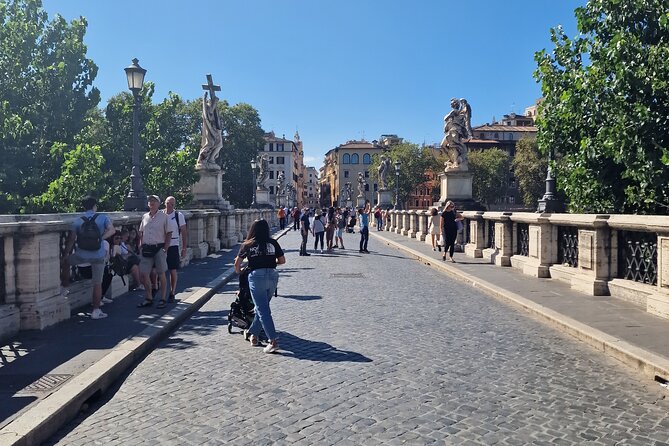
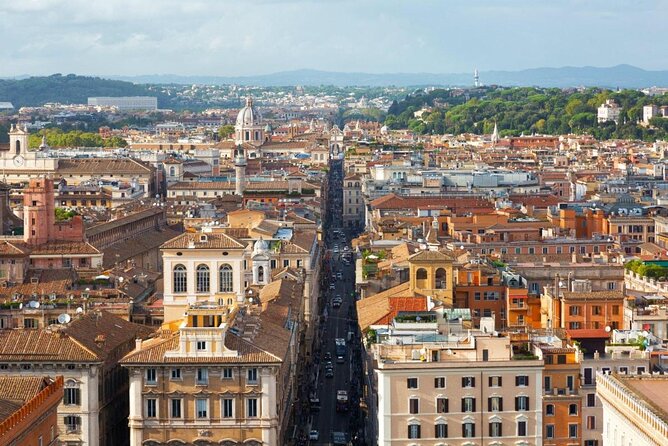
Once you’ve got the square in your head, you move into a major connector: Via del Corso. It’s one of the main streets in Rome’s historic center, and what’s useful here is the contrast. Rome is famous for tight, twisting lanes, but Via del Corso is straight. That straight stretch makes it easier to understand how neighborhoods connect.
The street is about 1.5 kilometers long and roughly 10 meters wide, so it’s one of the wider “corridors” through the historic center. That width makes a difference for comfort—especially in summer—because it’s easier to breathe and see where you’re going.
Admission isn’t part of this section because you’re walking the street. The real value is the guided context: you’re seeing how the city’s flow shaped what built where.
Via dei Condotti: fashion energy with a real coffee-history stop nearby
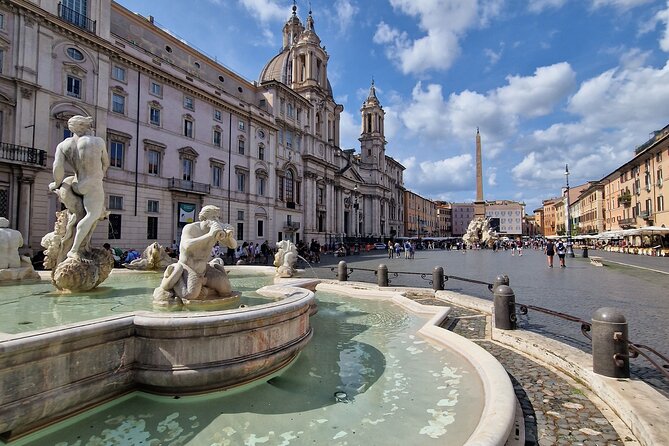
From Via del Corso, you head to Via dei Condotti, one of Rome’s fashionable streets. It’s crowded, polished, and full of storefronts—more modern than the ancient sites you just saw, but that’s part of Rome’s charm. A city that’s only ancient would be boring. Rome is alive.
The tour time here is short (about 10 minutes), but there’s a specific historical cue: Caffè Greco, described as a famous café established at Via Condotti 86 in 1760. Even if you don’t stop for a drink, knowing where that coffee legacy sits helps you place the street in time.
Also, the route notes major luxury brands along the way. I treat that as a visual reality check: Rome is not stuck in the past. It’s past and present in the same block.
Spanish Steps and Trevi Fountain: the wish-coin stop you’ll remember
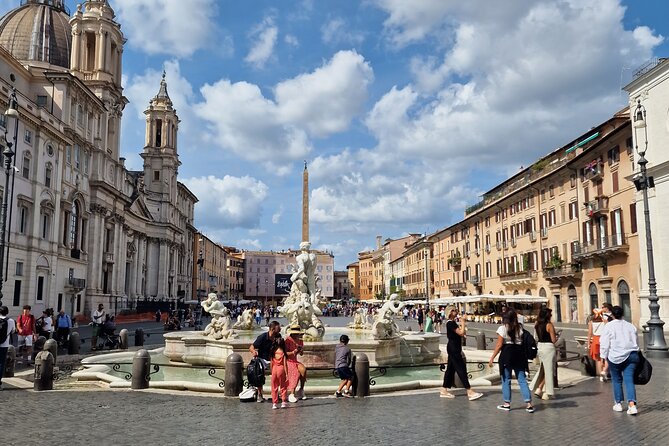
Spanish Steps
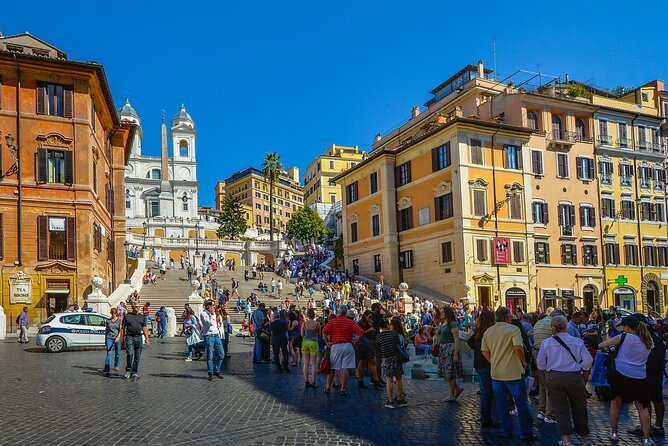
Your route then climbs into the classic photo zone: the Spanish Steps between Piazza di Spagna and Piazza Trinità dei Monti. The top is dominated by the Trinità dei Monti church, which gives the steps a natural “finish line” when you look up. It’s steep enough to feel like a mini workout, so go at a steady pace.
This is a free view stop, about 15 minutes. That means you’ll have time for photos and a look around, but not time for a full sit-down break. Plan for quick sightseeing energy here.
Trevi Fountain
Next comes the biggest “stand in one place” moment: Trevi Fountain. It’s described as the largest Baroque fountain in Rome, designed by Nicola Salvi and completed with Giuseppe Pannini and others. The scale is huge—about 26 meters high and about 49 meters wide—so even a quick glance feels like you’re in the middle of a set.
The fun tradition is built in: you toss a wish coin into Trevi Fountain. This is the kind of small ritual that makes a landmark feel personal instead of just famous.
This stop is also marked as free. Expect that the area can be busy at certain times, so keep your eyes up and be ready to move when your guide suggests.
Sant’Ignazio and Piazza Navona: Baroque drama with a perfect walking finish
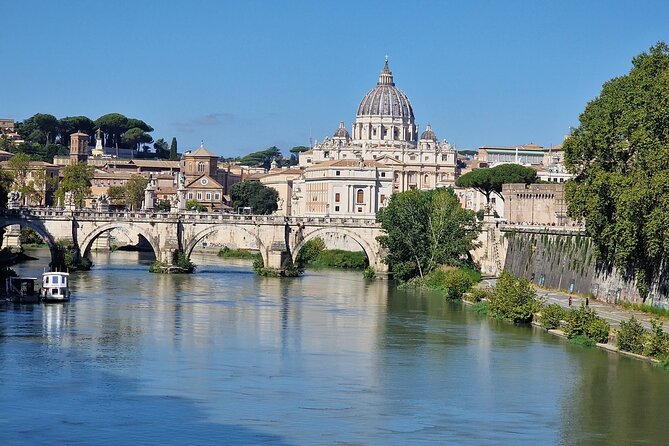
After Trevi, the tour continues into Baroque church territory and then lands in one of Rome’s most atmospheric public squares.
Church of St. Ignatius of Loyola at Campus Martius (Sant’Ignazio)
You’ll stop at Chiesa di Sant’Ignazio di Loyola, a Latin Catholic titular church dedicated to Ignatius of Loyola. It was built in the Baroque style between 1626 and 1650. This is one of those churches where the design makes you slow down and notice. The fact that it’s tied to the Society of Jesus also gives it a specific historical identity, not just generic ornament.
Admission for this stop is listed as free. That’s a good sign for your day: you can spend time looking without worrying about ticket timing for this segment.
Piazza Navona (stunning shape; ancient stadium story)
Then comes Piazza Navona, built on the site of the Stadium of Domitian from the 1st century AD. The square follows the stadium’s form, which is why the space feels “made” rather than random. The result is a perfect outdoor scene: fountains, building lines, and the kind of open space where you naturally pause and watch.
This stop is about 20 minutes and marked free. It’s one of the best places on the walk to reset your legs without losing momentum.
Castel Sant’Angelo to the Pantheon: finishing strong with two icons
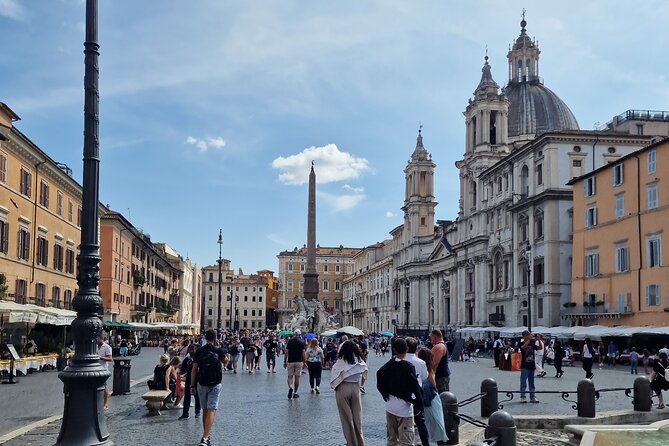
The route pushes toward the finish with Castel Sant’Angelo and then the Pantheon.
Castel Sant’Angelo
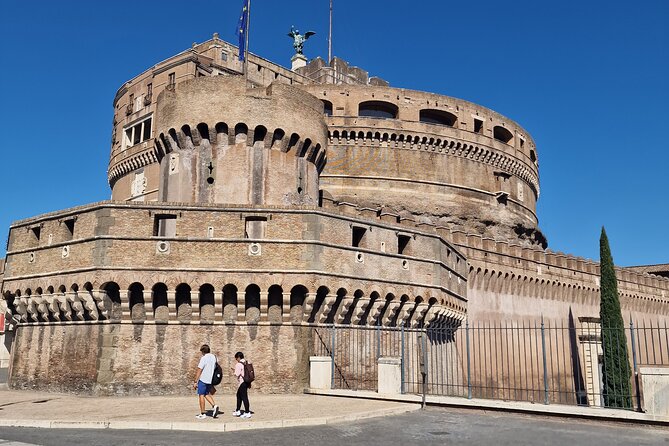
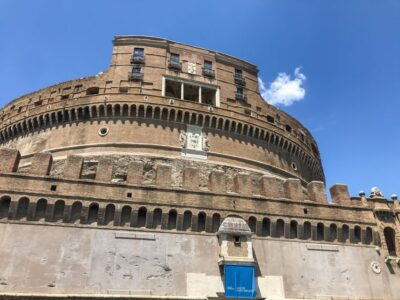
Castel Sant’Angelo is introduced as a towering cylindrical building in Parco Adriano. It began as Emperor Hadrian’s mausoleum and was later used by popes as a fortress and castle, before becoming a museum. The tour notes it was once the tallest building in Rome—an eye-opener when you see how much it dominates the skyline.
This is about a 25-minute stop and marked free. Even if you don’t go inside, it’s a powerful moment because you can understand it as a timeline in stone: Roman emperor, papal fortress, modern museum.
The tour ends near here: Lungotevere Castello, 50 is the listed end point. That’s handy if you want your day to flow right into riverside walks or whatever you have planned next.
Pantheon: the must-see, with ticket details to confirm
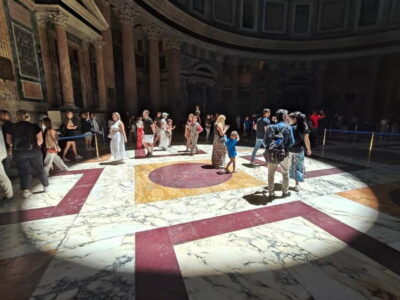
Finally, you reach the Pantheon—the former Roman temple, later a Catholic church since 609 AD (Basilica di Santa Maria ad Martyres). This is the stop most people obsess over, and the feedback backs that up. The Pantheon gets called out as remarkable and a top highlight.
But here’s the practical part: the Pantheon’s admission is listed as not included. So you should plan for that cost separately, even though the tour is designed to include Pantheon access and time on site.
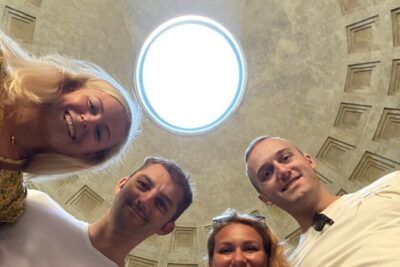
If you want the best value from the Pantheon portion, go in with one clear goal: look up at the oculus and pay attention to how the space is structured for light. A guide can make that moment land, because they’ll connect the design to what you’re seeing.
What the guide actually adds (and why Valerio’s name pops up)
A private walking tour lives or dies by the guide. In the feedback, Valerio stands out for being both personable and highly responsive—able to answer questions and offer recommendations beyond the walk. There’s also a note that he helped groups move toward their next tour start point, which is useful in a city where logistics can eat your time.
Another guide name that appears is Serena, praised for explaining the history around churches and the sites you pass. That’s the kind of storytelling that helps you stop treating churches like background scenery.
In practical terms, here’s how to use that strength:
- Ask one question early (How should I read what I’m seeing?)
- Ask one question midway (What’s the real story behind this place?)
- Ask one question at the end (What should I do next within walking distance?)
When you do that, the tour turns into a Rome “map” you can carry in your head.
Price and value: is $161.77 per person a smart deal?
At $161.77 per person for about 3 hours, this isn’t a bargain-basement option. But it can be solid value because:
- It’s a private tour, so you’re not paying for time spent waiting for strangers.
- You’re covering a cluster of major sights that usually cost time and coordination.
- Many stops are free to view (like Piazza del Popolo, Via del Corso, Via dei Condotti, Spanish Steps, Trevi Fountain, Piazza Navona, Sant’Ignazio, and Castel Sant’Angelo).
The places marked with admission not included—Santa Maria dei Miracoli, Santa Maria in Montesanto, and the Pantheon—are the parts where your total cost may rise. If you care most about those interior moments, you’ll want to budget for them.
Booking demand is also a clue. The tour is described as being booked about 70 days in advance on average. If you want your preferred day and time, don’t wait until the last week.
Who should book this Rome private walking tour?
I think this tour fits best if you:
- want a first-day orientation style walk so Rome makes more sense quickly
- like seeing major landmarks while still getting context (especially around churches and squares)
- prefer a private group experience where you can ask questions without crowd pressure
- want an itinerary that ends near Castel Sant’Angelo, so you can keep exploring after
It may be less ideal if you:
- want a long, slow museum day with deep interior time (this is about walking and short stops)
- hate ticket add-ons, since the Pantheon and some church admissions are listed as not included
Should you book it? My call
Book this if you want your Rome time to feel organized, not scattered. The route links the big “Rome cards”—Spanish Steps, Trevi Fountain, Piazza Navona, Castel Sant’Angelo, and the Pantheon—with in-between stops that teach you how to see the city. The guide-driven part is strong in the feedback, especially with names like Valerio and Serena showing up for their explanations and responsiveness.
Skip it only if you know you want a low-walking, slow-entry day, or if you want every major stop’s admission baked into one clear price. Here, you should expect a little extra for the Pantheon and the church interiors that list tickets as not included.
If you do book, wear shoes you trust, keep water handy, and go into the Pantheon ready to look up. That’s where the day clicks.
FAQ
How long is the Rome private walking tour?
It’s about 3 hours long (approx.).
What does it cost per person?
The price is listed as $161.77 per person.
Is this tour private?
Yes. It’s a private tour/activity, and only your group participates.
What language is the tour offered in?
The tour is offered in English.
Is there a mobile ticket?
Yes, the tour includes a mobile ticket.
Does the tour include Pantheon access?
The tour is described as including Pantheon access, but the Pantheon admission ticket is listed as not included, so you may need to cover the ticket separately.
Are the sights free to enter?
Many stops are listed as free (including Piazza del Popolo, Via del Corso, Spanish Steps, Trevi Fountain, Sant’Ignazio di Loyola, Piazza Navona, and Castel Sant’Angelo). Some church stops and the Pantheon are listed as not included for admission.
Where do you start and where does it end?
You start at Flaminio Obelisk, Piazza del Popolo, 21, 00187 Roma. The tour ends at Castel Sant’Angelo, Lungotevere Castello, 50, 00193 Roma.
What’s the cancellation policy?
Free cancellation is available if you cancel up to 24 hours in advance for a full refund.
More Tours in Rome
- Vatican Museums, Sistine Chapel & St. Peter’s Basilica Tour
★ 4.3 · 73,970 reviews - Vatican Museums, Sistine Chapel & St Peter’s Basilica Guided Tour
★ 4.5 · 39,149 reviews - Rome: Colosseum, Palatine Hill and Roman Forum Guided Tour
★ 4.8 · 32,814 reviews - Rome: Guided Tour of Colosseum, Roman Forum & Palatine Hill
★ 4.7 · 27,897 reviews - Rome: Colosseum, Roman Forum and Palatine Hill Guided Tour
★ 4.5 · 23,903 reviews - Rome: Colosseum Arena Floor, Palatine & Forum Guided Tour
★ 4.5 · 20,180 reviews
More Tour Reviews in Rome
- Vatican Museums, Sistine Chapel & St. Peter’s Basilica Tour
★ 4.3 · 73,970 reviews - Vatican Museums, Sistine Chapel & St Peter’s Basilica Guided Tour
★ 4.5 · 39,149 reviews - Rome: Colosseum, Palatine Hill and Roman Forum Guided Tour
★ 4.8 · 32,814 reviews - Rome: Guided Tour of Colosseum, Roman Forum & Palatine Hill
★ 4.7 · 27,897 reviews - Rome: Colosseum & Forum with Audio Guide App -Optional Arena
★ 4.2 · 24,770 reviews - Rome: Colosseum, Roman Forum and Palatine Hill Guided Tour
★ 4.5 · 23,903 reviews
Back to the Pantheon
- Rome: Pantheon Priority Entry Ticket & Interactive App
★ 4.1 · 5,114 reviews - Rome: Pantheon Priority Entry Tickets with Interactive App
★ 4.6 · 4,108 reviews - Rome: Pantheon Timeless Marvel Guided Tour with Entry Ticket
★ 4.9 · 4,002 reviews - Castel Sant’Angelo: Ticket with optional Vatican or Pantheon
★ 4.4 · 3,088 reviews - Pantheon Elite Guided Tour – Rome’s Iconic Ancient Temple
★ 5.0 · 1,447 reviews - Rome: Pantheon Small-Group Guided Tour with Entry Ticket
★ 4.9 · 1,226 reviews
Just added to our Rome reviews





Pantheon Tours, compared.
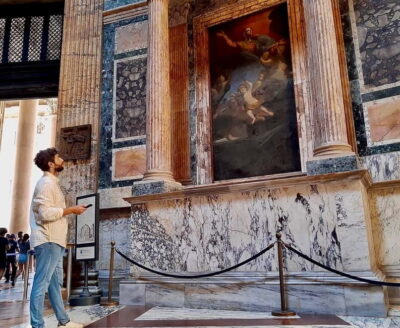 ★ 4.1Pantheon Priority Entry Ticket & Interactive AppFrom $145,114 reviews
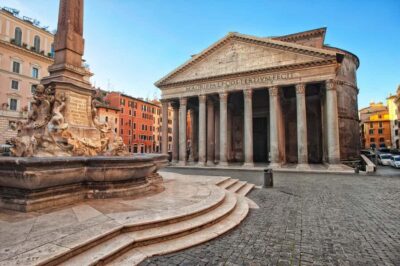 ★ 4.6Pantheon Priority Entry Tickets with Interactive AppFrom $54,108 reviews
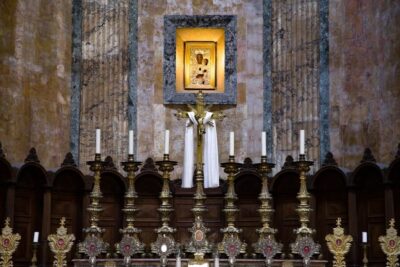 ★ 4.9Pantheon Timeless Marvel Guided Tour with Entry TicketFrom $214,002 reviews
 ★ 4.4Castel Sant’Angelo: Ticket with optional Vatican or PantheonFrom $183,088 reviews
 ★ 5.0Pantheon Elite Guided Tour – Rome’s Iconic Ancient TempleFrom $411,447 reviews
 ★ 4.9Pantheon Small-Group Guided Tour with Entry TicketFrom $511,226 reviews
 ★ 4.0Rome’s Iconic Temple: Pantheon Audio Guided Tour with Fast AccessFrom $211,188 reviews
 ★ 4.7Pantheon Small Group Tour and Skip-the-Line TicketFrom $531,008 reviews
Browse the lists this tour appears in