
Reviewed · COLOSSEUM & ANCIENT ROME TOURS
Rome: Colosseum, Circus Maximus, Forum & Ancient Rome Tour
Rome hits different on foot. This guided walking tour strings together the city’s most important Ancient Rome landmarks—starting with the Jewish Ghetto area and ending outside the Colosseum—so you see the bigger story without getting stuck in one spot.
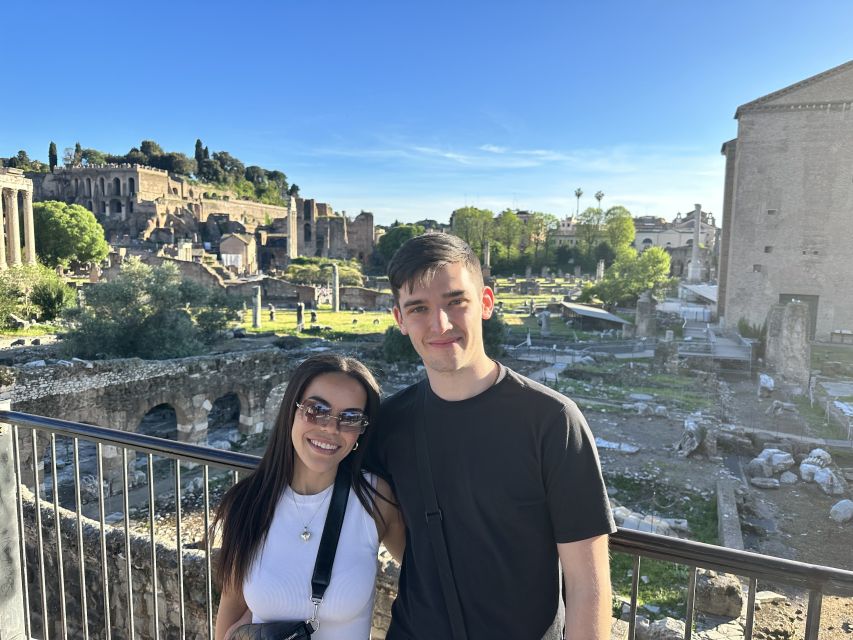
I especially like two things. First, the early stop at Piazza Cinque Scole, where you get a strong sense of place in the Ghetto area. Second, the viewpoint sequence along Via dei Fori Imperiali, which lets you look out over the Roman Forum and multiple imperial forums in one practical sweep.
One possible drawback: you’ll see the Colosseum from the outside only, and entrance tickets aren’t included—so if your must-do is going inside the arena floor, you’ll need a separate plan.
In This Review
- Key highlights worth your time
- The smart value of a 2-hour, guide-led Ancient Rome loop
- Piazza Cinque Scole: a powerful start in the Jewish Ghetto area
- Portico d’Ottavia and Ponte Fabricius: markets to the river, in one flow
- Theatre of Marcellus and Temple of Apollo: Roman sights that feel familiar
- Capitoline Hill and Michelangelo’s square: the payoff viewpoint
- Via dei Fori Imperiali and the Forum cluster: reading power on the street
- Circus Maximus and the Colosseum exterior: the big-hitters, correctly framed
- What you’re paying for: $243.56 and the value equation
- Booking reality checks before you commit
- Should you book this Colosseum, Circus Maximus, Forum & Ancient Rome tour?
- FAQ
- Where does the tour start and end?
- How long is the guided tour?
- Is there an option to enter the Colosseum?
- Are entrance tickets included in the price?
- What sights are covered during the walk?
- What is the meeting time rule if I arrive late?
- Does the tour run in bad weather?
- Who is the tour not suitable for?
Key highlights worth your time
- Outside Colosseum overview that puts the monument in context fast, without waiting for an interior visit
- Piazza Cinque Scole as an early off-the-radar start point with strong local atmosphere
- Portico d’Ottavia + Ponte Fabricius that connect market life and crossing the Tiber in a single walk
- Capitoline Hill and Michelangelo’s square for a high viewpoint and a satisfying end-of-hill payoff
- Via dei Fori Imperiali forum views that make the political landscape easier to understand on the street
- Circus Maximus stop so you get more than just arenas and temples
The smart value of a 2-hour, guide-led Ancient Rome loop
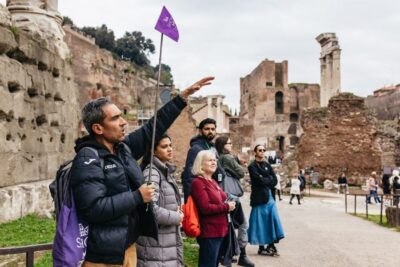
This is a short tour by design: 2 hours of walking that focuses on the main outdoor monuments and a few extra stops many people miss when they only chase one headline site. I like that the guide keeps the narrative moving, so you don’t feel like you’re just collecting photos. You get a guided path through the layers of Rome, from religious and civic spaces to market areas and power centers.
The route also fits how most first-time visitors think. You’re not trying to master Rome in a day. You’re trying to get oriented—and this tour does that with a logical rhythm: start with the atmosphere in the Ghetto area, move through market and river crossing points, then climb into the viewpoints and forum zone.
One more reason it works: the tour is outdoor, rain or shine. That matters because Rome days often come with weather surprises. Plan to wear shoes you can walk in for a while, since the “comfort” requirement is real.
Still on ancient Rome? A few more we rated
- Rome: Colosseum, Palatine Hill and Roman Forum Guided Tour
★ 4.8 · 32,814 reviews - Rome: Guided Tour of Colosseum, Roman Forum & Palatine Hill
★ 4.7 · 27,897 reviews - Rome: Colosseum & Forum with Audio Guide App -Optional Arena
★ 4.2 · 24,770 reviews - Rome: Colosseum, Roman Forum and Palatine Hill Guided Tour
★ 4.5 · 23,903 reviews
Piazza Cinque Scole: a powerful start in the Jewish Ghetto area
You begin your sightseeing at Piazza Cinque Scole, and it’s a great way to start because it shifts your Rome brain away from only temples and emperors. The stop is specifically tied to the Jewish Ghetto atmosphere, which gives the rest of the tour more contrast. You’re walking through a city that isn’t frozen in Roman times; it’s lived-in.
Why this is valuable: starting here changes how you read everything that comes later. When you move from community space into imperial civic space, the contrasts feel clearer. You can also connect the guide’s points to real urban texture—street corners, open plazas, and the feeling of being in the city instead of walking between isolated ruins.
Practical note: this is also a reminder that the tour meets at Basilica of Sant’Anastasia al Palatino (front) but the main sightseeing run starts at Piazza Cinque Scole. So when you check your timing, don’t show up last minute. The tour requires you to arrive 15 minutes early, and the guide can’t wait much beyond the start.
Portico d’Ottavia and Ponte Fabricius: markets to the river, in one flow
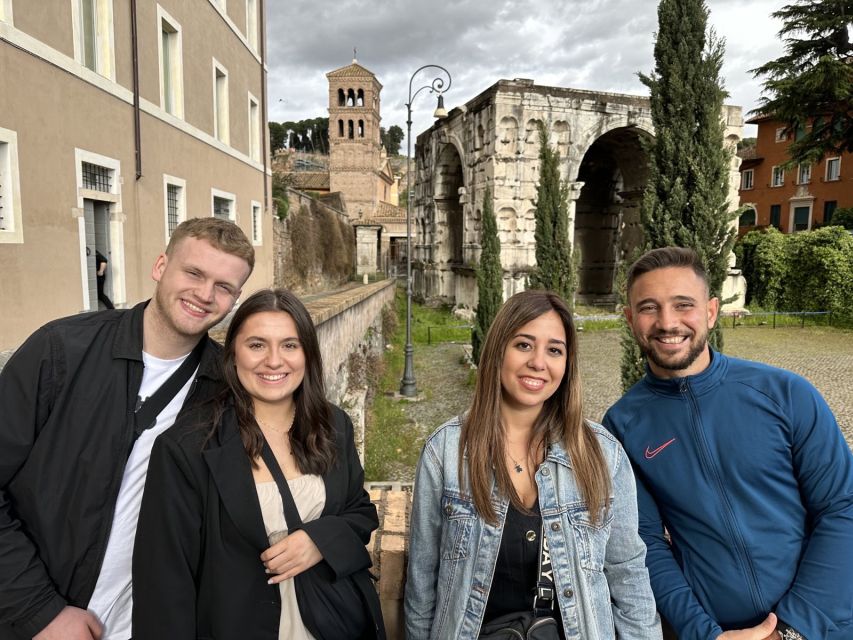
After the ghetto-area start, the tour moves to Portico d’Ottavia, described as a majestic structure that once marked the entrance to a bustling market. I like this stop because it helps you remember that Rome wasn’t only politics and spectacle. It was daily life—vendors, movement, noise, and crowds—with architecture shaping how people flowed.
Then you cross to Ponte Fabricius, highlighted as the oldest bridge in Rome, and it connects you to Tiber Island. Even if you’re not a bridge person, this matters for wayfinding and perspective. The Tiber is a natural divider and a reference point, and getting a guided crossing early can make the rest of the landmarks feel more connected.
This section also helps you understand the tour’s main strength: it’s not just “stand and stare.” You’re walking between key urban anchors, and the guide uses the street sequence to keep the story coherent.
Theatre of Marcellus and Temple of Apollo: Roman sights that feel familiar
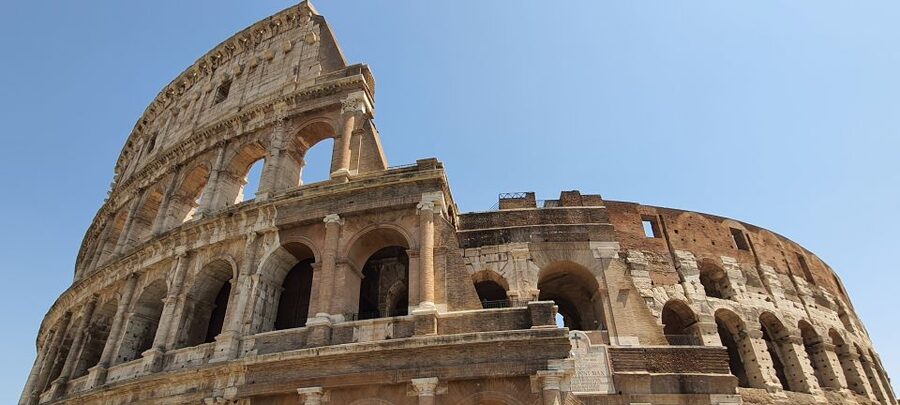
Next up is the Theatre of Marcellus, often mistaken for the Colosseum. That’s useful information because it sets expectations. If you’ve seen photos and thought you knew what you were looking at, the guide helps you reclassify the monument correctly—and that’s how you learn faster while walking.
Nearby is the Temple of Apollo, where the ruins are described as echoing the glory of Rome’s past. I like pairing a theatre with a temple because it covers different types of public life: spectacle and civic gathering, then sacred space and symbolic power. Even without an indoor stop, it’s a strong reminder that Roman monuments were designed to signal meaning from the street.
This part of the tour is also where you get your “less obvious” sightseeing payoff. The theatre stop and the Piazza Cinque Scole start are the two places the tour explicitly calls out as off-the-radar. If you’re the kind of traveler who gets bored after the third big “must-see,” this section helps keep the day from feeling like a checklist.
Capitoline Hill and Michelangelo’s square: the payoff viewpoint
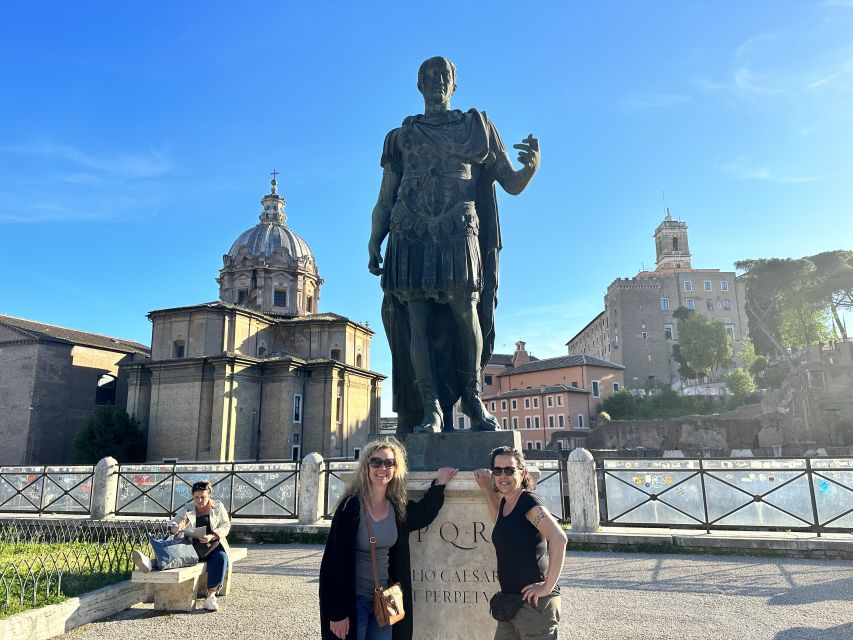
Climbing to Capitoline Hill is a highlight for most people because it turns the day from sightseeing-by-street into sightseeing-by-view. You reach the beautiful square designed by Michelangelo, and that gives you a clean visual anchor after walking through dense historical areas.
Why this is more than a photo stop: a viewpoint is a teaching tool. When you lift your eyes, you start to understand how Rome’s power zones relate to each other. The hill makes it easier to picture how the city grew and how different civic functions were positioned.
Keep expectations practical. This tour is walking-focused, and you’re doing an actual climb as part of the experience. So if you have mobility limitations, this is explicitly not the right match. And even if you’re fine walking, comfortable shoes aren’t optional here.
Via dei Fori Imperiali and the Forum cluster: reading power on the street
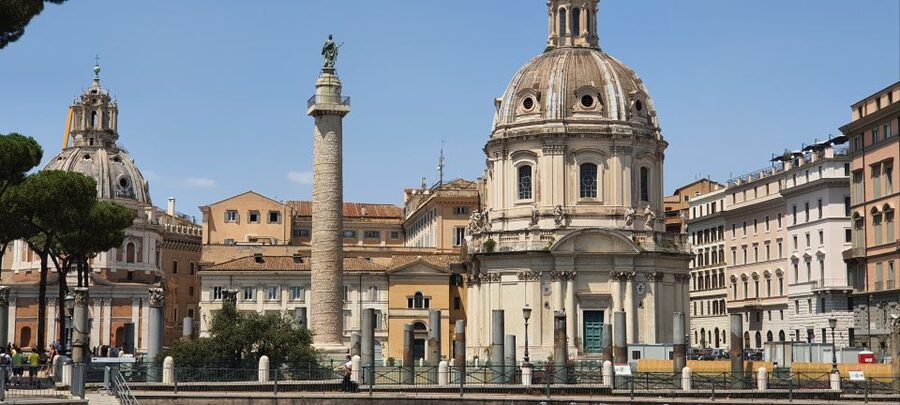
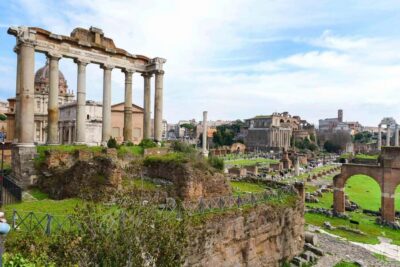
The tour’s most instructional stretch is Via dei Fori Imperiali, where you get the chance to understand the social and political life of past citizens while looking toward multiple forums: the Roman Forum, the Forum of Augustus, the Forum of Caesar, and the Forum of Nerva.
I like this approach because it avoids the trap many visitors fall into: staring at one ruin without understanding how it fits into the larger system. Here, you’re given a guided way to compare spaces. You’re looking at a cluster of forums from a path that helps you connect the dots.
And because the tour is only 2 hours, this matters. There’s no time to wander and guess. The guide’s job is to help you see the pattern. You’ll leave with a clearer mental map of civic power—who used these spaces, what they represented, and how the city presented itself.
Circus Maximus and the Colosseum exterior: the big-hitters, correctly framed
No visit to Rome would be complete without the Circus Maximus, described as the famous chariot-racing stadium. This is a smart inclusion because it expands the “Ancient Rome” picture beyond the Colosseum and beyond temples. It reminds you that Rome’s entertainment and public life were built at large scale.
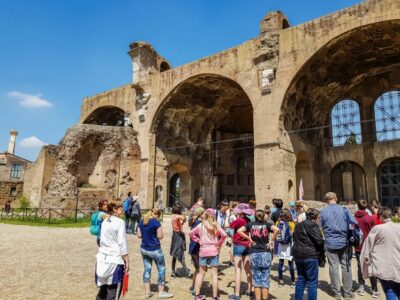
Then the tour ends outside the Colosseum, described as the world’s most famous amphitheater. You won’t go inside, and that’s intentional in a short walking tour. For many visitors, seeing it from the outside is still a key moment because you can link it back to earlier stops: the theatre, the forums, and the civic viewpoint on Capitoline Hill.
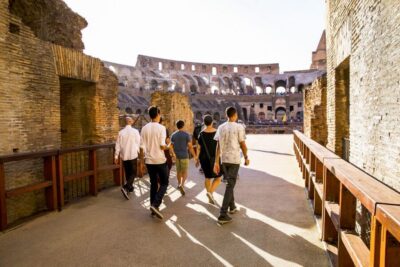
One thing to keep in mind: since entrance tickets and fees aren’t included and the Colosseum interior isn’t part of the visit, don’t expect this to replace a full Colosseum ticketed visit. Think of it as the narrative primer and orientation stop.
What you’re paying for: $243.56 and the value equation
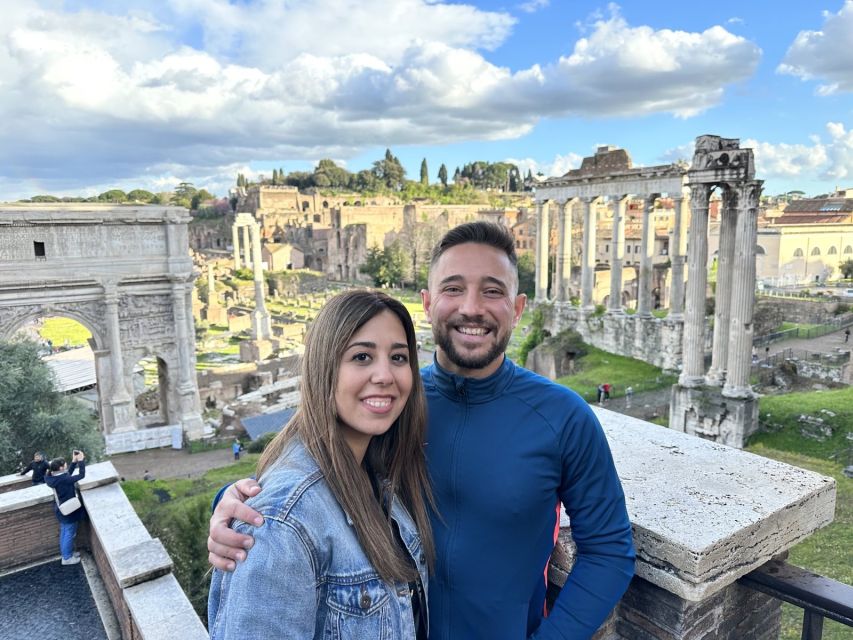
At $243.56 per person for a 2-hour guided walk, the price isn’t low. But it can still feel fair depending on what you want from Rome.
Here’s the value equation I’d use:
- You’re paying for a live English guide to connect multiple monuments into one story.
- You’re getting an efficient outdoor route that covers the Colosseum exterior, the Roman Forum area (from viewpoints), Circus Maximus, and key “in-between” stops.
- You’re not paying for Colosseum entry or other attraction tickets, because entrance is not included.
So who gets the best deal? People who want an organized overview and don’t want to spend hours figuring out what to see in what order. If you’re already planning a separate Colosseum interior visit, this tour becomes a strong add-on: it sets context so your later ticket visit lands better.
Also, the guide quality seems to matter a lot here. In the feedback, guides such as Bruno, Gabriel, and Francesco are praised for making the material easy to follow, with Bruno noted for a warm, humorous, friendly style, and Francesco for answering questions with ease. Sam is also described as personable and well-informed. That kind of coaching can turn a short walk into a meaningful one—especially when you’re dealing with scattered ruins.
Booking reality checks before you commit
A few practical points can prevent a disappointment:
- This is outdoor only. Plan for rain or shine.
- It’s not suitable for people with mobility impairments and not for wheelchair users.
- You should wear comfortable shoes and expect a climb to Capitoline Hill.
- You must arrive at the meeting point 15 minutes early, and guides wait no more than 10 minutes after the start time. Miss that window and you may lose the tour value without a remedy.
Lastly, because the Colosseum interior isn’t included, read your expectations carefully. If your ideal Rome moment is standing inside the arena, treat this tour as the context builder, not the final act.
Should you book this Colosseum, Circus Maximus, Forum & Ancient Rome tour?
I’d book it if you want a guided outdoor overview that helps you understand Ancient Rome, not just photograph it. The mix of stops—from Piazza Cinque Scole to Via dei Fori Imperiali viewpoints—makes the time feel purposeful, and the guide-led pacing is the main reason this tour works.
Skip or reconsider if your top priority is a Colosseum interior visit. This tour explicitly keeps you outside, and there are no entrance tickets included. In that case, you’ll want a separate ticketed plan for the arena, and then use this walk to learn how the rest of the city fits together.
If you’re flexible, comfortable walking, and want a short, structured day in central Rome with a strong narrative, this is a solid choice.
FAQ
Where does the tour start and end?
The tour meets in front of the Basilica of Sant’Anastasia al Palatino and ends back at the meeting point.
How long is the guided tour?
The duration is 2 hours.
Is there an option to enter the Colosseum?
No. The tour includes seeing the Colosseum from the outside only, and Colosseum entrance is not included.
Are entrance tickets included in the price?
No. Entrance tickets and fees are not included.
What sights are covered during the walk?
You’ll see main outdoor monuments and buildings including the Colosseum exterior, Circus Maximus, the Roman Forum area, Capitoline Hill, plus stops such as the Theatre of Marcellus and Temple of Apollo.
What is the meeting time rule if I arrive late?
You should arrive at the meeting point 15 minutes before the start time. The guide waits for no more than 10 minutes beyond the starting time, and late arrivals can’t join once the tour has started.
Does the tour run in bad weather?
Yes. The tour takes place rain or shine.
Who is the tour not suitable for?
It is not suitable for people with mobility impairments and not suitable for wheelchair users.
More Tours in Rome
- Vatican Museums, Sistine Chapel & St. Peter’s Basilica Tour
★ 4.3 · 73,970 reviews - Vatican Museums, Sistine Chapel & St Peter’s Basilica Guided Tour
★ 4.5 · 39,149 reviews - Rome: Colosseum, Palatine Hill and Roman Forum Guided Tour
★ 4.8 · 32,814 reviews - Rome: Guided Tour of Colosseum, Roman Forum & Palatine Hill
★ 4.7 · 27,897 reviews - Rome: Colosseum, Roman Forum and Palatine Hill Guided Tour
★ 4.5 · 23,903 reviews - Rome: Colosseum Arena Floor, Palatine & Forum Guided Tour
★ 4.5 · 20,180 reviews
More Tour Reviews in Rome
- Vatican Museums, Sistine Chapel & St. Peter’s Basilica Tour
★ 4.3 · 73,970 reviews - Vatican Museums, Sistine Chapel & St Peter’s Basilica Guided Tour
★ 4.5 · 39,149 reviews - Rome: Colosseum, Palatine Hill and Roman Forum Guided Tour
★ 4.8 · 32,814 reviews - Rome: Guided Tour of Colosseum, Roman Forum & Palatine Hill
★ 4.7 · 27,897 reviews - Rome: Colosseum & Forum with Audio Guide App -Optional Arena
★ 4.2 · 24,770 reviews - Rome: Colosseum, Roman Forum and Palatine Hill Guided Tour
★ 4.5 · 23,903 reviews
Ancient Rome, Kept Going
- Rome: Colosseum, Palatine Hill and Roman Forum Guided Tour
★ 4.8 · 32,814 reviews - Rome: Guided Tour of Colosseum, Roman Forum & Palatine Hill
★ 4.7 · 27,897 reviews - Rome: Colosseum & Forum with Audio Guide App -Optional Arena
★ 4.2 · 24,770 reviews - Rome: Colosseum, Roman Forum and Palatine Hill Guided Tour
★ 4.5 · 23,903 reviews - Rome: Colosseum Arena Floor, Palatine & Forum Guided Tour
★ 4.5 · 20,180 reviews - Rome: Colosseum Arena, Palatine Hill & Forum Guided Tour
★ 4.7 · 14,510 reviews
Just added to our Rome reviews





Colosseum & Ancient Rome Tours, compared.
 ★ 4.8Colosseum, Palatine Hill and Roman Forum Guided TourFrom $5232,814 reviews
 ★ 4.7Guided Tour of Colosseum, Roman Forum & Palatine HillFrom $5527,897 reviews
 ★ 4.2Colosseum & Forum with Audio Guide App -Optional ArenaFrom $4124,770 reviews
 ★ 4.5Colosseum, Roman Forum and Palatine Hill Guided TourFrom $5923,903 reviews
 ★ 4.5Colosseum Arena Floor, Palatine & Forum Guided TourFrom $4120,180 reviews
 ★ 4.7Colosseum Arena, Palatine Hill & Forum Guided TourFrom $8414,510 reviews
 ★ 4.6Colosseum,Forum & Palatine Tour + Optional Arena FloorFrom $4513,169 reviews
 ★ 4.7Colosseum: Underground and Ancient Rome TourFrom $16012,691 reviews