
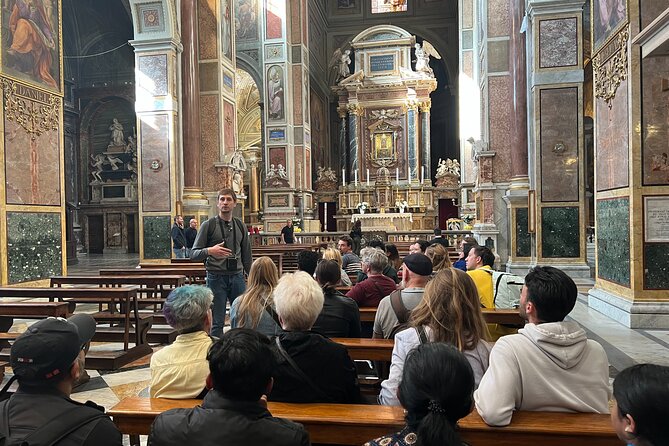
Reviewed · WALKING TOURS
Rome Art Walking Tour Who Killed Caravaggio
Caravaggio’s clues are everywhere in Rome. This 2-hour evening walking tour strings together art, real locations, and a murder mystery—so you see Baroque Rome as a story you can follow, not just a pile of famous names.
What I like most is the licensed local guide approach: you’re not only looking at paintings, you’re hearing the dramatic backstory that explains why each scene matters. Second, I love that the route takes you into churches where Caravaggio’s work is still hanging, so the art feels present and immediate. One thing to consider: it’s a tip-based tour, and as with many walking tours, you’ll want to stay close if you want every detail the guide shares while moving between stops.
In This Review
- Key takeaways before you go
- Rome after 5 pm: why this Caravaggio walk feels different
- Price and value: what $4.83 really buys you
- Meeting at Piazza della Minerva, then walking toward answers
- Stop 1: Piazza della Minerva’s mix of Bernini, Minerva, and a key church
- The Pantheon and Raphael: the light that explains why this all matters
- Palazzo Madama: Baroque power in the center of politics
- Church of St. Louis of the French: where Caravaggio’s St. Matthew becomes a dramatic plot
- Sant’Agostino: Madonna di Loreto and Raphael’s Isaiah in the same breath
- Via di Pallacorda: the mystery gets literal with Tomassoni
- Vicolo del Divino Amore: Lena and Caravaggio’s house, linked to scandal
- Palazzo Borghese and Il Circolo della Caccia: the elite club behind the scenes
- The guides make it: what works about the storytelling approach
- Who should book this Caravaggio tour (and who might skip it)
- Should you book Who Killed Caravaggio in Rome?
- FAQ
- How long is the Who Killed Caravaggio walking tour?
- What time does the tour start?
- Where do I meet the tour, and where does it end?
- What language is the tour offered in?
- Is the ticket mobile, and will I get confirmation?
- Are there admission fees at the stops?
- How big is the group?
- Is tipping included in the price?
- Is there free cancellation?
Key takeaways before you go
- A true mystery theme: You connect Caravaggio’s life to the Baroque art he helped shape.
- Churches with originals still on the wall: You’re not just hearing about masterpieces; you’re seeing them.
- Stop-by-stop storytelling: Each location gets its own scene-setting explanation, not one long lecture.
- Guides with strong stage energy: Past guides like Simone, Ivan, and Jacopo have been praised for enthusiasm and clear pacing.
- Small group feel: Maximum group size is 25, which helps the tour stay personal.
Rome after 5 pm: why this Caravaggio walk feels different
This is a Rome tour built around a very specific kind of attention. You start in the Baroque-and-beyond world around Piazza della Minerva and keep moving through places tied to Caravaggio’s life and impact. The premise is simple: solve what happened, then notice how the art reflects that tension—faith, scandal, street-level realism, and power.
The time slot helps. A 5:00 pm start means you’re often walking as crowds shift and the city’s mood changes. Rome can feel loud midday. In the evening, you get more time to actually look at details: faces, light, gesture, and the way dramatic scenes are staged inside churches.
The big win for you is the format: it’s short (about 2 hours) and focused. You’re not trying to absorb every museum in Rome. You’re learning how one artist’s story can organize a whole set of artworks around it.
Worth a look next to this Rome booking:
- Rome: Guided Food Walking Tour with Wine in Trastevere
★ 4.9 · 3,105 reviews - Rome: Trastevere & Campo de Fiori Street Food Walking Tour
★ 4.9 · 2,768 reviews - Rome: Paranormal Night Walking Tour & Secret Backstreets
★ 4.9 · 1,921 reviews - Rome: Trastevere Street Food Walking Tour with Local Expert
★ 4.8 · 1,784 reviews
Price and value: what $4.83 really buys you
At $4.83 per person, this looks like a bargain—and it mostly is, but with one key nuance. The tour is tip-based, meaning the guide’s compensation relies on what you choose to give afterward. So think of the listed price as the entry fee; the real experience depends on tipping.
Still, the value is unusually high for what you get:
- A licensed local guide
- A walking tour designed around storytelling and interpretation
- Baroque art stops tied to Caravaggio’s world
- Time in churches where the relevant works are physically in front of you
Also, the tour includes mobile tickets and runs in English. You won’t need to juggle paper or navigate a maze of transfers just to get to the first church.
Meeting at Piazza della Minerva, then walking toward answers
Your start point is Piazza della Minerva. It’s a smart choice because it places you right next to layers of Rome: ancient roots, medieval church architecture, and Baroque flourishes right next to each other.
From there, the route steadily escalates:
- Ancient Rome and a Renaissance giant
- A Baroque political building
- Major Caravaggio sites in national churches and Roman churches
- Then the darker, more personal “mystery” locations: alleys and the story behind the people in it
- Ending near Palazzo Borghese
The walking part matters. The tour is compact, and each stop is scheduled for a short window (often around 10–15 minutes). That forces focus. You’ll learn how to spot what the guide wants you to notice instead of drifting into random sight-seeing.
Stop 1: Piazza della Minerva’s mix of Bernini, Minerva, and a key church
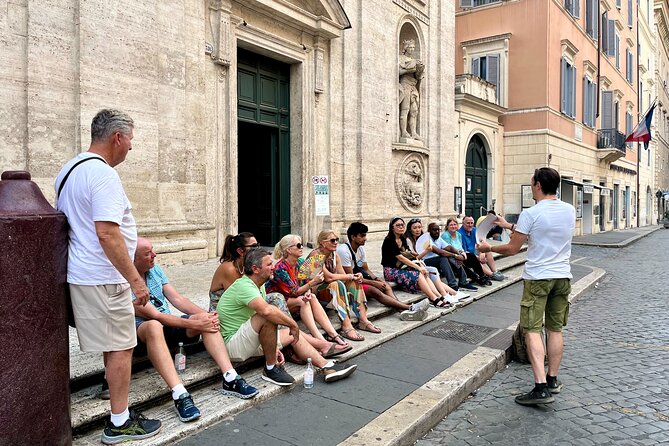
You begin at Piazza della Minerva, near the Pantheon area, where you’ll see Bernini’s Elephant and Obelisk. It’s one of those Rome landmarks that feels playful on the surface, but it also signals the Baroque taste for drama and theatrical symbolism.
Right nearby is Santa Maria sopra Minerva, a Gothic church built over an older temple connected to Minerva. That connection is useful for your tour brain: Rome didn’t replace the past; it kept stacking it. So when Caravaggio’s later work arrives, you’re already primed to think in layers—art speaking to older spiritual and cultural foundations.
This first stop is mostly about setting tone. You get a Baroque reference point, then the tour pulls you toward larger stages of art and belief.




The Pantheon and Raphael: the light that explains why this all matters
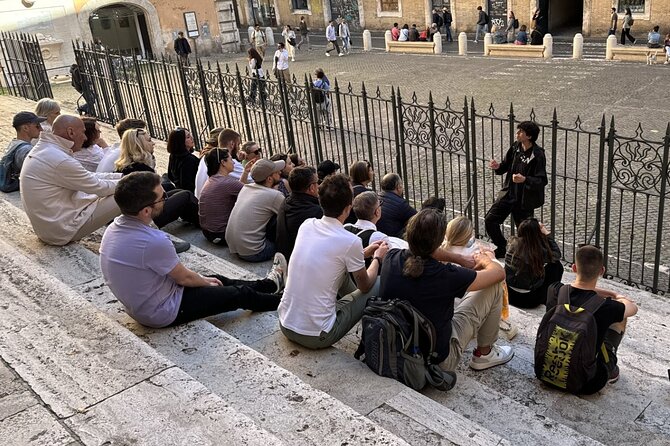
Next is the Pantheon, built around 126 AD and still astonishing. The defining feature for this kind of tour is the oculus—the circular opening at the top that lets daylight fall into the space. It’s the kind of visual effect that makes you understand why artists went after atmosphere and staged meaning with light.
You also learn how this space carries art history beyond engineering. The Pantheon is the resting place of Raphael, which helps the guide connect the dots between Renaissance art and the later Baroque style Caravaggio pushed toward.
Even if you think you know the Pantheon already, this stop is worth it on this itinerary because it’s not treated as a standalone monument. It becomes a hinge: from ancient form to later artistic storytelling.
Palazzo Madama: Baroque power in the center of politics
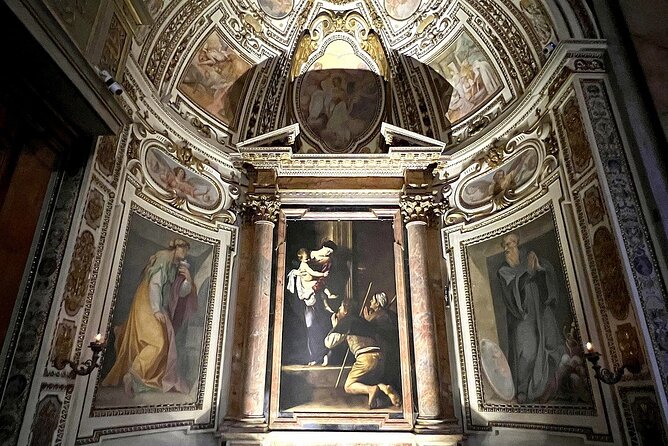
Then you move to Palazzo Madama, a Baroque palace that started as an earlier structure in the 16th century. Today it’s home to the Italian Senate. That sounds purely administrative, but it’s actually relevant to a mystery-art tour.
Power and patronage are part of Caravaggio’s story, even when the tour is focused on paintings. Seeing a seat of government in a palace shaped by aristocratic taste reminds you that art lived inside systems of influence. Baroque art wasn’t floating in a vacuum—it was made in response to audiences who had money, rank, and opinions.
This stop can also feel like a breather. It’s not as emotionally intense as some church interiors later on. For some people, that’s a good thing: it resets your attention before the tour hits the Caravaggio heavyweights.
Church of St. Louis of the French: where Caravaggio’s St. Matthew becomes a dramatic plot
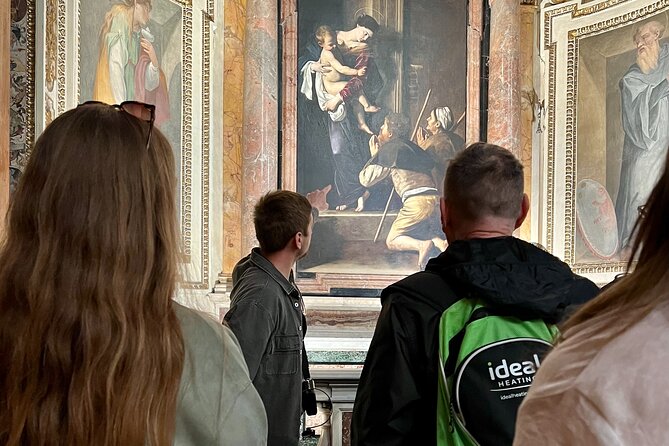
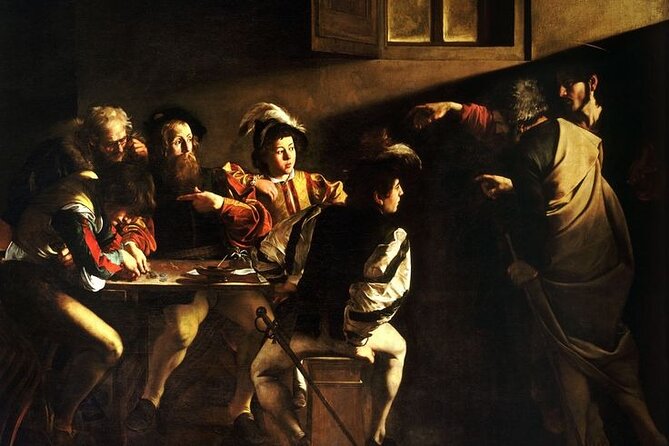
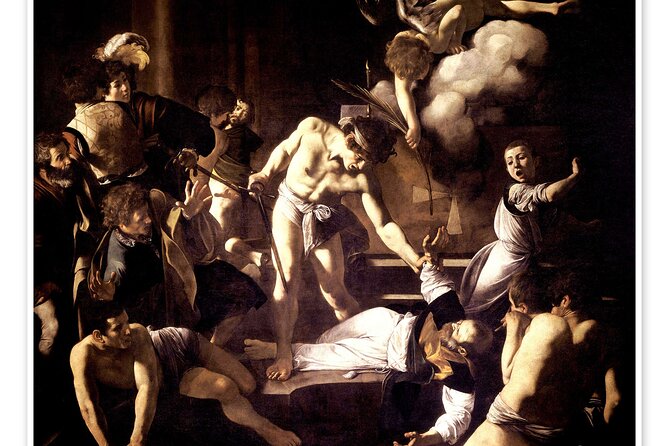
Your next major jump is San Luigi dei Francesi (St. Louis of the French), famous for the Contarelli Chapel. This is where the tour earns its title in a direct way.
Inside the Contarelli Chapel are three Caravaggio masterpieces depicting the life of St. Matthew. The guide’s job here is not just to point at paintings, but to explain how Caravaggio builds drama: through character, motion, and the sense that a sacred story is also a human one.
This is one of the stops where you’ll get the most from being present and looking closely. The tour format makes it easy to rush—but try not to. Give yourself a moment to notice the faces and the way scenes are arranged. This is Baroque storytelling in paint: it wants you to feel like the moment is happening right now.
And because you’re in a church, the art is treated as part of spiritual space rather than an isolated gallery object. That changes how it lands.
Sant’Agostino: Madonna di Loreto and Raphael’s Isaiah in the same breath
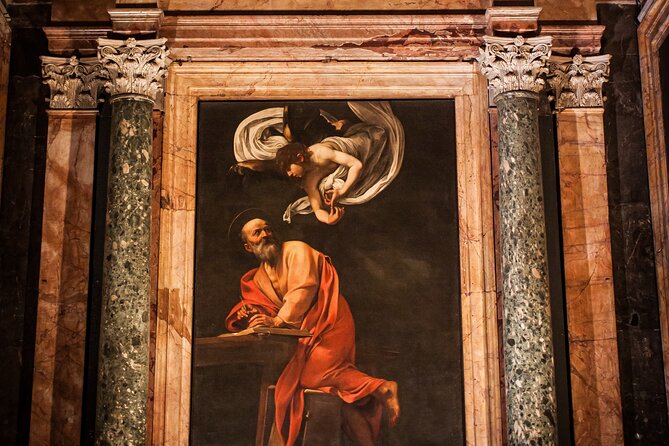
After St. Louis, you go to Sant’Agostino, near Piazza Navona. This is another church stop, and it’s a smart one because it mixes artists and styles in a way that helps you compare how different painters approach meaning.
Here you’ll see:
- Caravaggio’s Madonna di Loreto
- A Raphael fresco of Isaiah
This combination is valuable for your understanding of Caravaggio. You get the chance to see how Caravaggio’s approach differs from Raphael’s earlier direction. The guide’s storytelling helps you treat these not as separate highlights, but as part of a wider shift in Italian art—how sacred subjects were staged, lit, and emotionally pitched.
If you’re the kind of person who enjoys pattern-spotting, you’ll like this stop. You can come away thinking about how Baroque art took Renaissance foundations and made them more immediate, more human, and more dramatic.
Via di Pallacorda: the mystery gets literal with Tomassoni
Then the tour moves into the more “investigation” side of the theme: Via di Pallacorda.
This is presented as the murder scene of Tomassoni, Caravaggio’s victim. It’s the tour’s pivot from churches and paintings into the street-level narrative behind them.
You might not fully grasp the emotional weight just from the alley name alone, which is why the guide matters here. The value is connecting place to story: you’re standing somewhere the narrative points to, and the tour asks you to consider what kind of life leads to that outcome.
This is also one of the reasons the tour works even if you’re not an art fanatic. You’re following a plot, and art becomes the evidence.
Vicolo del Divino Amore: Lena and Caravaggio’s house, linked to scandal
After Via di Pallacorda, you walk to Vicolo del Divino Amore, and the tour focuses on Lena, described as Caravaggio’s house and model, plus the house of Caravaggio himself (the tour treats these as separate but closely linked moments in the same area).
This part is about scandal and human proximity. You’re learning that the story behind great art often includes relationships that were messy, complicated, and socially risky. By placing you in the vicinity of these homes, the tour helps you visualize the social world around Caravaggio.
It’s also where the guide’s storytelling pace really matters. If you drift too far behind, you’ll lose the meaning because this is less about architectural spectacle and more about narrative connection. The best way to get full value here is to keep your attention on the guide while still taking quick looks around.
Palazzo Borghese and Il Circolo della Caccia: the elite club behind the scenes
Your final stop is Palazzo Borghese, near the Spanish Steps area. This Baroque palace was home to the influential Borghese family. The tour connects the palace to Il Circolo della Caccia (The Hunting Club), a secretive elite club established in the 17th century.
The club is described as a gathering place for noblemen and intellectuals—people who discussed ideas, held exhibitions, and also did private hunting activities. The tour uses this to underline how exclusive circles shaped art culture. If Caravaggio’s story includes patrons and power networks, the Borghese family is part of that context.
You end here because it feels like a finishing frame. You start with monuments, move through masterpieces, then you close with the elite setting where art and ideas circulated.
The guides make it: what works about the storytelling approach
This tour isn’t just about locations. The strongest praise in the tour experience centers on the guide’s ability to keep the story clear and the tone engaging.
Guides such as Simone, Ivan, and Jacopo have been praised for:
- strong enthusiasm for Caravaggio
- respectful, patient explanations
- taking time and listening
- storytelling that feels lively without becoming chaotic
One practical detail to keep in mind: some guides will answer questions even while walking. That can be great if you’re close. If you’re a bit farther away, you might miss bits of the conversation during transitions. For your experience, try to position yourself near the front when you’re moving.
Also, the tour is described as gently interactive, meaning you’re invited into the story without feeling pressured.
Who should book this Caravaggio tour (and who might skip it)
You’ll likely love this if:
- you want a high-focus art experience in a short time
- you’re curious about Caravaggio’s life beyond the paintings
- you enjoy stories that connect art to real streets, not just art history timelines
- you like evening city walking and compact itineraries
You might skip it if:
- you prefer museum-style self-paced browsing over guided narrative
- you dislike walking between multiple church interiors and street sites in a single stretch
- you’re not interested in connecting people and events to art themes
Should you book Who Killed Caravaggio in Rome?
If your Rome plan includes at least one art-focused walk, I’d strongly consider booking this one. The combination of Caravaggio-linked church originals, a murder-mystery framing, and a licensed local guide makes it more engaging than a basic gallery tour.
The price is tempting, but remember it’s tip-based—so budget a fair tip for a guide doing real interpretive work. Also, plan to stay attentive while walking so you catch every story beat.
If you like your art with plot, this is a smart use of two hours in Rome. It turns famous works into clues, and that’s a fun way to see the city.
FAQ
How long is the Who Killed Caravaggio walking tour?
It’s about 2 hours (approximately).
What time does the tour start?
The start time is 5:00 pm.
Where do I meet the tour, and where does it end?
You meet at Piazza della Minerva, 00186 Roma RM, Italy. The tour ends at Palazzo Borghese, Piazza Borghese, 00186 Roma RM, Italy.
What language is the tour offered in?
The tour is offered in English.
Is the ticket mobile, and will I get confirmation?
You’ll have a mobile ticket, and you’ll receive confirmation at the time of booking.
Are there admission fees at the stops?
The itinerary lists stops as admission ticket free.
How big is the group?
The tour has a maximum of 25 travelers.
Is tipping included in the price?
No. The tour is tip-based, and tips are how guides work.
Is there free cancellation?
Yes. You can cancel for a full refund up to 24 hours in advance of the start time.
More Walking Tours in Rome
- Rome: Guided Food Walking Tour with Wine in Trastevere
★ 4.9 · 3,105 reviews - Rome: Trastevere & Campo de Fiori Street Food Walking Tour
★ 4.9 · 2,768 reviews - Rome: Paranormal Night Walking Tour & Secret Backstreets
★ 4.9 · 1,921 reviews - Rome: Trastevere Street Food Walking Tour with Local Expert
★ 4.8 · 1,784 reviews - Rome: Small-Group Guided Day or Night Walking Tour
★ 4.8 · 1,009 reviews - Rome by Night Walking Tour – Legends & Criminal Stories
★ 4.5 · 1,003 reviews
More Tours in Rome
- Vatican Museums, Sistine Chapel & St. Peter’s Basilica Tour
★ 4.3 · 73,970 reviews - Vatican Museums, Sistine Chapel & St Peter’s Basilica Guided Tour
★ 4.5 · 39,149 reviews - Rome: Colosseum, Palatine Hill and Roman Forum Guided Tour
★ 4.8 · 32,814 reviews - Rome: Guided Tour of Colosseum, Roman Forum & Palatine Hill
★ 4.7 · 27,897 reviews - Rome: Colosseum, Roman Forum and Palatine Hill Guided Tour
★ 4.5 · 23,903 reviews - Rome: Colosseum Arena Floor, Palatine & Forum Guided Tour
★ 4.5 · 20,180 reviews
More Tour Reviews in Rome
- Vatican Museums, Sistine Chapel & St. Peter’s Basilica Tour
★ 4.3 · 73,970 reviews - Vatican Museums, Sistine Chapel & St Peter’s Basilica Guided Tour
★ 4.5 · 39,149 reviews - Rome: Colosseum, Palatine Hill and Roman Forum Guided Tour
★ 4.8 · 32,814 reviews - Rome: Guided Tour of Colosseum, Roman Forum & Palatine Hill
★ 4.7 · 27,897 reviews - Rome: Colosseum & Forum with Audio Guide App -Optional Arena
★ 4.2 · 24,770 reviews - Rome: Colosseum, Roman Forum and Palatine Hill Guided Tour
★ 4.5 · 23,903 reviews
Just added to our Rome reviews





Walking Tours, compared.
 ★ 4.9Guided Food Walking Tour with Wine in TrastevereFrom $1003,105 reviews
 ★ 4.9Trastevere & Campo de Fiori Street Food Walking TourFrom $512,768 reviews
 ★ 4.9Paranormal Night Walking Tour & Secret BackstreetsFrom $341,921 reviews
 ★ 4.8Trastevere Street Food Walking Tour with Local ExpertFrom $571,784 reviews
 ★ 4.8Small-Group Guided Day or Night Walking TourFrom $231,009 reviews
 ★ 4.5Rome by Night Walking Tour – Legends & Criminal StoriesFrom $141,003 reviews
 ★ 4.4Guided City Center Evening Sightseeing Walking TourFrom $46953 reviews
 ★ 4.9Small-Group City Highlights Moonlight Walking TourFrom $29949 reviews
Browse the lists this tour appears in