
Reviewed · MUSEUMS
Leonardo da Vinci Museum: the Universal Genius and His Works
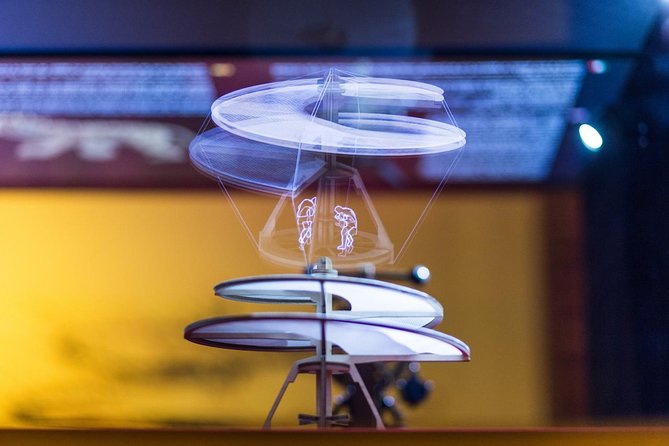
Leonardo’s machines feel surprisingly close-up. In Rome, this interactive exhibition brings Leonardo da Vinci to life with large-scale reproductions, touch-friendly designs, and modern effects like 3D holograms and videomapping at Piazza della Cancelleria 1.
I especially like two things: first, you get to interact with more than 65 life-size reproductions of his machine drawings, and second, the show is paced in a way that works for both adults and kids. The setting is also an easy add-on to other Vatican-area sights in the neighborhood.
One thing to factor in: it’s not a giant museum, so if you want a deep, slow, lecture-style experience, you may finish faster than you expect unless you use the audio guide.
In This Review
- Key things to know before you go
- Entering Rome’s Leonardo Exhibit at Piazza della Cancelleria
- Price and timing: how to get good value without rushing
- The main stop: Museo/Mostra Leonardo da Vinci and the machine rooms
- What you’ll actually do inside
- What to watch for (and what could disappoint)
- What the interactive layout teaches you about art and engineering
- Audio guide: the €3 add-on that can slow the pace in a good way
- The underground pond and the 43 B.C. tomb surprise
- Location strategy: fit it next to the rest of your Rome day
- Who should book this Leonardo da Vinci museum?
- Should you book the Leonardo da Vinci Museum tour?
- FAQ
- How long does the Leonardo da Vinci Museum visit take?
- Is the admission ticket included in the tour price?
- Do I need to bring an audio guide?
- What languages are audio guides available in?
- Is this experience offered in English?
- Where is the museum located?
- What are the opening hours?
- Is the ticket mobile?
- Is it suitable for families and kids?
- Can I cancel for free?
- Is it easy to reach using public transportation?
Key things to know before you go
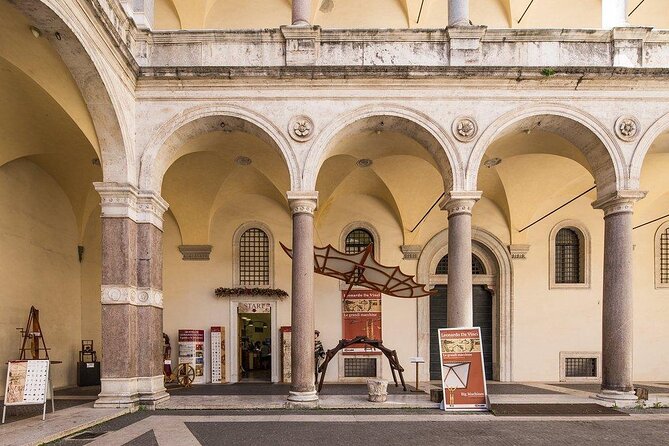
- Life-size machine reproductions you can touch and try, not just glass cases
- 3D holograms and videomapping that modernize how you see Leonardo’s ideas
- Plan for 40 minutes minimum, with a typical visit around 45 to 60 minutes
- Audio guide costs extra (€3.00) but can help you move at the right speed
- An underground pond and tomb surprise (43 B.C.) closes the experience with a wow moment
- Central location near major sights, making it simple to fit into a day
Entering Rome’s Leonardo Exhibit at Piazza della Cancelleria
This is a well-located stop for a Rome day. The address is Piazza della Cancelleria 1, in the heart of the city, and it’s near public transportation. In practice, that means you can do it as a midday breather, or slot it in after you’ve walked around the Vatican area.
I also like the way this exhibition treats you like you’re supposed to use your hands and your eyes. You’re not only looking at drawings or models from across the room. You’re working through concepts: what the machine was meant to do, how the parts relate, and why Leonardo’s sketches still feel practical.
If you’re traveling with kids, this place is designed for that mix of curiosity. The exhibition is described as suitable for visitors of all ages, with the practical note that children must be accompanied by an adult. That’s exactly what you want in a family stop: clear “everyone can participate” energy without needing to be an expert.
Worth a look next to this Rome booking:
- Vatican Museums, Sistine Chapel & St. Peter’s Basilica Tour
★ 4.3 · 73,970 reviews - Vatican Museums, Sistine Chapel & St Peter’s Basilica Guided Tour
★ 4.5 · 39,149 reviews - Rome: Vatican Museums, Sistine Chapel and Basilica Tour
★ 4.3 · 16,039 reviews - Vatican Museums & Sistine Chapel Skip-the-Line Entry Ticket
★ 4.4 · 13,838 reviews
Price and timing: how to get good value without rushing
The price is $10.81 per person, which is refreshingly straightforward for Rome. What makes it good value isn’t just the ticket price. It’s the format: you’re paying for time in an interactive exhibit with multiple types of displays—hands-on replicas, multimedia effects, and a concluding surprise.
Timing is also realistic. The experience runs about 45 minutes to 1 hour, and the important planning note is that you need at least 40 minutes to visit properly. If you arrive expecting it to be a quick pass, you’ll feel the squeeze. If you arrive with an extra 60–90 minutes in your day buffer, you’ll have a much better time. You can read, test, watch the multimedia moments, and still stay on schedule.
You’ll also want to check opening hours. The exhibit is open Monday to Friday, 9:30 AM to 7:00 PM, and it’s closed on December 25. That’s a short window compared to some major museum schedules, so if you’re traveling outside those days, plan ahead.
One small logistics note that matters: the ticket is described as mobile, and confirmation comes at booking time. That usually makes entry smoother, but it also means you should keep your confirmation on your phone easy to find.
The main stop: Museo/Mostra Leonardo da Vinci and the machine rooms
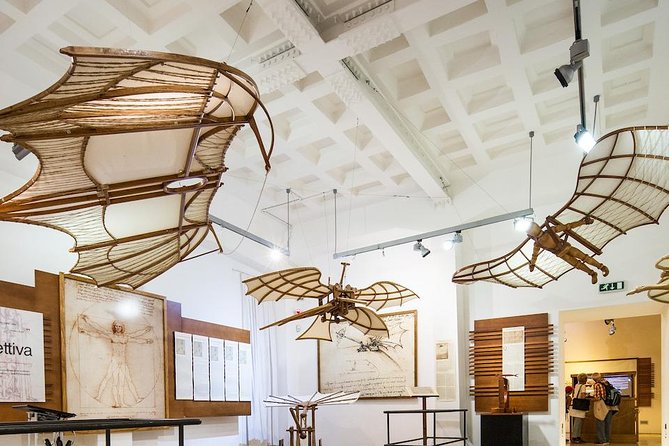
Your visit centers on Museo/Mostra Leonardo da Vinci – Il Genio le Invenzioni. This is where the show earns its keep. You’ll see more than 65 reproductions of Leonardo’s machine drawings, and they’re presented at real-life scale. That scale matters because it helps you understand the intention behind the sketch. A small diagram can look clever. A machine-sized version feels real—and suddenly the problem-solving behind it becomes obvious.
What you’ll actually do inside
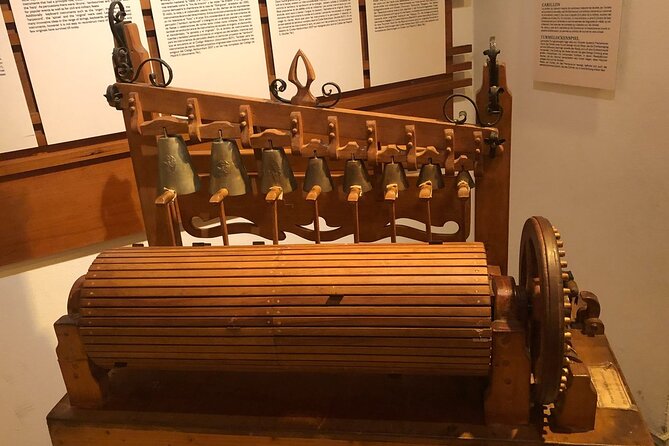
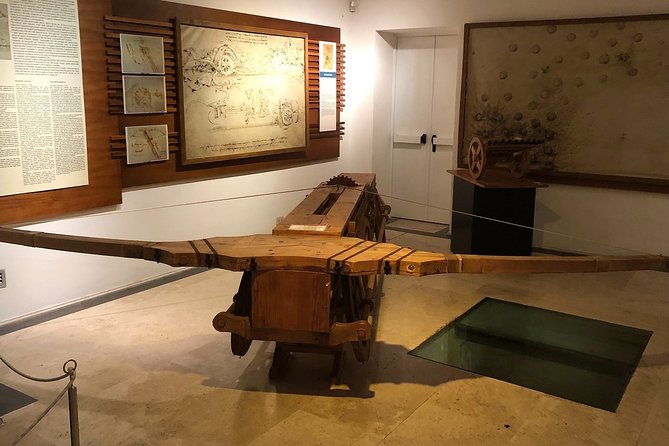
The experience is set up so you’re not only reading labels. You can touch and try many of the inventions, which turns the exhibit into a kind of hands-on learning lab. You get to test the basic idea: how parts might move, how pressure or balance could work, and how Leonardo’s engineering imagination could translate into something buildable.
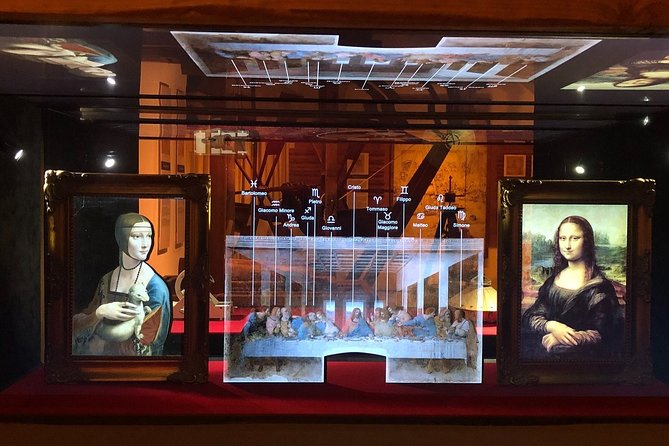
On top of that, the exhibition uses 3D holograms and videomapping. These aren’t just decoration. They help explain what’s going on with mechanisms that can be hard to visualize from a flat sketch alone. When the visuals line up with the physical replica, you get a clearer sense of motion and function.
What to watch for (and what could disappoint)
This is a smaller venue than many big Roman museums, and that’s part of the charm. But it can also be a drawback if you want a long, slow wander. If you move quickly and skip the explanatory moments, you might feel like you’re done sooner than planned.
There’s also one practical consideration: some people have reported that certain exhibits may be under construction or not available to physically try. That doesn’t mean the whole visit is broken, but it’s smart to keep a flexible mindset. If a specific machine is a must-see for you, it’s worth arriving when you can slow down and adjust.
Still, the overall design is strongly focused on interaction. That’s why people come back satisfied: it’s not Leonardo as a distant genius behind glass. It’s Leonardo as an inventor you can test.
What the interactive layout teaches you about art and engineering
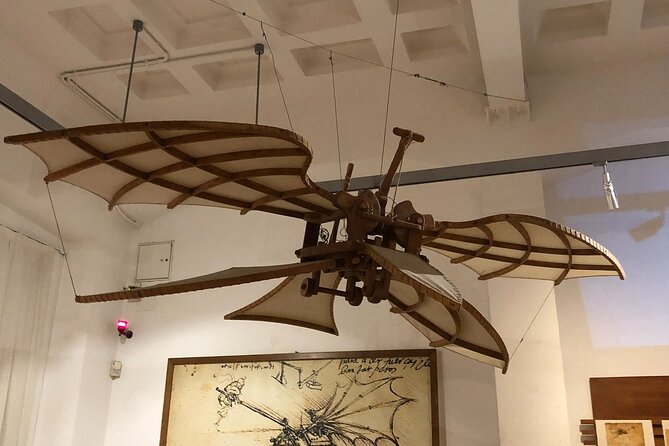
Leonardo da Vinci is often presented as an art legend, an engineering myth, or a historical figure in a textbook. Here, the exhibition nudges you to see him as all three: artist, engineer, craftsman.
You can feel that in the way the exhibit frames his ideas. Instead of separating art and mechanics, the show connects concepts. You see how his imagination turns into drawings. You see those drawings converted into functioning or at least mechanism-based models. Then multimedia helps you understand how the parts could work.
This approach is especially useful if you’re not traveling with a specific interest in engineering. You don’t need background knowledge to enjoy it. The experience gives you enough structure to interpret what you’re seeing on the spot—without turning the visit into a quiz.
And if you are an engineering-minded visitor, you’ll probably appreciate the real-life scaling more than you expect. Diagrams are one thing. A life-size model makes you think about weight, movement, and feasibility. Even if the replica is not identical to a build Leonardo would have finished, the thinking is still there.
Audio guide: the €3 add-on that can slow the pace in a good way
Audioguides are not included, and they cost €3.00 per person if you add them at the entrance. The exhibit is offered in English, but the audio guide option matters because it can help you understand what you’re looking at as you go.
It’s also available in many languages, including Italian, Spanish, English, French, German, Portoghese, Russian, Dutch, Romanian, Polish, and Hebrew. So even if you start in English or prefer to travel with a different language option, you’re likely covered.
Based on experience-style feedback patterns, the audio guide tends to help you avoid the all-too-common problem of finishing a hands-on exhibit too fast. When you have explanations tied to each section, you naturally spend more time reading and testing. If you’re the type who likes to understand the “why” behind the “what,” I’d plan on the extra €3.
One caution: audio tour flow can be confusing if it isn’t clearly matched to what you’re seeing. If you’re easily thrown off by changing room order, take a quiet moment to orient yourself before you start listening. Then follow the exhibit sequence at your own pace.
The underground pond and the 43 B.C. tomb surprise
The show ends with a hidden surprise: an underground pond where you can see the tomb of Aulo Irzio, dating to 43 B.C. That’s a great way to close the visit because it switches gears from machines to something unexpected and atmospheric.
This kind of ending works because it changes your brain’s mode from problem-solving to storytelling. You’ve spent the earlier part of the exhibit thinking about mechanisms and how ideas translate into form. Then suddenly you’re in a real-feeling space connected to ancient Rome. The contrast makes the final moment memorable.
If you like “a last-minute twist” in museum design, this ending likely hits for you. And if you don’t care about the historical element, it still serves a purpose: it gives your legs and eyes a break from repetitive screens and replica close-ups.
Location strategy: fit it next to the rest of your Rome day
This is the kind of exhibit that pairs well with nearby walking. People have described it as easy to find and close to major sightseeing areas, including the area around Piazza Navona and the Campo de’ Fiori direction. Even if you’re not following that exact route, the point stays the same: you won’t waste half your afternoon commuting across town.
I like doing this sort of indoor stop when the light or crowds make outdoor sightseeing less pleasant. Since it’s an enclosed exhibition, you can take advantage of breaks on hot or busy days. There’s also mention of air conditioning, which is a real comfort factor in warm weather.
Who should book this Leonardo da Vinci museum?
This experience is a good match if you want any of the following:
- You like hands-on exhibits more than long galleries of text
- You want a family-friendly stop where kids can touch and test
- You’re curious about Leonardo’s inventions and want them explained through models and multimedia
- You prefer a visit that fits into a normal Rome day without consuming your whole afternoon
It may not be the best fit if:
- You expect a huge multi-hour museum with lots of originals
- You only want academic depth and full historical context
- You’re sensitive to the possibility that a few interactive parts may be temporarily unavailable
Still, even the small size tends to work in its favor. You’re not committing to a half-day of museum stamina. You’re committing to focused time with interactive concepts, plus that underground finishing moment.
Should you book the Leonardo da Vinci Museum tour?
Yes, if your goal is an efficient, interactive introduction to Leonardo da Vinci’s inventions in central Rome. The value is strong for the price because the experience is built around hands-on interaction, multimedia explanations, and a memorable wrap-up with the 43 B.C. Aulo Irzio tomb.
If you’re deciding between rushing through or enjoying it properly, tilt toward slowing down with the audio guide. It’s an extra €3.00, but it often changes how much you get from the exhibit by helping you understand what you’re testing.
If you’re in Rome during the Monday–Friday 9:30 AM–7:00 PM window, this is an easy recommend. Just arrive with enough time to do the full route, and don’t treat it like a quick museum stop you can sprint through.
FAQ
How long does the Leonardo da Vinci Museum visit take?
Plan for about 45 minutes to 1 hour. The museum recommends you allow at least 40 minutes.
Is the admission ticket included in the tour price?
Yes. Admission to the Leonardo da Vinci Exhibition is included.
Do I need to bring an audio guide?
No, the audio guide is not included. You can rent one at the entrance for €3.00 per person.
What languages are audio guides available in?
Audio guides are listed as available in Italian, Spanish, English, French, German, Portoghese, Russian, Dutch, Romanian, Polish, and Hebrew.
Is this experience offered in English?
Yes, it is offered in English.
Where is the museum located?
The address is Piazza della Cancelleria 1 in Rome.
What are the opening hours?
The exhibit is open Monday to Friday, 9:30 AM to 7:00 PM. It is closed on December 25th.
Is the ticket mobile?
Yes. The tour includes a mobile ticket.
Is it suitable for families and kids?
It’s designed for visitors of all ages. Children must be accompanied by an adult.
Can I cancel for free?
Yes. There is free cancellation. You can cancel up to 24 hours in advance for a full refund.
Is it easy to reach using public transportation?
Yes. It’s described as near public transportation.
More Museums in Rome
- Vatican Museums, Sistine Chapel & St. Peter’s Basilica Tour
★ 4.3 · 73,970 reviews - Vatican Museums, Sistine Chapel & St Peter’s Basilica Guided Tour
★ 4.5 · 39,149 reviews - Rome: Vatican Museums, Sistine Chapel and Basilica Tour
★ 4.3 · 16,039 reviews - Vatican Museums & Sistine Chapel Skip-the-Line Entry Ticket
★ 4.4 · 13,838 reviews - Rome: Vatican Museums, Sistine Chapel & Basilica Tour
★ 4.7 · 13,217 reviews - Rome: Vatican Museums & Sistine Chapel Guided Tour
★ 4.3 · 12,117 reviews
More Tour Reviews in Rome
- Vatican Museums, Sistine Chapel & St. Peter’s Basilica Tour
★ 4.3 · 73,970 reviews - Vatican Museums, Sistine Chapel & St Peter’s Basilica Guided Tour
★ 4.5 · 39,149 reviews - Rome: Colosseum, Palatine Hill and Roman Forum Guided Tour
★ 4.8 · 32,814 reviews - Rome: Guided Tour of Colosseum, Roman Forum & Palatine Hill
★ 4.7 · 27,897 reviews - Rome: Colosseum & Forum with Audio Guide App -Optional Arena
★ 4.2 · 24,770 reviews - Rome: Colosseum, Roman Forum and Palatine Hill Guided Tour
★ 4.5 · 23,903 reviews
Just added to our Rome reviews





Museums, compared.
 ★ 4.5Vatican: Museums & Sistine Chapel Entrance TicketFrom $38144,003 reviews
 ★ 4.3Vatican Museums, Sistine Chapel & St. Peter’s Basilica TourFrom $7273,970 reviews
 ★ 4.5Vatican Museums, Sistine Chapel & St Peter’s Basilica Guided TourFrom $2239,149 reviews
 ★ 4.3Vatican Museums, Sistine Chapel and Basilica TourFrom $7316,039 reviews
 ★ 4.4Vatican Museums & Sistine Chapel Skip-the-Line Entry TicketFrom $4313,838 reviews
 ★ 4.7Vatican Museums, Sistine Chapel & Basilica TourFrom $7213,217 reviews
 ★ 4.3Vatican Museums & Sistine Chapel Guided TourFrom $11812,117 reviews
 ★ 4.2Vatican Museums & Sistine Chapel Skip-The-Line TicketFrom $4111,708 reviews