

Reviewed · TOURS
E-Tuk Tour Express Highlights of Rome
One ride, seven Rome landmarks, and a lot less walking. This e-tuk tour is a smooth way to see major sights faster while still getting a real guide instead of just staring at maps. I like the English-speaking driver/guide approach, and I also like that you can get headsets if you want extra help hearing every detail. One big consideration: if you’re traveling with a toddler, double-check the child-safety seat requirement ahead of time because Italian road laws are strict.
The route packs in famous stops like the Spanish Steps, Trevi Fountain, and the Pantheon, then continues on to places most people skip because they’re harder to reach on foot. The group stays small (max 15 travelers), and you get a mobile ticket plus photo stops at the main landmarks. Just remember: this is time-boxed, so you’re there to look, listen, and move—not to linger for an hour at one spot.
In This Review
- Key highlights to know before you book
- First Impressions From Piazza del Popolo
- Is $72.23 Worth It for an E-Tuk Tour?
- How the 90 Minutes Really Works
- Spanish Steps: The Baroque Staircase Everyone Wants a Photo of
- Trevi Fountain: Neptune, Wishes, and the Power of a Short Stop
- Pantheon: Ancient Engineering With a Sky-Opening Twist
- Piazza Navona: Art, Fountains, and a Living Public Square
- Teatro di Marcello: A Roman Theater You Can Actually Notice
- Colosseum: The Big Name, Plus a Quick Forum Context
- Circo Massimo: Ancient Chariot Racing at Huge Scale
- E-Tuk Comfort: Seating, Noise, and Staying in Sync
- Family Safety and the Car-Seat Reality in Rome
- Who This Tour Is Best For (And Who Might Want Something Else)
- Should You Book the E-Tuk Highlights of Rome Tour?
- FAQ
- How long is the E-Tuk Tour Highlights of Rome?
- Where does the tour start and where does it end?
- Is the tour offered in English?
- What’s included in the price?
- Are entrance tickets included?
- Can I get headsets to hear the guide?
- How many people are in the group?
- What’s the cancellation policy?
- Do children need a car seat?
Key highlights to know before you book
- E-tuk pace for less walking: designed to help you cover more ground in 90 minutes.
- English guidance plus headsets: ask for headsets so the story doesn’t get lost over traffic noise.
- Small group size: up to 15 travelers, which usually keeps the ride from feeling chaotic.
- Free-admission stops on the plan: several key stops are listed as free admission.
- Photo stops at main landmarks: you don’t have to guess when to pull out your camera.
- Family safety rules are real: the child safety seat law can affect boarding if you show up unprepared.
First Impressions From Piazza del Popolo
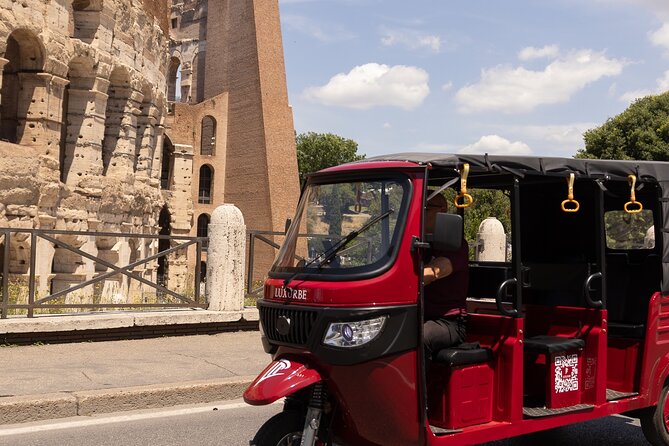
This tour starts and ends right back at Piazza del Popolo (Piazza del Popolo, 11, 00187 Roma RM). That matters more than it sounds. When a trip loops back to the same spot, you’re not stuck hunting for a bus or guessing how to get home after the last photo.
You’ll hop into an e-tuk for about 1 hour 30 minutes total, with the schedule built around short landmark visits and the rest of the time spent in transit. Because the vehicle does the legwork, the whole experience feels like a “great hits” sampler—especially if Rome walking fatigue has already started to creep in.
The operator is Luxurbe, and the tour is offered in English. With an English-speaking driver/guide, you’re not left to read your way through the day.
Weighing this one up? Here is how a few Rome favourites compare:
- Vatican Museums, Sistine Chapel & St. Peter’s Basilica Tour
★ 4.3 · 73,970 reviews - Vatican Museums, Sistine Chapel & St Peter’s Basilica Guided Tour
★ 4.5 · 39,149 reviews - Rome: Colosseum, Palatine Hill and Roman Forum Guided Tour
★ 4.8 · 32,814 reviews - Rome: Guided Tour of Colosseum, Roman Forum & Palatine Hill
★ 4.7 · 27,897 reviews
Is $72.23 Worth It for an E-Tuk Tour?
At $72.23 per person, this isn’t the cheapest way to see Rome. So the value question is simple: does it save you enough time and strain to justify the price?
Here’s the practical math I’d use:
- You get guided stops at recognizable icons plus some less-expected ancient sites.
- You avoid a lot of “stand up, walk ten minutes, stop, backtrack” time.
- You get support hearing the guide via headsets (available), plus audio guides if they’re available upon request.
If you’re comfortable walking and you enjoy going slow, you could probably do a free-form route on your own. But if you want a guided overview without turning your day into a marathon, the e-tuk format is the point. You’re paying for speed, guidance, and simpler logistics in a city that loves cobblestones.
Also, the tour is booked about 26 days in advance on average. That usually means you can plan ahead without gambling on last-minute availability.
The overall rating shown for the experience is 3.6 out of 5 (18 ratings). That’s not terrible, but it tells you to go in with your eyes open—especially around safety and day-of expectations.
How the 90 Minutes Really Works
The day is structured as a sequence of short visits: each landmark gets around 10 minutes, and the remaining minutes are for travel time between stops.
That timing style has two effects:
- You get a quick “first look” at each place before your brain mixes it all together.
- You also won’t get hours of in-depth museum time at any single site.
So treat this as a sightseeing relay. Think look, listen, learn a few key facts, snap a photo, get back in the e-tuk. If you want longer time inside monuments, plan to add your own follow-up visit later.
The itinerary also highlights the fact that many stops are listed as free admission. That’s great for budget. Still, entrance tickets are listed as not included. In other words: don’t assume every site will be free if something changes day-to-day or if you want a special entry option.
Spanish Steps: The Baroque Staircase Everyone Wants a Photo of
Your first major stop is the Spanish Steps, built in 1725. This stretch of 135 steps connects Piazza di Spagna to the Trinità dei Monti church and has a classic Baroque look that explains why it’s a favorite for meeting up, people-watching, and quick photos.
What I like about starting here: it’s visually strong and easy to orient yourself. Even if you’re not an architecture nerd, you can feel why this spot became a symbol of Roman style. In a short stop, your guide can point out the key idea: the staircase is more than steps—it’s a dramatic link between two important points in the city.
One practical tip: wear shoes you trust. Even with an e-tuk, you’ll still step off to take in the view and get your bearings.

Trevi Fountain: Neptune, Wishes, and the Power of a Short Stop
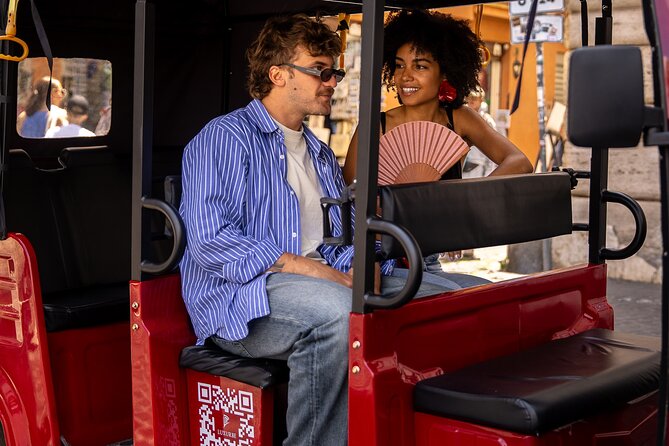
Next is Trevi Fountain, a Baroque masterpiece filled with mythical sculpture. You’ll hear the story of prosperity and the famous tradition of tossing coins—plus details about Neptune’s chariot and the surrounding figures.
Trevi Fountain is one of those places where a short visit can still feel satisfying, because:
- the fountain is instantly recognizable,
- the sound of flowing water does half the work for you,
- and you can get the “why it matters” story without committing to a long wait.
At the same time, it’s also a magnet for crowds. The e-tuk helps you arrive as part of a guided flow, and the photo-stop rhythm means you’re less likely to waste time guessing when you’ll get your turn.
Pantheon: Ancient Engineering With a Sky-Opening Twist

Then comes the Pantheon, and this is where the tour’s guide-led value really shows. The Pantheon is famous for its massive dome and its oculus—the open circle at the top that brings light in like it’s part of the design.
Even if you’ve seen pictures, the interior tends to land differently in person because the building is still doing what it was designed to do: frame the sky, focus your attention, and make the space feel purposeful.
The Pantheon was originally a temple dedicated to all gods, and the guide can connect that ancient purpose to what you see now. In a quick 10 minutes, the goal isn’t to read every inscription. It’s to grasp the main idea of Roman architectural confidence—how engineering and religion mixed together in stone.
Piazza Navona: Art, Fountains, and a Living Public Square
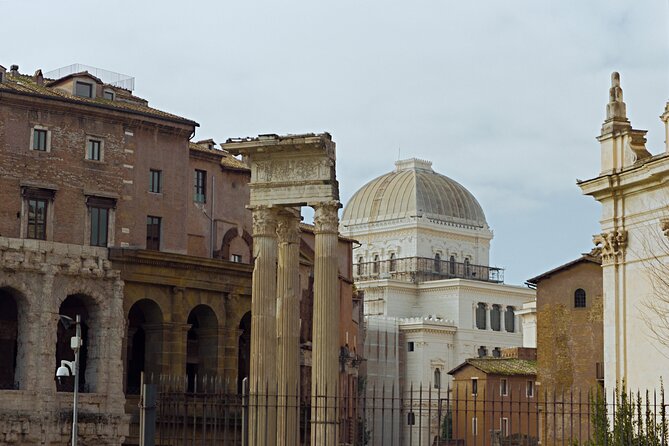
Piazza Navona is next, known for its Baroque elegance and its role as a central public square. You’ll see the Fontana dei Quattro Fiumi, and you’ll also get a sense of why this area has long attracted people to sit, talk, and watch.
In a short stop, Piazza Navona works because it’s more than a single landmark. The square itself is the attraction. If you want to “feel” Rome’s street-life rhythm without spending all day walking between museums, this kind of square stop is a smart use of time.
Your guide can tie the fountains and architecture into the bigger Baroque story so it doesn’t feel like random scenery.
Teatro di Marcello: A Roman Theater You Can Actually Notice
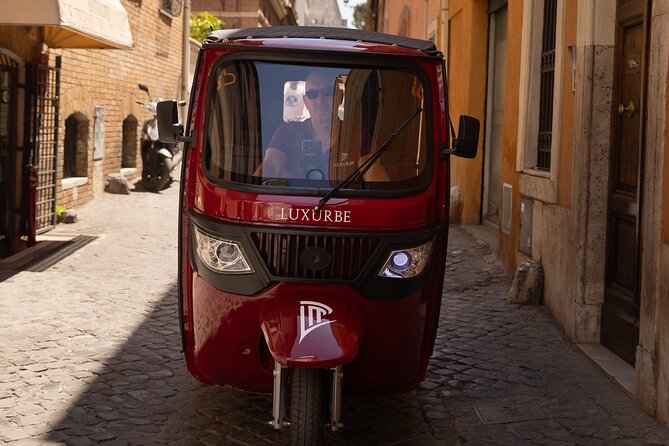
The Theatre of Marcellus (Teatro di Marcello) is built in 13 BC and was commissioned by Augustus. It was an open-air theater that once hosted plays and music.
This stop is the kind of add-on that makes an e-tuk tour more than just a photo-bus. Most first-timers chase the headline monuments. Teatro di Marcello gives you a chance to see an ancient structure with the scale and arch logic Rome is known for—without making you hunt for it on your own.
The short time here means you’ll likely focus on the arches and the overall layout rather than a deep dive into details. But that’s fine. The point is to recognize the Roman building language and connect it to what you’ve already seen.
Colosseum: The Big Name, Plus a Quick Forum Context

No Rome highlights run is complete without the Colosseum. This amphitheater is iconic for a reason: it hosted gladiator games and other events, and it became one of the clearest symbols of Roman spectacle.
What helps on this tour is the nearby context. The Roman Forum is described as the heart of ancient Rome, with ruins of temples, basilicas, and public spaces. That quick linking gives your brain an anchor: Colosseum wasn’t floating in space. It belonged to a bigger civic world.
In a 10-minute stop, you won’t solve every question about the Colosseum in one go. But you’ll leave with a more organized picture of where it fits—especially if your day is otherwise made up of scattered monuments.
Circo Massimo: Ancient Chariot Racing at Huge Scale
Your final big stop is Circo Massimo, an ancient chariot racing stadium that could hold over 250,000 spectators. It dates back to the 6th century BC and still represents Roman engineering at massive scale.
This is also a great example of why an e-tuk format works. Circo Massimo isn’t just a single building. It’s a whole venue space—and the e-tuk helps you get from place to place without turning the day into a long walking loop.
The guide can explain the original purpose and also what the area represents today as a public event space. In other words: it’s not only ruins. It’s a location that still holds gatherings and momentum.
E-Tuk Comfort: Seating, Noise, and Staying in Sync
The e-tuk isn’t just about convenience. It changes how you experience the city because you’re not constantly navigating foot traffic and tight streets on foot.
A few practical notes that match the tour’s included items:
- You get photo stops at main landmarks, so you aren’t chasing the group every time you want a picture.
- You can request audio guides if they’re available.
- Headsets can be provided so you don’t miss the narration over ambient noise.
That last bit matters in Rome. Even when the guide is giving useful info, street sounds can drown it out. Having headsets lets you actually follow the story, not just hear pieces.
Also, with a max of 15 travelers, the ride stays manageable. Fewer people means easier timing for stop-and-start moments.
Family Safety and the Car-Seat Reality in Rome
One part of the experience deserves your attention before you arrive: child safety seat rules.
Italian road safety laws prohibit transporting children under 3 years old or below 15 kg in vehicles without an appropriate child safety seat. If you’re traveling with a toddler, this isn’t a “might happen” issue—it’s a legal requirement enforced for passenger safety.
In one real-life situation, a family arrived expecting to board but was refused because they didn’t have the required seat. The company response emphasized that safety is non-negotiable and suggested families contact in advance for suitable solutions and assistance with local rental options.
My advice is simple: if your child needs a car seat, plan like it’s required for every ride. Don’t assume it will be handled on-site. If you’re unsure, contact the operator before your tour date so you can avoid a frustrating, last-minute scramble.
Who This Tour Is Best For (And Who Might Want Something Else)
This tour is a strong match if:
- you want to see many famous sights without a lot of walking,
- your schedule is tight and you want a structured route,
- you prefer a guide-led overview in English rather than reading on your own,
- you’d benefit from headsets to hear narration clearly.
It may be less satisfying if you like slow travel or you want long time inside major interiors. The stops are designed to be short. You’ll get key highlights, but you won’t get the long, slow wander time you might crave.
If you’re traveling as a couple or small group, the max 15 traveler limit also helps keep the pace friendly instead of rushed.
Should You Book the E-Tuk Highlights of Rome Tour?
Book it if you want a fast, guided Rome sampler with less walking and clear landmark focus. For many visitors, it’s an efficient way to connect dots between famous sites and the ancient context that makes them make sense.
Skip it or rethink if:
- you’re traveling with a toddler and you can’t reliably meet the child safety seat requirement,
- you’re expecting a long, unhurried museum-style experience at each stop,
- or you want to spend the day doing independent wandering.
One smart approach is to use this tour as your orientation day. Then pick 1 or 2 stops you liked best and return on your own when you want extra time.
If that’s your style, this e-tuk route is a practical way to get moving, learn a few key facts, and leave with photos you actually earned.
FAQ
How long is the E-Tuk Tour Highlights of Rome?
It’s about 1 hour 30 minutes in total.
Where does the tour start and where does it end?
It starts at Piazza del Popolo, 11, 00187 Roma RM, Italy, and the tour ends back at the same meeting point.
Is the tour offered in English?
Yes. The experience is offered in English, and the guide/driver is English-speaking.
What’s included in the price?
Included are a guided sightseeing tour by electric e-tuk, an English-speaking driver/guide, photo stops at main landmarks, and audio guides if provided upon request (if available).
Are entrance tickets included?
Entrance tickets are not listed as included. In the stop details, several sights are marked as free admission, but entrance tickets are still generally not guaranteed as part of the package.
Can I get headsets to hear the guide?
Headsets can be provided to help you hear the narration clearly.
How many people are in the group?
The tour has a maximum of 15 travelers.
What’s the cancellation policy?
You can cancel for free up to 24 hours before the experience start time for a full refund.
Do children need a car seat?
Italian road safety laws prohibit transporting children under 3 years old or below 15 kg without an appropriate child safety seat. If you’re traveling with a toddler, you’ll need to plan for that requirement.
More Tours in Rome
- Vatican Museums, Sistine Chapel & St. Peter’s Basilica Tour
★ 4.3 · 73,970 reviews - Vatican Museums, Sistine Chapel & St Peter’s Basilica Guided Tour
★ 4.5 · 39,149 reviews - Rome: Colosseum, Palatine Hill and Roman Forum Guided Tour
★ 4.8 · 32,814 reviews - Rome: Guided Tour of Colosseum, Roman Forum & Palatine Hill
★ 4.7 · 27,897 reviews - Rome: Colosseum, Roman Forum and Palatine Hill Guided Tour
★ 4.5 · 23,903 reviews - Rome: Colosseum Arena Floor, Palatine & Forum Guided Tour
★ 4.5 · 20,180 reviews
More Tour Reviews in Rome
- Vatican Museums, Sistine Chapel & St. Peter’s Basilica Tour
★ 4.3 · 73,970 reviews - Vatican Museums, Sistine Chapel & St Peter’s Basilica Guided Tour
★ 4.5 · 39,149 reviews - Rome: Colosseum, Palatine Hill and Roman Forum Guided Tour
★ 4.8 · 32,814 reviews - Rome: Guided Tour of Colosseum, Roman Forum & Palatine Hill
★ 4.7 · 27,897 reviews - Rome: Colosseum & Forum with Audio Guide App -Optional Arena
★ 4.2 · 24,770 reviews - Rome: Colosseum, Roman Forum and Palatine Hill Guided Tour
★ 4.5 · 23,903 reviews
Just added to our Rome reviews





Tours, compared.
 ★ 4.3Vatican Museums, Sistine Chapel & St. Peter’s Basilica TourFrom $7273,970 reviews
 ★ 4.5Vatican Museums, Sistine Chapel & St Peter’s Basilica Guided TourFrom $2239,149 reviews
 ★ 4.8Colosseum, Palatine Hill and Roman Forum Guided TourFrom $5232,814 reviews
 ★ 4.7Guided Tour of Colosseum, Roman Forum & Palatine HillFrom $5527,897 reviews
 ★ 4.5Colosseum, Roman Forum and Palatine Hill Guided TourFrom $5923,903 reviews
 ★ 4.5Colosseum Arena Floor, Palatine & Forum Guided TourFrom $4120,180 reviews
 ★ 4.3Vatican Museums, Sistine Chapel and Basilica TourFrom $7316,039 reviews
 ★ 4.7Colosseum Arena, Palatine Hill & Forum Guided TourFrom $8414,510 reviews