
Reviewed · ROME
Basilicas, the Scala Santa, and Relics of Christ
One of the most moving stops in Rome is inside its churches. This short pilgrimage-style tour brings you face-to-face with relics of Christ and the famous Scala Santa, tied together by clear storytelling and time to pray. I especially like how it connects what you’re seeing—wood, steps, fragments—to why early Christians valued these objects.
I also like that you get a guide in English or Portuguese, plus radio headphones, so you don’t have to strain over crowd noise. The only real drawback is that the pace is intentionally reverent, and you’ll need to follow church dress rules; plus the tour requires a minimum group size and can be canceled if it does not meet it.
Key highlights you’ll feel right away
- Manger-wood relic at Santa Maria Maggiore, linking the Nativity story to a tangible artifact
- Scala Santa (Holy Staircase), visited with guided context and a focus on reflection
- Holy Cross of Jerusalem stops that focus on Passion relics and prayerful atmosphere
- St. John Lateran as the spiritual center of Catholicism, with a strong “why this matters” explanation
- Santa Prassede included for additional sacred art and historical atmosphere
- Small-group pacing in a short time window, with radios to keep the narration clear
In This Review
- Rome’s Relics Pilgrimage: What This Tour Is Really Like
- Starting at Santa Maria Maggiore: The Nativity Wood Opener
- St. John Lateran: Why the Cathedral of Rome Matters
- Holy Cross of Jerusalem: Passion Relics and Prayerful Quiet
- Scala Sancta (Holy Staircase): When Tradition Meets the Senses
- Santa Prassede: Sacred Art and Another Layer of Rome’s Belief
- Back to Santa Maria Maggiore: Closing the Circle
- What Makes the Guide Matter (and Who You Might Hear)
- Price and Value: Is $65 Worth It?
- Logistics That Affect Your Comfort (Not Just Your Schedule)
- Who Should Book This Tour?
- Final Thought: Should You Book Basilicas, the Scala Santa, and Relics of Christ?
- FAQ
- How long is the tour?
- Where does the tour start?
- What languages are the tours available in?
- Is food included?
- Do I need proper attire to enter the churches?
- Are pets allowed?
Rome’s Relics Pilgrimage: What This Tour Is Really Like
If you like your Rome with a thread of faith running through it, this tour is for you. It’s not a long museum crawl. It’s a focused walk between major Christian sites where the guide ties together art, history, and belief in a way that feels practical, not preachy.
The tour is priced at $65 per person for about 2 to 2.5 hours, and you’re not just wandering. You’ll have a specialized guide and radio headphones, which is a big deal in Rome where voices get swallowed by crowds, marble echoes, and constant foot traffic.
One note on expectations: you’ll encounter a serious, prayer-centered tone. If you want everything to be casual and light, this may feel intense. If you want meaning and structure, it delivers.
Starting at Santa Maria Maggiore: The Nativity Wood Opener
You’ll begin in the area of Santa Maria Maggiore (the meeting point can vary, but it’s tied to the Piazza di Santa Maria Maggiore). This is a smart start because it sets the theme immediately: Christianity as a chain of sacred moments, not just famous buildings.
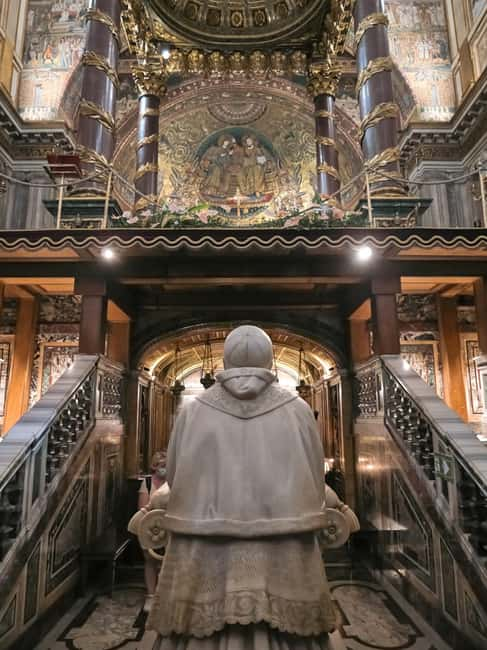
At Santa Maria Maggiore, the highlight is the relic connected to the wood from the manger of Jesus. That’s the kind of detail that changes how you look around. Instead of only admiring art or architecture, you’re being guided to notice the significance of what’s preserved here and why it mattered to believers over centuries.
Even if you’re not deeply religious, you can still appreciate the human instinct behind relic veneration: people wanted reminders that the story was real, anchored in objects and places. This start makes that idea feel concrete.
Weighing this one up? Here is how a few Rome favourites compare:
- Vatican Museums, Sistine Chapel & St. Peter’s Basilica Tour
★ 4.3 · 73,970 reviews - Vatican Museums, Sistine Chapel & St Peter’s Basilica Guided Tour
★ 4.5 · 39,149 reviews - Rome: Colosseum, Palatine Hill and Roman Forum Guided Tour
★ 4.8 · 32,814 reviews - Rome: Guided Tour of Colosseum, Roman Forum & Palatine Hill
★ 4.7 · 27,897 reviews
St. John Lateran: Why the Cathedral of Rome Matters
Next you’ll head to the Archbasilica of St. John Lateran, the cathedral of Rome often described as the mother of all churches. The value of this stop is less about one single item and more about the role the site plays in Catholic identity.
Expect guided time here, around 30 minutes, where the guide frames the site as a symbol of unity and the spiritual center of Catholicism. That framing matters because otherwise St. John Lateran can feel like one more big Roman church. With the guide’s context, you get the “why” behind the grandeur.
This is also a good moment for you to slow down. The tour isn’t rushing from photo spot to photo spot. It gives you room to listen, look, and absorb.
Holy Cross of Jerusalem: Passion Relics and Prayerful Quiet
From Lateran, the route takes you to the Basilica of the Holy Cross in Jerusalem. Here the focus shifts from Nativity to Passion, and you’ll spend about 30 minutes with the guide.
This is the stop where relics become the main character. You’ll visit where important Passion-linked relics are preserved, including fragments of the True Cross. You’ll also hear context that helps you understand how people related physical objects to the events of Christ’s suffering.
If you’re the type who likes to see how faith shaped culture, you’ll likely enjoy this part most. It’s where you feel the connection between belief and art, between theology and stone-and-silver preservation.
Scala Sancta (Holy Staircase): When Tradition Meets the Senses
Then comes one of the most talked-about parts of the tour: Scala Sancta, the Holy Staircase. You’ll spend around 15 minutes here with a guided visit.
According to tradition, these are the steps Jesus climbed before being judged by Pontius Pilate. Even if you treat the tradition differently than a believer, the atmosphere is powerful. The sacredness is not abstract. It’s built into how the space is used and how the visit is conducted.
The best way to prepare yourself: think of it as a short pilgrimage moment, not a photo stop. Give your attention to the meaning and the guide’s framing, and the time goes faster than you’d expect.




Santa Prassede: Sacred Art and Another Layer of Rome’s Belief
After Scala Sancta, the tour includes Santa Prassede for about 15 minutes. This stop rounds out the theme by adding another layer: how sacred stories and devotion show up in the look and feel of the church.
The key value here is contrast. You’ve just been in one of the most tradition-heavy spaces in Rome. Now you’re being shown how different churches support devotion in different ways—through preserved objects, through atmosphere, through art that holds attention.
Even within a short total tour time, Santa Prassede helps you understand Rome as a place where faith is visible in many forms, not just one famous staircase.
Back to Santa Maria Maggiore: Closing the Circle
The tour finishes by returning you to the Basilica Papale di Santa Maria Maggiore, with around 30 minutes for a guided visit. This closing move feels intentional because it brings the focus back to the beginning.
You’re not just seeing Santa Maria Maggiore once. You’re getting a second angle on it—more time to connect the initial relic theme with what the basilica means in the broader Christian world.
This is also a practical advantage: finishing here means you’re likely not stuck far from a major hub. You can keep exploring at your own pace once the tour ends, whether that means grabbing a quick bite nearby or continuing to other churches.
What Makes the Guide Matter (and Who You Might Hear)
This kind of tour lives or dies on the guide. And the good news is the narration is built for clarity: you’ll use radio headphones, and the tour provides a live guide speaking English or Portuguese.
Two names came up in positive experiences: Juliana and Marco. The standout theme from those kinds of guides is how they handle the sacred content with care while keeping the explanation organized. You get a sense of order—what you’re looking at, why it’s meaningful, and how the stops connect into one story.
That’s especially helpful if you’re not used to relic-focused travel. It keeps you from feeling lost in a swirl of artwork and incense.
Price and Value: Is $65 Worth It?
For $65 per person over 2 to 2.5 hours, the value comes from three things: a specialized guide, radio headphones, and multiple major sites packed into one walk.
You should also factor in what’s not included. Food and drinks aren’t included, so plan for a snack or water separately. And entrance to prepaid places isn’t included, which means if any stop requires a paid ticket you may need to handle that on your own.
In plain terms: this is a good deal if you want structure and meaning over self-guided wandering. If you’re happy reading signage and taking photos, you might spend less on your own. But if you want the connective tissue—the stories that link manger wood, Passion relics, and the Holy Staircase—you’re paying for someone to make it coherent.
Logistics That Affect Your Comfort (Not Just Your Schedule)
You’re walking, mostly in central Rome church neighborhoods. The tour includes a walking tour and visits multiple sites, so comfortable shoes are non-negotiable.
Also pay attention to the church setting. The tour notes proper attire is required for entering churches. For you, that means plan simple, respectful clothing that won’t get you stuck awkwardly adjusting at the entrance.
Finally, it’s a small-group experience. There’s also a minimum of 4 people, and if that number isn’t reached, the tour can be canceled 24 hours before it starts. If your schedule is tight, it’s smart to book with time-buffer in mind.
Who Should Book This Tour?
Book it if you want Rome through a spiritual and historical lens. This tour is built for people who care about Christianity’s physical traces: relics, preserved objects, and the way sacred stories were kept alive through generations.
It’s also a good match if you’re traveling with a mix of interests. Someone who likes architecture will still appreciate the churches. Someone who cares about faith history will have clear “why” at each stop.
Skip it if you’re mostly after casual sightseeing, long photo sessions, or a totally secular explanation. The tone is prayer-friendly and tradition-forward. You’ll feel it.
Final Thought: Should You Book Basilicas, the Scala Santa, and Relics of Christ?
If your goal is a short, guided pilgrimage route through some of Rome’s most significant Christian spaces, I’d say yes. It’s well timed, reasonably priced for the number of stops, and the guide-led context is the difference between seeing churches and understanding what they’re doing in Christian life.
On the other hand, if you need lots of downtime, hate dress-code rules, or you’re uneasy with relic-focused spirituality, you might feel out of place. This isn’t a neutral “great sights” loop. It’s a structured walk meant for reflection.
If that sounds like your kind of Rome, you’ll likely leave feeling like the city gave you more than postcards—something you can carry.
FAQ
How long is the tour?
The duration is listed as 2 to 2.5 hours.
Where does the tour start?
The meeting point may vary depending on the option booked. The listed starting location is Piazza di Santa Maria Maggiore.
What languages are the tours available in?
The live tour guide speaks English and Portuguese.
Is food included?
No. Food and drinks are not included.
Do I need proper attire to enter the churches?
Yes. The tour notes proper attire is required for entering churches.
Are pets allowed?
No. Pets are not allowed.
More Tour Reviews in Rome
- Vatican Museums, Sistine Chapel & St. Peter’s Basilica Tour
★ 4.3 · 73,970 reviews - Vatican Museums, Sistine Chapel & St Peter’s Basilica Guided Tour
★ 4.5 · 39,149 reviews - Rome: Colosseum, Palatine Hill and Roman Forum Guided Tour
★ 4.8 · 32,814 reviews - Rome: Guided Tour of Colosseum, Roman Forum & Palatine Hill
★ 4.7 · 27,897 reviews - Rome: Colosseum & Forum with Audio Guide App -Optional Arena
★ 4.2 · 24,770 reviews - Rome: Colosseum, Roman Forum and Palatine Hill Guided Tour
★ 4.5 · 23,903 reviews




